THE CLASSIC COLLECTION✦Lost DiariesCLASSIC FREE BOOKS
Lost Diaries
Maurice Baring
THE CLASSIC COLLECTION · 1874
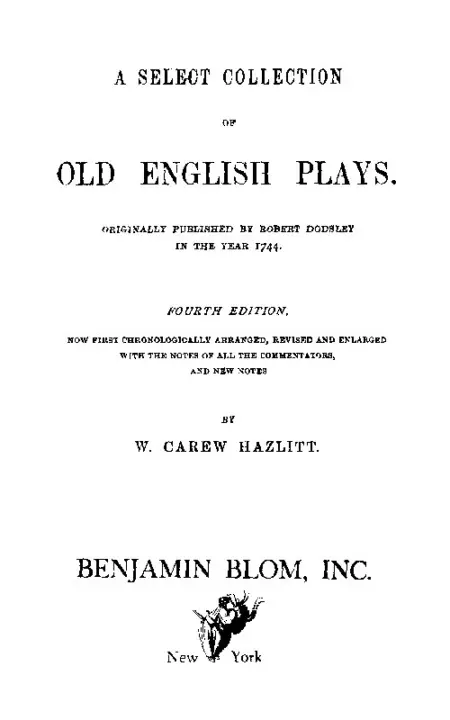
"A Select Collection of Old English Plays, Volume 12" by Robert Dodsley is a compilation of early English dramas, likely assembled in the 18th century. This volume includes works that reflect the theatrical traditions of that period, particularly focusing on themes of love, avarice, and social critique. Readers can expect the plays collected within to showcase a variety of characters and scenarios typical of old English comedy. The opening portion introduces "The Old Couple," a comedy by Thomas May, featuring prominent characters like Eugeny, humanity's tragic figure, and Theodore, the virtuous son of the miserly Earthworm. The narrative centers around the secret meeting of Eugeny and Artemia, highlighting themes of forbidden love and societal constraints. The dialogue reveals the emotional turmoil faced by Eugeny due to his past deeds, setting a tone for the complexities of the relationships that unfold within the comedic framework. Through witty exchanges and poignant reflections, the play promises a blend of humor and introspection that is characteristic of its time.
Introduction adapted from the source catalogue; source summaries may be automatically generated.
Free to read · English · 148,252 words · No account needed
MAKE TIME FOR A GOOD BOOK
On by default. Untick to stop anonymous reading totals. Each page counts after 10 seconds in view. How this works.
Anonymous counting is on unless you have switched it off.
[207] A term anciently used in salutation, or rather in drinking. See Selden's notes on the ninth song of Drayton's "Polyolbion," and [Steevens's] notes on "Macbeth," act i. sc. 7, for a particular account of the origin of this phrase.--Steevens.
[208] [A term in fencing.]
[209] [Cartwright's adoption of the English of a period of which he was evidently very ignorant, has made his character of "The Antiquary" a very tedious and troublesome one. By intermete we are here to understand intermit; but there is no such word in early English. Intermit occurs in Coleridge's "Glossary," 1859.]
[210] To do.
[211] [Old copy, paynant.]
[212] Morglay was the sword of Bevis of Southampton. It afterwards became a cant word for a sword in general. See "Every Man in his Humour," Act iii. so. 1; also "Every Woman in her Humour," 1609, sig. D 4--
"Had I been accompanied with my toledo or morglay."
[213] Pity.
[214] Now complete. The passage requires this explanation, or poor Moth's argument seems to want force, his present hopes being founded on a supposition that all possible discoveries to be made by beating have been already made.
[215] Moth here seems to allude to the following circumstance in the English History: "But uppon the morne followynge, both hostes joyned agayne, and fought egerly: contynuyng whych fyghte, Edrycus espying Edmunde to be at advauntage of wynnyng of the feld, sodaynly pyght a dead mannes hed upon a speare head, and cryed to the host of Englyshmen, fle, fle, ye Englyshmen, and save youre selfes, lo here is the heade of Edmunde your kinge."--Fabyan's "Chronicle."
[216] Verstegan, in his "Restitution of Decayed Intelligence," 1634, p. 130, gives the following account of this transaction:--"King Hingistus prepared them a feast; and after the Brittains were well whitled with wine, he fell to taunting and girning at them; whereupon blowes ensued; and the Brittish nobility there present, being in all three hundreth, were all of them slaine; as William of Malmesbury reporteth: though others make the number more, and say that the Saxons had each of them a seax (a kind of crooked knife) closely in his pocket, and that at the watch-word, Nem cowr seaxes, which is, take your seaxes, they suddainely, and at unwares, slew the Brittaines."
[217] Care not.
[218] Gift.
[219] In spite of.
[220] Always.
[221] A lively spark.
[222] [Old copy, syren.] So in "Timon of Athens," act iv. sc. 3--
"The tub-fast and the diet."
See a note on that passage, Shakespeare, viii. 409, edit.
1778.--Steevens.
[223] [Old copy repeats taking after of, as it appears, erroneously, since it spoils the sense, and is not essential to the metre, such metre as it is! By my swear, by my oath: it is an unusual phrase, but occurs again just below.]
Your reading position is saved on this browser. Take it to another device with a library code. Reading pages adapt to text, rather than matching a printed edition.
BEHIND THE BOOK
This eBook is for the use of anyone anywhere in the United States and most other parts of the world at no cost and with almost no restrictions whatsoever. You may copy it, give it away or re-use it under the terms of the Project Gutenberg License included with this eBook or online at www.gutenberg.org. If you are not located in the United States, you will have to check the laws of the country where you are located before using this eBook. Read the source licence.
The original source file, including credits and licence, is retained by this library. Request an original-format copy at no charge. Please include the book title and Project Gutenberg identifier #46791.
KEEP YOUR CURIOSITY GOING
Maurice Baring
W. B. (William Butler) Yeats
Edward Martyn

John Brougham & Charlotte Brontë
Marguerite Merington
Leonid Andreyev