THE CLASSIC COLLECTION✦Lost DiariesCLASSIC FREE BOOKS
Lost Diaries
Maurice Baring
THE CLASSIC COLLECTION · 1874
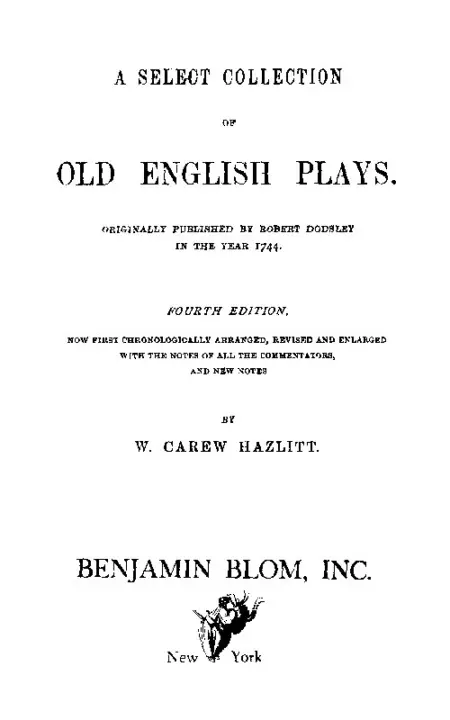
"A Select Collection of Old English Plays, Volume 12" by Robert Dodsley is a compilation of early English dramas, likely assembled in the 18th century. This volume includes works that reflect the theatrical traditions of that period, particularly focusing on themes of love, avarice, and social critique. Readers can expect the plays collected within to showcase a variety of characters and scenarios typical of old English comedy. The opening portion introduces "The Old Couple," a comedy by Thomas May, featuring prominent characters like Eugeny, humanity's tragic figure, and Theodore, the virtuous son of the miserly Earthworm. The narrative centers around the secret meeting of Eugeny and Artemia, highlighting themes of forbidden love and societal constraints. The dialogue reveals the emotional turmoil faced by Eugeny due to his past deeds, setting a tone for the complexities of the relationships that unfold within the comedic framework. Through witty exchanges and poignant reflections, the play promises a blend of humor and introspection that is characteristic of its time.
Introduction adapted from the source catalogue; source summaries may be automatically generated.
Free to read · English · 148,252 words · No account needed
MAKE TIME FOR A GOOD BOOK
On by default. Untick to stop anonymous reading totals. Each page counts after 10 seconds in view. How this works.
Anonymous counting is on unless you have switched it off.
[194] i.e., Scraps of anything; ~analegô~,
colligo. Every one has heard of the collectanea and analecta
poetarum.--Steevens.
[195] [The reading of the old copy is humble, which does not appear to agree at all with the context, since the parson addresses Andrew in a half-satirical strain of respect.]
[196] Robert Wisdom, a translator of the Psalms. Wood ("Athenæ Oxonienses," vol. i., "Fasti," p. 57) says he was "a good Latin and English poet of his time, and one that had been in exile in Queen Mary's reign. He was also rector of Settrington in Yorkshire, and died in 1568, having been nominated to a bishopric in Ireland in the time of Edward the 6th." His version of the Psalms is ridiculed in the "Remains of Samuel Butler," 1759, p. 41--
"Thence, with short meal and tedious grace,
In a loud tone and public place,
Sings Wisdom's Hymns, that trot and pace
As if Goliah scann'd 'em."
Again, p. 230: "Besides, when Rouse stood forth for his trial, Robin Wisdom was found the better poet." [Further particulars of Wisdom are to be found in Warton's Poetry, by Hazlitt, iv. 131.]
[197] [Old copy, my.]
[198] [Of these books the two former are not at present known by such titles. The third, the "Life of Mistress Katherine Stubs," by her husband, the celebrated Philip Stubs, was originally published in 1591, and went through many editions.] The Author observes, in the opening of the tract: "At fifteen years of age, her father being dead, her mother bestowed her in marriage upon one Master Philip Stubbes, with whom she lived four years and almost a half, very honestly and godly."
Richard Brome, in his play of "The Antipodes," act iii. sc. 2, mentions one of them in the following manner--
"A booke of the godly life and death
Of Mistress Katherine Stubs, which I have turn'd
Into sweet meetre, for the vertuous youth,
To woe an ancient lady widow with."
Again, Bishop Corbet in his "Iter Boreale," says--
"And in some barn hear cited many an author, Kate Stubbs, Anne Ascue, or the Ladies Daughter."
[199] i.e., Been the mediator. The stickler now is called the sidesman. So in "Troilus and Cressida," act v. sc. 8--
"And, stickler-like, our armies separates."
--Steevens.
[200] "Moot is a term used in the Inns-of-Court, and signifies the handling or arguing a case for exercise."--Blount.
For the regulations of Mooting and Reading-Days, see Dugdale's
"Origines Juridiciales."
Your reading position is saved on this browser. Take it to another device with a library code. Reading pages adapt to text, rather than matching a printed edition.
BEHIND THE BOOK
This eBook is for the use of anyone anywhere in the United States and most other parts of the world at no cost and with almost no restrictions whatsoever. You may copy it, give it away or re-use it under the terms of the Project Gutenberg License included with this eBook or online at www.gutenberg.org. If you are not located in the United States, you will have to check the laws of the country where you are located before using this eBook. Read the source licence.
The original source file, including credits and licence, is retained by this library. Request an original-format copy at no charge. Please include the book title and Project Gutenberg identifier #46791.
KEEP YOUR CURIOSITY GOING
Maurice Baring
W. B. (William Butler) Yeats
Edward Martyn

John Brougham & Charlotte Brontë
Marguerite Merington
Leonid Andreyev