THE CLASSIC COLLECTION✦Lost DiariesCLASSIC FREE BOOKS
Lost Diaries
Maurice Baring
THE CLASSIC COLLECTION · 1874
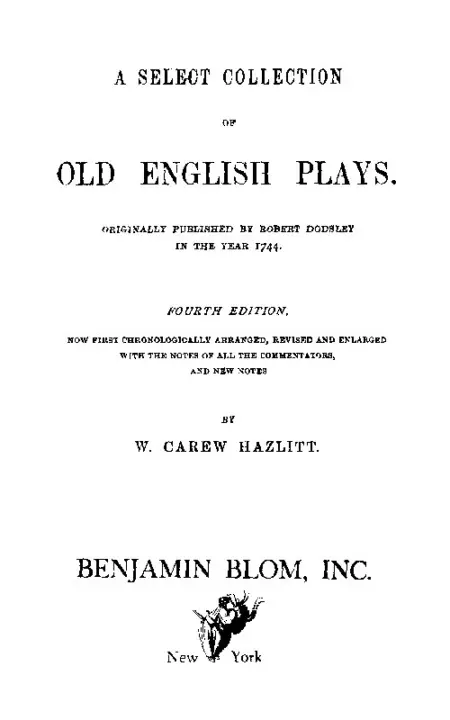
"A Select Collection of Old English Plays, Volume 12" by Robert Dodsley is a compilation of early English dramas, likely assembled in the 18th century. This volume includes works that reflect the theatrical traditions of that period, particularly focusing on themes of love, avarice, and social critique. Readers can expect the plays collected within to showcase a variety of characters and scenarios typical of old English comedy. The opening portion introduces "The Old Couple," a comedy by Thomas May, featuring prominent characters like Eugeny, humanity's tragic figure, and Theodore, the virtuous son of the miserly Earthworm. The narrative centers around the secret meeting of Eugeny and Artemia, highlighting themes of forbidden love and societal constraints. The dialogue reveals the emotional turmoil faced by Eugeny due to his past deeds, setting a tone for the complexities of the relationships that unfold within the comedic framework. Through witty exchanges and poignant reflections, the play promises a blend of humor and introspection that is characteristic of its time.
Introduction adapted from the source catalogue; source summaries may be automatically generated.
Free to read · English · 148,252 words · No account needed
MAKE TIME FOR A GOOD BOOK
On by default. Untick to stop anonymous reading totals. Each page counts after 10 seconds in view. How this works.
Anonymous counting is on unless you have switched it off.
CRE. As God shall mend me, thou'rt the proudest thing---- Thou can'st not compliment, but in caparisons.
AND. What's that to you? I'd fain say something yet, But that I can't, my losses do so vex me.
CRE. Come, think not on't, my boy; I'll furnish thee.
AND. Sir, though----
CRE. Nay, to't, I say: help him, sir, help him.
AND. Sir, though without my cloak at this time--
To-morrow I shall have one--give me leave
Barely to say I am your servant, sir----
In hose and doublet.
CRE. I'll do what you told me.
HEAR. Take heed: if that you do't, he'll guess you're given
To idle spendings, and so cross the match.
I will invite him as to myself.
CRE. Do so.
HEAR. Sir Thomas, if you'll please so far to grace us,
As be a guest to-morrow here, we shall
Study hereafter to deserve the favour.
SIR T. Although I do not use to eat at ordinaries;
Yet to accept your courtesy, good friends,
I'll break my wonted custom.
HEAR. You shall have it
With a free heart.
SIR T. If I thought otherwise, I do assure you, I'd not venture hither. [Exeunt.
[137] i.e., Prize [or acquisition.]--Collier.
[138] March-pane was a confection made of pistachio nuts, almonds, sugar, &c., formerly in high esteem, and a constant article in the deserts of our ancestors. See the notes of Dr Gray, Mr Hawkins, and Mr Steevens, to "Romeo and Juliet," act i. sc. 5.
[139] This is called a St Stephen's pudding: it used formerly to be provided at St John's College, Cambridge, uniformly on St Stephen's day.--Pegge.
[140] See [Suckling's Works, by Hazlitt, ii. 33.]
[141] Or, caveare. Giles Fletcher, in his "Russe Commonwealth," 1591, p. 11, says: "In Russia they have divers kinds of fish, very good and delicate: as the Bellouga or Bellougina, of four or five elnes long; the Ostrina or Sturgeon, but not so thicke nor long. These four kinds of fish breed in the Volgha, and are catched in great plenty, and served thence into the whole realme for a great food. Of the roes of these foure kinds, they make very great store of Icary, or caveary."
The introduction of these foreign delicacies is ridiculed by several writers of the times; as Ben Jonson's "Cynthia's Revels," act iii. sc. 1: "Come; let us go and taste some light dinner, a dish of sliced caviare, or so."
And in Marston's "What you Will," act ii. sc. 1--
"A man can scarce put on a tuckt-up cap,
A button'd frizado sute; scarce eate good meate,
Anchovies, caviare, but hee's satired,
And term'd phantasticall."
Your reading position is saved on this browser. Take it to another device with a library code. Reading pages adapt to text, rather than matching a printed edition.
BEHIND THE BOOK
This eBook is for the use of anyone anywhere in the United States and most other parts of the world at no cost and with almost no restrictions whatsoever. You may copy it, give it away or re-use it under the terms of the Project Gutenberg License included with this eBook or online at www.gutenberg.org. If you are not located in the United States, you will have to check the laws of the country where you are located before using this eBook. Read the source licence.
The original source file, including credits and licence, is retained by this library. Request an original-format copy at no charge. Please include the book title and Project Gutenberg identifier #46791.
KEEP YOUR CURIOSITY GOING
Maurice Baring
W. B. (William Butler) Yeats
Edward Martyn

John Brougham & Charlotte Brontë
Marguerite Merington
Leonid Andreyev