THE CLASSIC COLLECTION✦Lost DiariesCLASSIC FREE BOOKS
Lost Diaries
Maurice Baring
THE CLASSIC COLLECTION · 1874
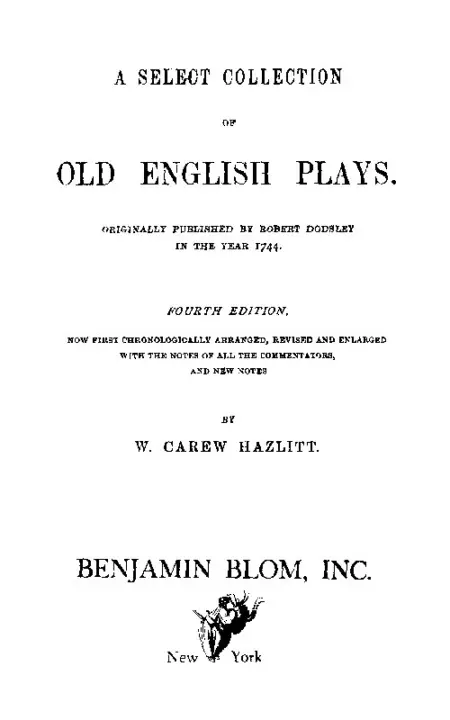
"A Select Collection of Old English Plays, Volume 12" by Robert Dodsley is a compilation of early English dramas, likely assembled in the 18th century. This volume includes works that reflect the theatrical traditions of that period, particularly focusing on themes of love, avarice, and social critique. Readers can expect the plays collected within to showcase a variety of characters and scenarios typical of old English comedy. The opening portion introduces "The Old Couple," a comedy by Thomas May, featuring prominent characters like Eugeny, humanity's tragic figure, and Theodore, the virtuous son of the miserly Earthworm. The narrative centers around the secret meeting of Eugeny and Artemia, highlighting themes of forbidden love and societal constraints. The dialogue reveals the emotional turmoil faced by Eugeny due to his past deeds, setting a tone for the complexities of the relationships that unfold within the comedic framework. Through witty exchanges and poignant reflections, the play promises a blend of humor and introspection that is characteristic of its time.
Introduction adapted from the source catalogue; source summaries may be automatically generated.
Free to read · English · 148,252 words · No account needed
MAKE TIME FOR A GOOD BOOK
On by default. Untick to stop anonymous reading totals. Each page counts after 10 seconds in view. How this works.
Anonymous counting is on unless you have switched it off.
STEPH. Not yet, I'll wrack his sorrows to the height, And of themselves they'll then sink softly down. Keeper, go thou again after my brother, Charge in my name him and his son to appear Before the king; to whom I will make known Their wrongs against me, showing just cause To disinherit both by course of law. Begone!
KEEP. I am gone, sir. [Exit.
STEPH. Come, wife.
WIFE. What's your meaning, sir?
STEPH. Thou shalt know that anon. The heavens oft scowl, clouds thicken, winds blow high, Yet the brightest sun clears all, and so will I. [Exeunt.
Enter HENRY III., attended by MONTFORT, PEMBROKE, and ARUNDEL, LORD MAYOR, STEPHEN FOSTER as Sheriff, ALDERMAN BREWEN, &c.
KING. O, welcome is all love; our people's shouts In their heart's language makes our bienvenues Most high and sovereign: we return all thanks Unto our loving citizens; [To BREWEN] chiefly to you, sir, Whose pious work invites our majesty To royalise this place with our best presence, Accompanied with this reverend Cardinal: Would [that] me might, after [so] many broils, End our days [too] in these religious toils: We would work most faithfully. But, bounteous sir, How do you call your buildings?
BREW. Unless it please your majesty to change it,
I call it Domus Dei.
KING. The house of God;
It is too good to change: pray you, proceed.
BREW. These are my ends: to all distressed Christians, Whose travels this way bend, the hospital shall Free succour be for three days and three nights Sojourn: diet[104] and lodging, both sweet and satisfying:
And (if their need be such) as much in coin As shall, for three days more, defray their further travel: This unto heaven--be you testator, good my liege, And witness with me, noble gentlemen-- Most free and faithfully I dedicate.
KING. An honourable work, and deserves large memory.
MONT. 'Tis a good example, 'tis pity 'tis no better followed.
ARUN. But say, sir: now in some future age, Perhaps some two or three hundred year behind us, This place, intended for a use so charitable, Should be unhallow'd again by villanous inhabitants, Say whores instead of Christians, and Your hospital tenements turn'd into stews, Would not this grieve you in your grave?[105]
BREW. If my grave were capable of grief, sure it would, sir.
KING. Prythee, be a false prophet.
ARUN. I will, if I can, my lord.
KING. Let now our heralds in the streets proclaim
The title and [the] office of this hospital;
Make known to all distressed travellers,
That we'll accept his charitable house;
This Domus Dei shall be their free sojourn,
As is proposed.
Your reading position is saved on this browser. Take it to another device with a library code. Reading pages adapt to text, rather than matching a printed edition.
BEHIND THE BOOK
This eBook is for the use of anyone anywhere in the United States and most other parts of the world at no cost and with almost no restrictions whatsoever. You may copy it, give it away or re-use it under the terms of the Project Gutenberg License included with this eBook or online at www.gutenberg.org. If you are not located in the United States, you will have to check the laws of the country where you are located before using this eBook. Read the source licence.
The original source file, including credits and licence, is retained by this library. Request an original-format copy at no charge. Please include the book title and Project Gutenberg identifier #46791.
KEEP YOUR CURIOSITY GOING
Maurice Baring
W. B. (William Butler) Yeats
Edward Martyn

John Brougham & Charlotte Brontë
Marguerite Merington
Leonid Andreyev