THE CLASSIC COLLECTION✦Lost DiariesCLASSIC FREE BOOKS
Lost Diaries
Maurice Baring
THE CLASSIC COLLECTION · 1874
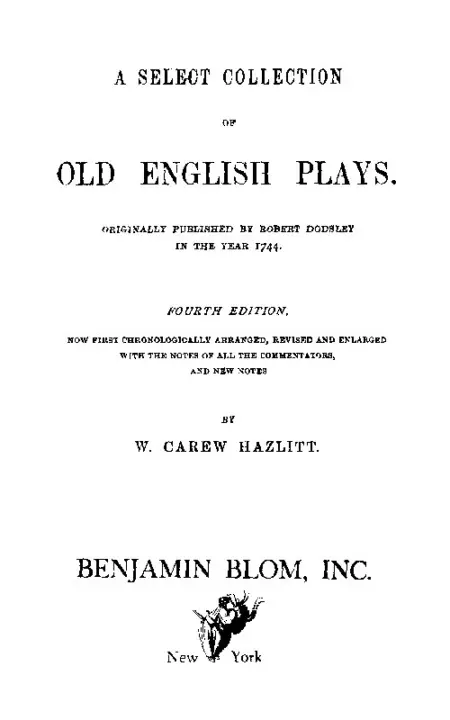
"A Select Collection of Old English Plays, Volume 12" by Robert Dodsley is a compilation of early English dramas, likely assembled in the 18th century. This volume includes works that reflect the theatrical traditions of that period, particularly focusing on themes of love, avarice, and social critique. Readers can expect the plays collected within to showcase a variety of characters and scenarios typical of old English comedy. The opening portion introduces "The Old Couple," a comedy by Thomas May, featuring prominent characters like Eugeny, humanity's tragic figure, and Theodore, the virtuous son of the miserly Earthworm. The narrative centers around the secret meeting of Eugeny and Artemia, highlighting themes of forbidden love and societal constraints. The dialogue reveals the emotional turmoil faced by Eugeny due to his past deeds, setting a tone for the complexities of the relationships that unfold within the comedic framework. Through witty exchanges and poignant reflections, the play promises a blend of humor and introspection that is characteristic of its time.
Introduction adapted from the source catalogue; source summaries may be automatically generated.
Free to read · English · 148,252 words · No account needed
MAKE TIME FOR A GOOD BOOK
On by default. Untick to stop anonymous reading totals. Each page counts after 10 seconds in view. How this works.
Anonymous counting is on unless you have switched it off.
BREW. Come, where's Master Foster? O, you lose time, sir,
Not meeting fortune that comes to kiss you!
The Lord Mayor and Aldermen stay at the Guildhall
Expecting you, as well to set down order
Touching the entertainment of the king,
As to elect you for the following year
A sheriff of London.
STEPH. Their loves outstrip my merit:
Yet, since they lay that load on me, I'll bear it,
And wait in scarlet on my liege and king.
But pray resolve me, master alderman,
Why makes the king this visitation?
BREW. Troth, sir, to honour me, I thank his highness, Who with my lord the Cardinal comes along To see the dedication of my house, Built for the weary travellers to rest in; Where stands three hundred beds for their relief, With meat, drink, and some money, when they part; Which I'll give freely with a willing heart.
STEPH. A pious, worthy, and religious act. Come, sir, to th' Guildhall. Wife, look to your kinsman; Watch him near, but do not hinder him If he relieve his father. Come, master alderman: With such sweet incense up your offerings fly, I'll build one altar more to charity. [Exeunt.
[93] i.e., Let him be declared victor. The expression is not uncommon in our old dramatic writers.
[94] This phrase is, I believe, still common among bowlers, with the exception that the mistress is now called the jack.
[95] [An apparent allusion to the then recent settlement of Newfoundland, an account of which is to be found in Vaughan's "Golden Fleece," 1626, and "Newlander's Cure," 1630, besides other works.]
[96] [The word began, even before this, to acquire a bad sense, and was used contemptuously, as we use chapman or chap now.]
[97] This word seems used here with no very definite meaning. Pistol, in the "Merry Wives of Windsor," ii. 1, applies it to Mrs Ford--
"He loves thy gally-mawfrey; Ford, perpend."
[98] [A play on eels and heels.]
[99] [Old copy and Dilke read--
"He's no rival here, sir; has struck me."]
[100] [Men, fellows.]
[101] I scarcely need observe that the Clown puns between the sergeant's mace and the spice of that name. Poor as it is, it is common enough.
[102] One of the counters was situated in Wood Street, Cheapside.
Your reading position is saved on this browser. Take it to another device with a library code. Reading pages adapt to text, rather than matching a printed edition.
BEHIND THE BOOK
This eBook is for the use of anyone anywhere in the United States and most other parts of the world at no cost and with almost no restrictions whatsoever. You may copy it, give it away or re-use it under the terms of the Project Gutenberg License included with this eBook or online at www.gutenberg.org. If you are not located in the United States, you will have to check the laws of the country where you are located before using this eBook. Read the source licence.
The original source file, including credits and licence, is retained by this library. Request an original-format copy at no charge. Please include the book title and Project Gutenberg identifier #46791.
KEEP YOUR CURIOSITY GOING
Maurice Baring
W. B. (William Butler) Yeats
Edward Martyn

John Brougham & Charlotte Brontë
Marguerite Merington
Leonid Andreyev