THE CLASSIC COLLECTION✦A Christmas Carol The original manuscriptCLASSIC FREE BOOKS
A Christmas Carol The original manuscript
Charles Dickens
THE CLASSIC COLLECTION · 1895
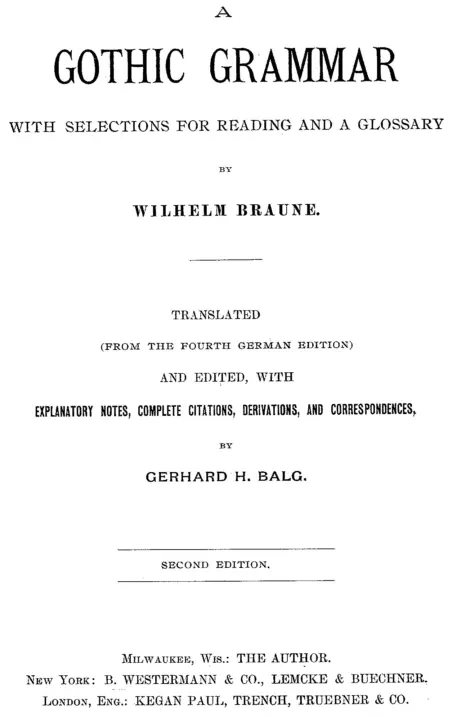
"A Gothic Grammar" by Wilhelm Braune is an academic textbook written in the late 19th century. The work serves as both a comprehensive introduction and an instructional guide for students seeking to learn the Gothic language, emphasizing phonology and inflectional grammar while providing reading selections and a glossary for practical application. The opening of this grammar provides insight into its structure and intended use in an academic context. It first outlines the purpose of the book, which is to aid students in gaining a practical understanding of Gothic, enabling them to follow lectures on historical and comparative grammar. Braune emphasizes that the focus will be on phonology and inflection without relying heavily on comparative grammar. Additionally, it advises beginners on how to approach the chapters, indicating that initial focus should be on phonology before progressing to inflections and reading texts, along with guidance on supplemental resources for deeper study. This sets the stage for a systematic exploration of the intricacies of the Gothic language.
Introduction adapted from the source catalogue; source summaries may be automatically generated.
Free to read · English · 99,757 words · No account needed
MAKE TIME FOR A GOOD BOOK
On by default. Untick to stop anonymous reading totals. Each page counts after 10 seconds in view. How this works.
Anonymous counting is on unless you have switched it off.
23. =jabai nu baírais...gamuneis= (Gr., 200, n. 1; and 196); a conditional sentence, the vs. of the protasis being in the opt., those of the apodosis in the imper. (S., 102, e).--=aibr=; s. 'Vocabulary'.--=þeins=; attributes generally follow their sb. (S., 10, n. 2).--=ƕa=; here indef. (Gr., 162, n. 2; S., 78, n. 2). 24. Here the apodosis begins.--=þô=; the art. is uzed, because the sacrifice (=aibr=) is again mentiond (as =giba=) (S., 67).--=þeina=; for its strong inflection, s. Gr. 122, n. 1.--=brôþr þeinamma=; dat. after =gasibjôn= (S., 43). 25. =andastauin þeinamma=; dat. after =waíla hugjands= (S., 41).--=ibai=, lest, lit. perhaps, which sense is also exprest by the opt. =atgibai=.--=stauin=; from =staua=, m. (Gr., 108; not f.; Gr., 97).--=in karkara gal.=; =gal. in= w. acc., more frequently w. dat.; see =qimiþ in=, abuv; =jah galagjaza=, and [then] thou wilt be cast. 26. =usgaggis..usgibis=; the first prs. expresses the first, the second the past future.--=minnistan=; this word does not exactly answer ἔσχατον (which Wulfila in other places renders by =aftuma=, =aftumists=, =spêdiza=, =spêdists=, =spêdumists=). It is not impossibl, however, that =kintus= ment not one particular coin (or mezure), but any coin (or mezure) of litl value.
27. For the tenses and opt. mood, see 21, abuv. 28. =saei saíƕiþ=; ind. in a rel. clause for a Grk. ptc. (S., 99).--=du lustôn=; inf. of purpose after =du= (S., 144).--=izôs=; gen. after =lustôn= (S., 26).--=gahôrinôda= (For the Grk. aor.; S., 87, (3)) =izai=; instrumental dat. of association (S., 52, (1), c). 29. =marzjai=; opt. necessitated by the sense, not by the conj. =jabai= (S., 102).--=usstigg ita jah waírp=; the order of words is Grk.; in Engl. we repeat the object 'it' after the second v. (=waírp=).--=gadriusai in gaíaínnan=; =gadr. in= w. acc.; onse (Lu. 8, 7) it takes the dat.; comp. =qiman in=, chap. V, 20, abuv. 30. =taíhswô þeina handus=; comp. the sequence of words (without the art.) with the similar expression (with the art.) in 29, abuv.--=þô=, this, that; but αὐτήν in Grk.--=batizô ist þus ei=, etc.; the dependent clause after =batizô ist= is sumtimes an acc. w. inf. (S., 113); =þus= is dat. of advantage (S., 36, (4)).--=fraqistnai....gadriusai=; both optativs imply possibility (S., 103). 31. =-uh þan=; both particls (= =þan= alone) ar here continuativ: but farther, also.--=saei aflêtai qên=; opt. in a rel. clause which does not contain a statement of the speaker, but of sum one else (cp. verse 32, below); =qên= is less definit here than in the following verse, where =seina= is emfatic, and =qên seina= means as much as 'his legitimate wife'.--=gibai=; hort. opt. (S., 91, (2)).--=afstassais bôkôs=, a writing (lit. letters; cp. the Latin 'littera': 'litterae') of divorcement (lit. 'standing off'; cp. the G. 'abstand' in the sense of 'desistence'). 32. =saei aflêtiþ.....taujiþ=; the vs. ar in the ind. mood, because they contain the speaker's statements (as opposed to the preceding ones).--=izê=; for =izei= (Gr., 157, n. 3). 33. =ufarswarais...usgibais=; hort. opt. (S., 91, (2)).--=fraujin=; without the articl, when signifying God (S., 68, n. 2. The Grk. text has τῷ). 34. =swaran=; objectiv inf. after =qiþan=, to say, with the sense of 'commanding' (S., 110).--=guþs=; gen. in its abbreviated form (Gr., 94, n. 3). 35. =baúrgs=; without the art., as in Grk. 36. =tagl=, a singl hair; =skuft=, the hairs collectivly. 37. =sijaiþ-þan= (for =sijaih þan=, for =sijai-uh þan=; see Gr., 62, n. 3), but ... shall be.--=þata= (art.) =managizô=; n. compar. uzed as sb.: lit. 'the more', i. e. what is more.--=þaim=; dat. as abl. (S., 54, 3), after the compar. =managizô= (= =þau= w. nom.; cp. the Grk. gen. and the Lt. abl. in such cases).--=ubilin=; dat. of the n. sg. =ubilô= uzed as sb. 38. =und=, for, in return for, w. dat.; in other senses, and more frequently, w. acc. 39. =andstandan=; inf., as in verse 34.--=allis=; adverbial gen., from the adj. =alls=, at all, without equivalent in the Grk. text. Wulfila probably inserted it according to verse 34, where the Grk. text shows ὅλως.--=þamma unsêljin=; weak adj. n. uzed as sb.; see =ubilin= in 37, abuv.--=ƕas=; here indef., as in 23, abuv.--=stautai=; opt., as in 29, abuv; likewise the imper. =wandei= in the apodosis.--=jah=, also. 40. =jah=, and.--=þamma wiljandin=; a participial construction, as in Grk. (τῷ θέλοντι).--=niman=; complimentary inf. after =wiljandin= (as in 42, below; S., 109). 41. =ananauþjai..gaggais=; the prs. opt. in protasis and apodosis (S., 102, a).--=rasta aina=; acc. expressing extent of space (S., 15, (2), β); =rasta= (for μίλιον, the Roman mile), lit. 'rest', place of resting, a stage or station, also the distance between two stages. 42. =þamma wiljandin=; dat. as abl. after =uswandjais= (S., 54, (1), where =us= should be inserted after =af=).--=leiƕan= (complementary inf.; S., 109) =sis=, to borrow; =leiƕan=, to lend. 43. =frijôs...fiais fiand.....frijôþ fijands=; these words and several others ar found both with and without =j= (Gr., 10, n. 4); =fiand= (=fijand=), acc. of =fiands= (=fijands=), enemy, lit. hating, prsp. of =fi(j)an=, to hate (Gr., 115). 44. =þiuþjaiþ þans wrikandans=; bless ye (= treat wel; for the dat. after =þiuþjan=, s. S., 45, page 246, below).--=bi=, concerning, for.--=usþriutandans=; acc. of the prs. ptc. (Gr., 133) of =usþriutan=, the =us-= being intensiv; =-þriutan= = '-trude' in 'obtrude'. 45. =ei waírþaiþ sunjus=; =ei=, that, in order that; =waírþaiþ=, prs. opt. in a final clause (S., 96, a).--=in himinam=; adv. frase uzed substantivly after the art. (=þis=).--=urranneiþ=; =ur-= from =us=; Gr., 24, n. 2; 78, n. 4.--=rigneiþ=; from =rignjan=, factitiv of =rign=, n., rain. 46. =ƕô mizdônô=; the interr. =ƕô= agrees with the following gen. in gender.--=niu= (i. e. =ni-u=); interr. particl.--=þai þiudô=, the (= those) of the Gentiles, = the Gentiles; =þiudô= is gen. pl. of =þiuda=, peple. 47. =þans frijônds izwarans=, the frends (of) yours, = your frends; =frijônds= is sb. in form (Gr., 115) and meaning, while =þans frijôndans= stil has its verbal force; =izwarans= is a poss. prn. acc. pl. agreeing with =frijônds=, but =izwis= is a personal prn. acc. pl. guvernd by =frijôndans=.--=ƕê=; instr. case of =ƕa=, n. of =ƕas= (Gr., 159; S., 51).--=managizô=; compar. after =ƕê= (S., 51). 48. =jus=; for the personal prn. with a vb., see verse 22, abuv.--=swaswê atta izwar sa in himinam= is the subject, not =sa=, =sa in himinam= being an attribute of =atta izwar=, and may be renderd by a rel. clause in English.
Your reading position is saved on this browser. Take it to another device with a library code. Reading pages adapt to text, rather than matching a printed edition.
BEHIND THE BOOK
This eBook is for the use of anyone anywhere in the United States and most other parts of the world at no cost and with almost no restrictions whatsoever. You may copy it, give it away or re-use it under the terms of the Project Gutenberg License included with this eBook or online at www.gutenberg.org. If you are not located in the United States, you will have to check the laws of the country where you are located before using this eBook. Read the source licence.
The original source file, including credits and licence, is retained by this library. Request an original-format copy at no charge. Please include the book title and Project Gutenberg identifier #50336.
KEEP YOUR CURIOSITY GOING
Charles Dickens
Violet Hunt
Marjorie Bowen

Edward Lucas White
James Mooney
May Agnes Fleming