THE CLASSIC COLLECTION✦Artists Past and Present; Random StudiesCLASSIC FREE BOOKS
Artists Past and Present; Random Studies
Elisabeth Luther Cary
THE CLASSIC COLLECTION · 1902
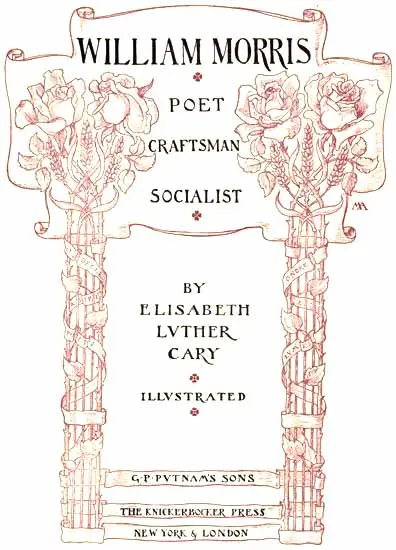
"William Morris: Poet, Craftsman, Socialist" by Elisabeth Luther Cary is a biographical account written in the early 20th century. This work explores the life and contributions of William Morris, a significant figure in the arts, literature, and socialism of the 19th century. The book likely focuses on Morris's artistic vision, creative endeavors, and his commitment to social reform, woven together with glimpses of his personal experiences and relationships. The opening of the book sets the stage by emphasizing Morris's holistic approach to life, where his artistic and social pursuits were deeply interconnected. It outlines his early life, starting with his childhood in Essex, England, highlighting how the beauty of the landscape and the rich history of the region influenced his lifelong fascination with the Middle Ages and the desire to improve the world around him. Morris's struggles with formal education and his passionate interests emerge early, demonstrating how his artistic inclinations shaped his identity and paved the way for a career dedicated to craftsmanship, poetry, and socialist ideals. This initial portrayal reveals a man driven by dreams and an idealistic vision of a better society, inviting readers to explore further into his remarkable life.
Introduction adapted from the source catalogue; source summaries may be automatically generated.
Free to read · English · 79,457 words · No account needed
MAKE TIME FOR A GOOD BOOK
On by default. Untick to stop anonymous reading totals. Each page counts after 10 seconds in view. How this works.
Anonymous counting is on unless you have switched it off.
When Morris, under the influence of old theories and new associations, came to consider not only the desirability but the possibility of establishing a social order in which men could work quite happily and art could get loose from handcuffs welded and locked by commercialism, it was a necessity of his temperament that he should turn his back on halfway methods and urge drastic reforms. His way was not the way of compromise, and he seriously believed that if "civilisation" could be swept out of the path by a revolution which should destroy all class distinctions and all machinery and machine-made goods, which should do away with commercialism and strip the world to its bare bones, so that men could start afresh, all equal and all freed from the superfluities of life, there would grow up a charming communism in which kind hearts would take the place of coronets, and cheerful labour the place of hopeless toil. We find him writing in a private letter--madly, yet with the downright force that kindled where it struck--that he has "faith more than a grain of mustard seed in the future history of civilisation," that he now knows it to be doomed to destruction, and that it is a consolation and joy to him to think of barbarism once more flooding the world, "and real feelings and passions, however rudimentary, taking the place of our wretched hypocrisies." It was thus he thought, or felt, about the new field of labour upon which he was entering, and it is from this point of view that he must be defended against the slurs that have been cast at him as a "Capitalist-Socialist." He did not ignore the ideal of renunciation which had tempted him in his youth, and which he again thought of in his middle age--though less tempted, perhaps. But he reasoned, logically enough, that for one man or a few men to divide his or their wealth with the poor would not advance the world by a furlong or a foot toward the state of things which he had at heart to bring about. It might raise the beneficiaries a little higher in the ranks--in other words, bring them a little closer to the dangerous middle-class, from which came the worst of their troubles, and it might also have the effect of making them a trifle more content with existing conditions. Neither effect was desirable in his eyes. A divine discontent to be spread throughout all classes was the end and aim of such Socialism as he accepted. Nothing could be done except through the antagonism of classes, which seemed in itself to provide a remedy. In News from Nowhere, his best known Socialistic romance, the name of which was perhaps suggested by Kingsley's Utopian and anagrammatic Erewhon, he puts into the mouth of an old man who is himself a survival from the days of "class slavery," a description of the imaginary change to an ideal Communism. Toward the end of the nineteenth century, it is assumed, a federation of labour made it possible for the workmen or "slaves" to establish from time to time important strikes that would sometimes stop an industry altogether for a while, and to impose upon their "masters" other restrictions that seriously interfered with the systematic conduct of commerce. The resulting "bad times" reached a crisis in the year 1952, when the "Combined Workers" determined upon the bold step of demanding a practical reversal of classes, by which they should have the management of the whole natural resources of the country, together with the machinery for using them. The upper classes resisting, riots ensued, then the "Great Strike." "The railways did not run," the old man recalls; "the telegraph wires were unserved; flesh, fish, and green stuff brought to market was allowed to lie there still packed and perishing; the thousands of middle-class families, who were utterly dependent for the next meal on the workers, made frantic efforts through their more energetic members to cater for the needs of the day, and amongst those of them who could not throw off the fear of what was to follow, there was, I am told, a certain enjoyment of this unexpected picnic--a forecast of the days to come in which all labour grew pleasant." Out of all this came civil war, with destruction of wares and machinery and also the destruction of the spirit of commercialism. With the removal of the spur of competition it is admitted that there was a temporary danger of making men dull by giving them too much time for thought or idle musing. How was this danger overcome? By a growing interest in art, to be sure. The people, all workmen now, and providing very simply for their simple needs, "no longer driven desperately to painful and terrible overwork," began to wish to make the work they had in hand as attractive as possible, and rudely and awkwardly to ornament the wares they produced. "Thus at last and by slow degrees," the old man concludes, "we got pleasure into our work; then we became conscious of that pleasure, and cultivated it, and took care that we had our fill of it, and then all was gained and we were happy."
Your reading position is saved on this browser. Take it to another device with a library code. Reading pages adapt to text, rather than matching a printed edition.
BEHIND THE BOOK
This eBook is for the use of anyone anywhere in the United States and most other parts of the world at no cost and with almost no restrictions whatsoever. You may copy it, give it away or re-use it under the terms of the Project Gutenberg License included with this eBook or online at www.gutenberg.org. If you are not located in the United States, you will have to check the laws of the country where you are located before using this eBook. Read the source licence.
The original source file, including credits and licence, is retained by this library. Request an original-format copy at no charge. Please include the book title and Project Gutenberg identifier #39725.
KEEP YOUR CURIOSITY GOING
Cécile Tormay

Moritz Busch
John L. Ransom
Frances Wright
Cécile Tormay

Mabel Potter Daggett