THE CLASSIC COLLECTION✦Artists Past and Present; Random StudiesCLASSIC FREE BOOKS
Artists Past and Present; Random Studies
Elisabeth Luther Cary
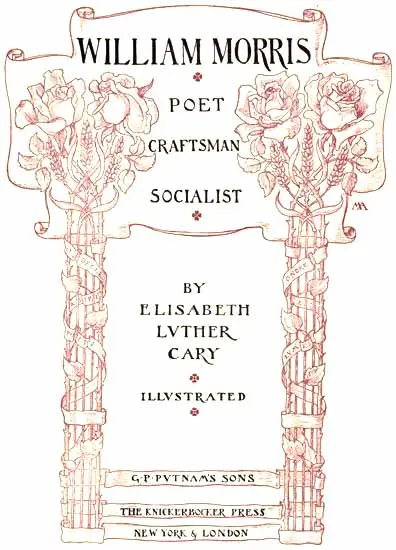
THE CLASSIC COLLECTION · 1902
"William Morris: Poet, Craftsman, Socialist" by Elisabeth Luther Cary is a biographical account written in the early 20th century. This work explores the life and contributions of William Morris, a significant figure in the arts, literature, and socialism of the 19th century. The book likely focuses on Morris's artistic vision, creative endeavors, and his commitment to social reform, woven together with glimpses of his personal experiences and relationships. The opening of the book sets the stage by emphasizing Morris's holistic approach to life, where his artistic and social pursuits were deeply interconnected. It outlines his early life, starting with his childhood in Essex, England, highlighting how the beauty of the landscape and the rich history of the region influenced his lifelong fascination with the Middle Ages and the desire to improve the world around him. Morris's struggles with formal education and his passionate interests emerge early, demonstrating how his artistic inclinations shaped his identity and paved the way for a career dedicated to craftsmanship, poetry, and socialist ideals. This initial portrayal reveals a man driven by dreams and an idealistic vision of a better society, inviting readers to explore further into his remarkable life.
Introduction adapted from the source catalogue; source summaries may be automatically generated.
Free to read · English · 79,457 words · No account needed
MAKE TIME FOR A GOOD BOOK
On by default. Untick to stop anonymous reading totals. Each page counts after 10 seconds in view. How this works.
Anonymous counting is on unless you have switched it off.
"Is not this a reasonable plea? It means prudence. If the buildings are not worth anything they are not worth restoring; if they are worth anything they are at least worth treating with common sense and prudence.
"Come now, I invite you to support the most prudent Society in all
England."
It is easy to understand from such examples as this how Morris gained his popularity as a lecturer. In the printed sentences you read the eager, persuasive accent, so convincing because so convinced. On the platform he stood, say his friends, like a conqueror, stalwart and sturdy, his good grey eyes flashing or twinkling, his voice deepening with feeling, his gesture and speech sudden and spontaneous, his aspect that of an insurgent, a fighter against custom and orthodoxy.
It was not long after the formation of the Society for the Protection of Ancient Buildings that he began to show himself a rebel in more than words against existing social laws. The steps by which he reached his membership in the Democratic Federation in the year 1883 are not very easily traced. Comments on the distressing gulf between rich and poor and on the conditions under which the modern workingman did his task became more frequent in his letters and addresses. His mind seemed to be gradually adjusting itself to the thought that the only hope for obtaining ideal conditions in which--this was always the ultimate goal--art might be constantly associated with handicraft, was perhaps to let art go for the time being, and upset society and all its conventions in preparation for a new earth. "Art must go under," he wrote in one of his private letters "where or however it may come up again." But it was always the fate of art that concerned him. He never really understood what Socialism technically and economically speaking meant. He read its books with labour and sorrow, and struggled with its theories in support of his antagonism to the commercial methods of modern business, but he gained no firm grasp of any underlying political principle. In most of his later addresses he talked pure sentiment concerning social questions, characteristically declaring it to be the purest reason. His avowed belief was that "workmen should be artists and artists workmen," and this, he felt, could only be attained under the freest conditions. A workman should not be clothed in shabby garments, should not be wretchedly housed, overworked, or underfed. But neither will it profit him much if he wear good clothes, and keep short hours, and eat wholesome food, and contribute to the ugliness of the wares turned out by commerce. The idea that a man works only to earn leisure in which he does no work was shocking to him as it had been to Ruskin. Pleasant work to do, leisure for other work of a different pleasantness, this was what the workingman really wanted if only he knew it. It was clear to Morris that he himself worked "not the least in the world for the sake of earning leisure by it," but "partly driven by the fear of starvation and disgrace," and partly because he loved the work itself; and while he was ready to confess that he spent a part of his leisure "as a dog does" in contemplation, and liked it well enough, he also spent part of it in work which gave him as much pleasure as his bread-earning work, neither more nor less. Obviously if there are men with whom such is not the case it is because they have not the right kind of work to do, and are not doing it in the right way, and it is equally obvious that the wrong work and the wrong way of doing it are forced upon them. Left to themselves they are bound to do what pleases them and what will please others of right minds. The ideal handicraftsman developing under an ideal social order "shall put his own individual intelligence and enthusiasm into the goods he fashions. So far from his labour being 'divided,' which is the technical phrase for his always doing one minute piece of work and never being allowed to think of any other, so far from that, he must know all about the ware he is making and its relation to similar wares; he must have a natural aptitude for his work so strong that no education can force him away from his special bent. He must be allowed to think of what he is doing and to vary his work as the circumstances of it vary, and his own moods. He must be forever stirring to make the piece he is at work at better than the last. He must refuse at anybody's bidding to turn out, I won't say a bad, but even an indifferent piece of work, whatever the public want or think they want. He must have a voice, and a voice worth listening to in the whole affair."
Your reading position is saved on this browser. Take it to another device with a library code. Reading pages adapt to text, rather than matching a printed edition.
BEHIND THE BOOK
This eBook is for the use of anyone anywhere in the United States and most other parts of the world at no cost and with almost no restrictions whatsoever. You may copy it, give it away or re-use it under the terms of the Project Gutenberg License included with this eBook or online at www.gutenberg.org. If you are not located in the United States, you will have to check the laws of the country where you are located before using this eBook. Read the source licence.
The original source file, including credits and licence, is retained by this library. Request an original-format copy at no charge. Please include the book title and Project Gutenberg identifier #39725.
KEEP YOUR CURIOSITY GOING
Cécile Tormay

Moritz Busch
John L. Ransom
Frances Wright
Cécile Tormay

Mabel Potter Daggett