THE CLASSIC COLLECTION✦Artists Past and Present; Random StudiesCLASSIC FREE BOOKS
Artists Past and Present; Random Studies
Elisabeth Luther Cary
THE CLASSIC COLLECTION · 1902
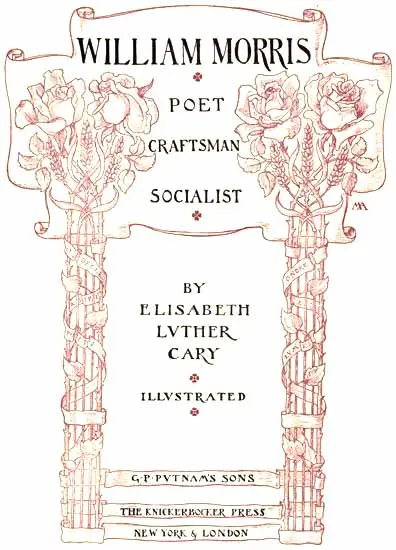
"William Morris: Poet, Craftsman, Socialist" by Elisabeth Luther Cary is a biographical account written in the early 20th century. This work explores the life and contributions of William Morris, a significant figure in the arts, literature, and socialism of the 19th century. The book likely focuses on Morris's artistic vision, creative endeavors, and his commitment to social reform, woven together with glimpses of his personal experiences and relationships. The opening of the book sets the stage by emphasizing Morris's holistic approach to life, where his artistic and social pursuits were deeply interconnected. It outlines his early life, starting with his childhood in Essex, England, highlighting how the beauty of the landscape and the rich history of the region influenced his lifelong fascination with the Middle Ages and the desire to improve the world around him. Morris's struggles with formal education and his passionate interests emerge early, demonstrating how his artistic inclinations shaped his identity and paved the way for a career dedicated to craftsmanship, poetry, and socialist ideals. This initial portrayal reveals a man driven by dreams and an idealistic vision of a better society, inviting readers to explore further into his remarkable life.
Introduction adapted from the source catalogue; source summaries may be automatically generated.
Free to read · English · 79,457 words · No account needed
MAKE TIME FOR A GOOD BOOK
On by default. Untick to stop anonymous reading totals. Each page counts after 10 seconds in view. How this works.
Anonymous counting is on unless you have switched it off.
In the translation, the origin of the noble Volsung race, of which Sigurd is the flower and crown, is traced to Sigi, called the son of Odin, and sent out from his father's land for killing a thrall. He is fortunate in war, marries a noble wife, and rules over the land of the Huns. His son is named Rerir. Volsung is the son of Rerir, and thus the great-grandson of Odin himself. He marries the daughter of a giant, and the ten sons and one daughter of this union are strong in sinew and huge in size, the Volsung race having the fame of being "great men and high-minded and far above the most of men both in cunning and in prowess and all things high and mighty." Volsung becomes in his turn king over Hunland, and builds for himself a noble Hall in the centre of which grows an oak-tree whose limbs "blossom fair out over the roof of the hall," and the trunk of which is called Branstock.
The poem opens with the description of a wedding-feast held in this Hall for Signy, King Volsung's daughter, who has been sought in marriage by Siggeir, King of the Goths, a smaller and meaner race than the Volsungs. Signy is not content with her fate, but her father has deemed the match to be a wise one, and, eminent in filial obedience as in all things else, she yields. From this point for some distance saga and poem march together save for certain minor changes intended to increase Signy's charm. During the feasting a one-eyed stranger enters the Hall and thrusts his sword up to its hilt into the tree-trunk, saying that who should draw the sword from the trunk should have it for his own and find it the best he had ever borne in his hand. This, of course, is Odin. Siggeir tries to draw the sword, and after him his nobles, and then the sons of King Volsung, but none succeeds until Sigmund, the twin of Signy, draws it lightly forth as an easy task. Siggeir is wroth and offers to buy the sword for thrice its weight in gold, but Sigmund will not part with it, and Siggeir sets sail for home in dudgeon, though concealing his feelings from the Volsungs and inviting them cordially to visit him in Gothland. Signy reads the future, and implores her father to undo the marriage and let Siggeir depart without her. (In the poem Morris has her offer herself as a sacrifice if her father will but remain in his kingdom and decline Siggeir's invitation.) King Volsung, however, insists on keeping his troth, and Signy and Siggeir depart, followed in due time by King Volsung and his sons and nobles in response to Siggeir's request. What Signy prophesied comes to pass and King Volsung falls at the hands of the Goths while his ten sons are taken captive. Now Signy prays her husband that her brothers be put for a time in the stocks, since home to her mind comes "the saw that says Sweet to eye while seen." Siggeir is delighted to consent though he deems her "mad and witless" to wish longer suffering for her brothers. Here the poem departs from the original in that Morris puts the idea of the stocks into the mind of Siggeir in answer to Signy's suggestion that her brothers be spared for a little time. Sigmund and the rest of the brothers are taken to the wildwood, and a beam is placed on their feet, and night by night for nine nights a she-wolf comes to devour one of them. (In the poem Morris hastens matters somewhat by having two wolves appear each night to despatch the brothers two at a time.) Each morning Signy sends a messenger to the wildwood who brings back the woeful news. Finally she thinks of a ruse, and on the tenth night the messenger is sent to smear the face of Sigmund, now the sole remaining brother, with honey, putting some also into his mouth. When the wolf comes she licks his face, and then puts her tongue into his mouth to get the last delicious drop. Sigmund promptly closes his teeth upon her tongue and in the struggle that ensues Sigmund's bonds are burst and the wolf escapes, leaving her tongue between his teeth. This incident was probably not sufficiently heroic to please Morris, and in the poem no mention is made of Signy's clever device, Sigmund gaining his freedom in a more dignified fashion and the details being slurred over lightly, with a vague and general allusion to snapping "with greedy teeth." Sigmund dwells in the wildwood in hiding, and Signy sends to him in turn her two sons by King Siggeir, that he may test their fitness to help avenge the fate of her family. Here again Morris mitigates the stern temper of Signy for a more womanly type. In the saga when Signy finds that the boys are not stout enough of heart to accomplish her purpose she bids Sigmund kill them at once: "Why should such as they live longer?" In the poem, however, when Signy sends her son to Sigmund he is delivered with the diplomatic message that if his heart avail not he may "wend the ways of his fate," and when it is found that his heart does not avail, he is returned in safety to his mother, Sigmund awaiting the slow coming of the competent one.
Your reading position is saved on this browser. Take it to another device with a library code. Reading pages adapt to text, rather than matching a printed edition.
BEHIND THE BOOK
This eBook is for the use of anyone anywhere in the United States and most other parts of the world at no cost and with almost no restrictions whatsoever. You may copy it, give it away or re-use it under the terms of the Project Gutenberg License included with this eBook or online at www.gutenberg.org. If you are not located in the United States, you will have to check the laws of the country where you are located before using this eBook. Read the source licence.
The original source file, including credits and licence, is retained by this library. Request an original-format copy at no charge. Please include the book title and Project Gutenberg identifier #39725.
KEEP YOUR CURIOSITY GOING
Cécile Tormay

Moritz Busch
John L. Ransom
Frances Wright
Cécile Tormay

Mabel Potter Daggett