THE CLASSIC COLLECTION✦Artists Past and Present; Random StudiesCLASSIC FREE BOOKS
Artists Past and Present; Random Studies
Elisabeth Luther Cary
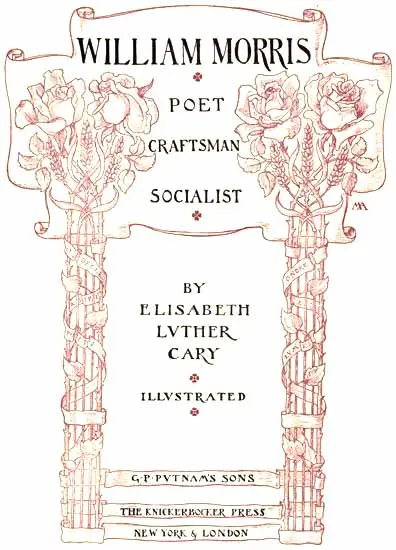
THE CLASSIC COLLECTION · 1902
"William Morris: Poet, Craftsman, Socialist" by Elisabeth Luther Cary is a biographical account written in the early 20th century. This work explores the life and contributions of William Morris, a significant figure in the arts, literature, and socialism of the 19th century. The book likely focuses on Morris's artistic vision, creative endeavors, and his commitment to social reform, woven together with glimpses of his personal experiences and relationships. The opening of the book sets the stage by emphasizing Morris's holistic approach to life, where his artistic and social pursuits were deeply interconnected. It outlines his early life, starting with his childhood in Essex, England, highlighting how the beauty of the landscape and the rich history of the region influenced his lifelong fascination with the Middle Ages and the desire to improve the world around him. Morris's struggles with formal education and his passionate interests emerge early, demonstrating how his artistic inclinations shaped his identity and paved the way for a career dedicated to craftsmanship, poetry, and socialist ideals. This initial portrayal reveals a man driven by dreams and an idealistic vision of a better society, inviting readers to explore further into his remarkable life.
Introduction adapted from the source catalogue; source summaries may be automatically generated.
Free to read · English · 79,457 words · No account needed
MAKE TIME FOR A GOOD BOOK
On by default. Untick to stop anonymous reading totals. Each page counts after 10 seconds in view. How this works.
Anonymous counting is on unless you have switched it off.
Two years later he made a still more adventurous journey across the arid tableland occupying the central portion of Iceland and across the northern mountains to the sea. It was highly characteristic of him that for the time he yielded himself utterly to the influence of the strange and awful land upon his imagination, and that for years afterward his writing was flooded by the impressions that continually swept back upon his mind as he reverted to these experiences. Mr. Mackail gives an amusing instance of the way in which the interest uppermost with him became an obsession leading to the most childlike extravagances. During a holiday tour in Belgium he came to a place where neither French nor English was spoken. He therefore "made a desperate effort at making himself understood by haranguing the amazed inn-keeper in Icelandic." His first visit to Italy, made between the first and second visits to Iceland, took faint hold upon him, nor was the second Italian journey, made some years later, and marked by a troublesome attack of gout, notably successful. He was a man of the North as surely as Rossetti was a man of the South, and it would have been a renaissance indeed that could have turned him into a Florentine or a Venetian.
During this middle period of his life, at the height of his great activity, an event occurred involving the element of tragedy, if the breaking of friendships be accounted tragic. In 1875 the firm was dissolved. Following Mr. Mackail's account of the circumstances that led to the dissolution, we find that the business had become one in which Morris supplied practically all the capital, invention, and control. It was also the chief source of his income. On the other hand, his partners might find themselves at any time seriously involved in the liabilities of a business which was rapidly extending. Hence the desirability of the dissolution and reconstitution of the firm. But in connection with this step an embarrassing situation arose. Under the original instrument, each partner had equal rights in the assets of the firm. After the first year or two the profits had never been divided, and the six partners of Morris, for the hundred and twenty pounds by which they were represented in the contributed capital at the beginning, had now claims on the business for some seven or eight thousand pounds. If these claims were insisted upon, Morris would be placed in a position of considerable financial difficulty. Burne-Jones, Webb, and Faulkner refused to accept any consideration. "The other three," says Mr. Mackail, "stood on the strict letter of their legal rights." Naturally the relations between Morris and the latter became grievously strained, and with Rossetti the break was absolute and irremediable. In passing out of Morris's life, as he then did, he certainly left it more serene, but with him went also the vivifying influence of his genius. In considering the very unfortunate part played by him in the conflict among the members of the firm, it is fair to give a certain weight to details emphasised in Mr. William Rossetti's account as modifying--to a slight degree, it is true, but still modifying--the sordid aspect of Rossetti's action. Madox Brown, who was one of the partners wishing not to forego their legal rights, was getting on in years and was a comparatively poor man. He had always counted on the firm "as an important eventual accession to his professional earnings." No one familiar with Rossetti's character can doubt that a desire to stand by his old friend and teacher in such a matter would have a strong influence with him. To his brother's mind, his attitude was throughout "one of conciliation," with the wish "to adjust contending claims had that but been possible." "He himself," says Mr. William Rossetti, "retired from the firm without desiring any compensation for his own benefit. A sum was, however, assigned to him. He laid it apart for the eventual advantage of a member of the Morris family, but, ere his death, circumstances had induced him to trench upon it not a little." It is easy to imagine circumstances trenching upon any sum of money under Rossetti's direct control, and in the absence of any testimony the reader acquainted with his prodigal disposition may very well be pardoned for doubting whether any member of the Morris family became appreciably the richer for his impulse. Nevertheless, it is a reasonable conclusion that he was not actuated by a sordid motive in opposing the essentially just claim made by Morris, but was to his own mind acting in accordance with the demands of a friendship older and closer than that between him and Morris. It must be noted, however, that a reconciliation was effected in the course of time between Morris and Madox Brown, while in Rossetti's case the wound never healed. The outcome of the negotiations was that Madox Brown was bought out, "receiving a handsome sum," says Mr. William Rossetti, and the business went on under the sole management and proprietorship of Morris.
Your reading position is saved on this browser. Take it to another device with a library code. Reading pages adapt to text, rather than matching a printed edition.
BEHIND THE BOOK
This eBook is for the use of anyone anywhere in the United States and most other parts of the world at no cost and with almost no restrictions whatsoever. You may copy it, give it away or re-use it under the terms of the Project Gutenberg License included with this eBook or online at www.gutenberg.org. If you are not located in the United States, you will have to check the laws of the country where you are located before using this eBook. Read the source licence.
The original source file, including credits and licence, is retained by this library. Request an original-format copy at no charge. Please include the book title and Project Gutenberg identifier #39725.
KEEP YOUR CURIOSITY GOING
Cécile Tormay

Moritz Busch
John L. Ransom
Frances Wright
Cécile Tormay

Mabel Potter Daggett