THE CLASSIC COLLECTION✦Artists Past and Present; Random StudiesCLASSIC FREE BOOKS
Artists Past and Present; Random Studies
Elisabeth Luther Cary
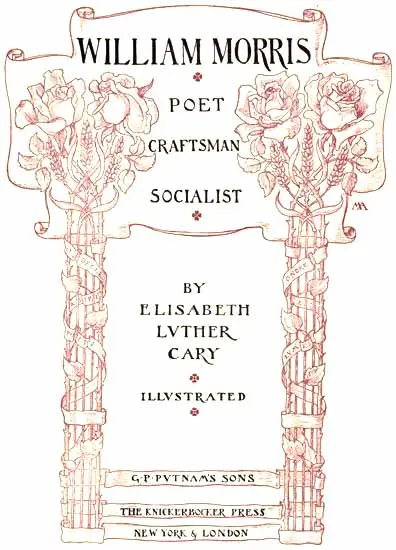
THE CLASSIC COLLECTION · 1902
"William Morris: Poet, Craftsman, Socialist" by Elisabeth Luther Cary is a biographical account written in the early 20th century. This work explores the life and contributions of William Morris, a significant figure in the arts, literature, and socialism of the 19th century. The book likely focuses on Morris's artistic vision, creative endeavors, and his commitment to social reform, woven together with glimpses of his personal experiences and relationships. The opening of the book sets the stage by emphasizing Morris's holistic approach to life, where his artistic and social pursuits were deeply interconnected. It outlines his early life, starting with his childhood in Essex, England, highlighting how the beauty of the landscape and the rich history of the region influenced his lifelong fascination with the Middle Ages and the desire to improve the world around him. Morris's struggles with formal education and his passionate interests emerge early, demonstrating how his artistic inclinations shaped his identity and paved the way for a career dedicated to craftsmanship, poetry, and socialist ideals. This initial portrayal reveals a man driven by dreams and an idealistic vision of a better society, inviting readers to explore further into his remarkable life.
Introduction adapted from the source catalogue; source summaries may be automatically generated.
Free to read · English · 79,457 words · No account needed
MAKE TIME FOR A GOOD BOOK
On by default. Untick to stop anonymous reading totals. Each page counts after 10 seconds in view. How this works.
Anonymous counting is on unless you have switched it off.
Wall-papers were among the earliest staple products of the firm in Red Lion Square, although Morris always regarded them in the light of a compromise; an altogether unsatisfactory substitute for the hand-painting, or tapestry or silk or printed cotton hangings, which he considered the proper covering for the bare walls which, of course, no one not in "an unhealthy state of mind and probably of body also" could endure to leave bare. The first to be designed, the Trellis paper, was the combined work of Morris and Webb, the former being responsible for the rose-trellis intended, we may suppose, to bring with it pleasant recollections of gardens in June and inspired by his own sweet garden at Upton, the latter for the birds that cling to the lattice or dart upward among the heavily thorned stems. In the early papers the designs were very simple and direct, often more quaint than beautiful, as in the case of the well-known Daisy paper, and depending greatly on the colouring for the attractiveness they possessed. Later came such intricate patterns as the Pimpernel, the Acanthus, so elaborate as to require a double set of blocks and no less than thirty-two printings, and the paper designed for St. James's Palace, as large and magnificent as the environment in which it was to be placed demanded. It is quite obvious from these designs that Morris did not regard his wall-hangings as backgrounds but as decorations in themselves. As a matter of fact he did not fancy pictures for his walls. After his early burst of enthusiasm over Rossetti's paintings he bought few pictures if any, and they do not seem ever to have entered into his schemes of decoration. The wall of a room was always important to him, and despite his discontent with paper coverings for it, he was anxious to have such coverings as ornamental as possible, admitting them to be useful "as things go," and treating them in considerable detail in his lectures on the decorative arts. He advised making up for the poverty of the material by great thoughtfulness in the design: "The more and the more mysteriously you interweave your sprays and stems, the better for your purpose, as the whole thing has to be pasted flat upon a wall and the cost of all this intricacy will but come out of your own brain and hand." Concerning colour he was equally specific. In his lecture characteristically called Making the Best of It, in which with an accent of discouragement he endeavours to show his audience how at the time of his speaking to make a middle-class home "endurable," he lays down certain rules which indicate at one and the same time his mastery of his subject and the incommunicability of right taste in this direction, although many of his ideas may be pondered to great advantage by even the mind untrained in colour schemes. He begins with his usual preliminary statement as to the health of those who disagree with him. "Though we may each have our special preferences," he says, "among the main colours, which we shall do quite right to indulge, it is a sign of disease in an artist to have a prejudice against any particular colour, though such prejudices are common and violent enough among people imperfectly educated in art, or with naturally dull perceptions of it. Still colours have their ways in decoration, so to say, both positively in themselves, and relatively to each man's way of using them. So I may be excused for setting down some things I seem to have noticed about these ways." After thus establishing friendly relations with his audience, he instructs them that yellow is a colour to be used sparingly and in connection with "gleaming materials" such as silk; that red to be at its finest must be deep and full and between crimson and scarlet; that purple no one in his senses would think of using bright and in masses, and that the best shade of it tends toward russet; green, he continues, must seldom be used both bright and strong. "On the other hand," he adds, "do not fall into the trap of a dingy, bilious-looking yellow-green, a colour to which I have a special and personal hatred, because (if you will excuse my mentioning personal matters) I have been supposed to have somewhat brought it into vogue." Dingy colours were abhorred by him in all cases, and his patience with those customers who demanded them was extremely limited. Blue was his "holiday colour," and "if you duly guard against getting it cold if it tend toward red, or rank if it tends toward green," you "need not be much afraid of its brightness."
Your reading position is saved on this browser. Take it to another device with a library code. Reading pages adapt to text, rather than matching a printed edition.
BEHIND THE BOOK
This eBook is for the use of anyone anywhere in the United States and most other parts of the world at no cost and with almost no restrictions whatsoever. You may copy it, give it away or re-use it under the terms of the Project Gutenberg License included with this eBook or online at www.gutenberg.org. If you are not located in the United States, you will have to check the laws of the country where you are located before using this eBook. Read the source licence.
The original source file, including credits and licence, is retained by this library. Request an original-format copy at no charge. Please include the book title and Project Gutenberg identifier #39725.
KEEP YOUR CURIOSITY GOING
Cécile Tormay

Moritz Busch
John L. Ransom
Frances Wright
Cécile Tormay

Mabel Potter Daggett