THE CLASSIC COLLECTION✦Artists Past and Present; Random StudiesCLASSIC FREE BOOKS
Artists Past and Present; Random Studies
Elisabeth Luther Cary
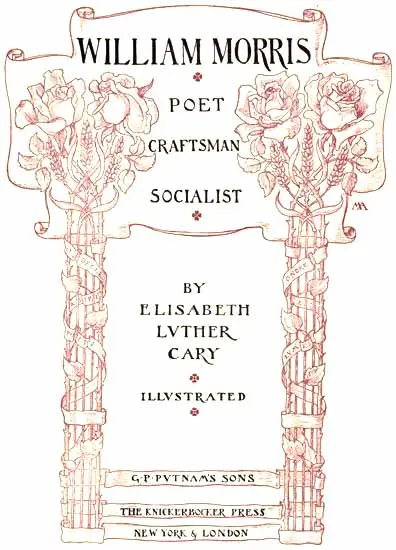
THE CLASSIC COLLECTION · 1902
"William Morris: Poet, Craftsman, Socialist" by Elisabeth Luther Cary is a biographical account written in the early 20th century. This work explores the life and contributions of William Morris, a significant figure in the arts, literature, and socialism of the 19th century. The book likely focuses on Morris's artistic vision, creative endeavors, and his commitment to social reform, woven together with glimpses of his personal experiences and relationships. The opening of the book sets the stage by emphasizing Morris's holistic approach to life, where his artistic and social pursuits were deeply interconnected. It outlines his early life, starting with his childhood in Essex, England, highlighting how the beauty of the landscape and the rich history of the region influenced his lifelong fascination with the Middle Ages and the desire to improve the world around him. Morris's struggles with formal education and his passionate interests emerge early, demonstrating how his artistic inclinations shaped his identity and paved the way for a career dedicated to craftsmanship, poetry, and socialist ideals. This initial portrayal reveals a man driven by dreams and an idealistic vision of a better society, inviting readers to explore further into his remarkable life.
Introduction adapted from the source catalogue; source summaries may be automatically generated.
Free to read · English · 79,457 words · No account needed
MAKE TIME FOR A GOOD BOOK
On by default. Untick to stop anonymous reading totals. Each page counts after 10 seconds in view. How this works.
Anonymous counting is on unless you have switched it off.
It must be admitted, however, that while his soul and vigour found vent in his designing and in the journeyman work--"delightful work, hard for the body and easy for the mind"--at which he was so ready to lend a hand, his artistic product lacked somewhat in the qualities that come from the exercise of the higher intellectual gifts. It was more than an attempt to revive old Gothic forms; it was an adoption of old forms with an infusion of modern spirit; but it missed the native and personal character of work growing out of contemporaneous conditions and tastes. Imaginative craftsman as he was, Morris was never quite an artist in the strict sense of the word. He had a fine sense of colour and, within certain limits, a right feeling for pattern; but his invention was too exuberant for repose, and he displayed in the greater part of his work an ornamental luxuriance that destroyed dignity and simplicity of effect. He did not like the restraints of art, and he seems to have been incapable of entering the sphere of abstract thought in which the principles governing great art are found. "No schools of art," he says with his superbly inaccurate generalisation, "have ever been contented to use abstract lines and forms and colours--that is, lines and so forth without any meaning." Such ornament he deemed "outlandish." He wanted his patterns, especially his wall-paper patterns, to remind people of pleasant scenes: "of the close vine trellis that keeps out the sun by the Nile side; or of the wild woods and their streams with the dogs panting beside them; or of the swallows sweeping above the garden boughs toward the house eaves where their nestlings are, while the sun breaks the clouds on them; or of the many-flowered summer meadows of Picardy,"--all very charming things to think about, but as really pertinent to wall-paper designing as the pleasant memory of a hard road with a fast horse speeding over it would be to the designing of a carpet. He preached the closest observation of nature and the most delicate understanding of it before attempting conventionalisation, but he did not hesitate to break all the laws of nature in his designs when he happened to want to do so. He did not hesitate, as Mr. Day has said, to make an acorn grow from two stalks or to give a lily five petals. Fitness in ornament was one of his fundamental principles, and he made his designs for the place in which they were to be seen and with direct reference to the limitations of opportunities of that place. It was never his way to turn a wall-paper loose on the market for any chance purchaser. He must know, if possible, something of the walls to which the design was to be applied and of the room in which it was to live, and he then adapted his design to his idea of what was required. This idea, however, was commonly much influenced by certain pre-conceived theories. He believed, for example, that there should be a sense of mystery in every pattern designed. This mystery he tried to get, not by masking the geometrical structure upon which a recurring pattern must be based, but by covering the ground equably and richly, so that the observer may not "be able to read the whole thing at once." Thus many of his designs are so over-elaborated as to give the effect of restlessness, whereas "rest" was the word oftenest on his lips in connection with domestic art. In common with most designers who derive their ideals from mediaeval sources, he was less impressed by the tranquillity gained from calm clean spaces, the measure, order, and stateliness brought about by the simple relation of abstract lines, the repose of the rhythmical play of mass in perfect proportion, undisturbed by decorative detail, than by the charm of highly vitalised imagery. But though he erred on the side of luxuriance--while preaching simplicity--he never allowed his design to sink into vulgarity or petty picturesqueness. He might be intricate but he was not vague. "Run any risk of failure rather than involve yourself in a tangle of poor weak lines that people can't make out," he says. "Definite form bounded by firm outline is a necessity for all ornament. You ought always to go for positive patterns when they may be had." They might always be had from him. And it is due to his positive quality, his uncompromising certainty of the rightness of the thing that he is doing, that even when he is most imitative he gives an impression of originality, and is in fact original in the sense that he has thought out for himself the methods and motives of the ancient art by which he is consciously and intentionally influenced.
Your reading position is saved on this browser. Take it to another device with a library code. Reading pages adapt to text, rather than matching a printed edition.
BEHIND THE BOOK
This eBook is for the use of anyone anywhere in the United States and most other parts of the world at no cost and with almost no restrictions whatsoever. You may copy it, give it away or re-use it under the terms of the Project Gutenberg License included with this eBook or online at www.gutenberg.org. If you are not located in the United States, you will have to check the laws of the country where you are located before using this eBook. Read the source licence.
The original source file, including credits and licence, is retained by this library. Request an original-format copy at no charge. Please include the book title and Project Gutenberg identifier #39725.
KEEP YOUR CURIOSITY GOING
Cécile Tormay

Moritz Busch
John L. Ransom
Frances Wright
Cécile Tormay

Mabel Potter Daggett