THE CLASSIC COLLECTION✦Artists Past and Present; Random StudiesCLASSIC FREE BOOKS
Artists Past and Present; Random Studies
Elisabeth Luther Cary
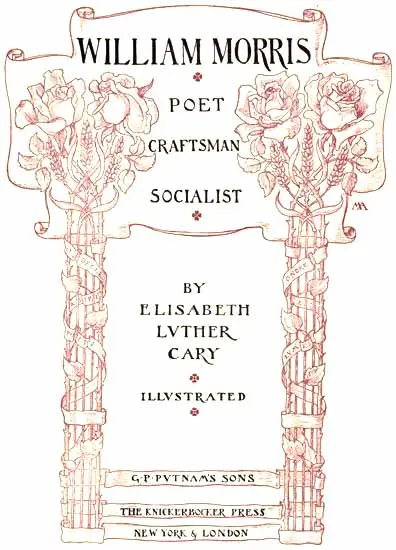
THE CLASSIC COLLECTION · 1902
"William Morris: Poet, Craftsman, Socialist" by Elisabeth Luther Cary is a biographical account written in the early 20th century. This work explores the life and contributions of William Morris, a significant figure in the arts, literature, and socialism of the 19th century. The book likely focuses on Morris's artistic vision, creative endeavors, and his commitment to social reform, woven together with glimpses of his personal experiences and relationships. The opening of the book sets the stage by emphasizing Morris's holistic approach to life, where his artistic and social pursuits were deeply interconnected. It outlines his early life, starting with his childhood in Essex, England, highlighting how the beauty of the landscape and the rich history of the region influenced his lifelong fascination with the Middle Ages and the desire to improve the world around him. Morris's struggles with formal education and his passionate interests emerge early, demonstrating how his artistic inclinations shaped his identity and paved the way for a career dedicated to craftsmanship, poetry, and socialist ideals. This initial portrayal reveals a man driven by dreams and an idealistic vision of a better society, inviting readers to explore further into his remarkable life.
Introduction adapted from the source catalogue; source summaries may be automatically generated.
Free to read · English · 79,457 words · No account needed
MAKE TIME FOR A GOOD BOOK
On by default. Untick to stop anonymous reading totals. Each page counts after 10 seconds in view. How this works.
Anonymous counting is on unless you have switched it off.
It is obvious that with this slender financial basis the business required the utmost energy, industry, skill, and talent to keep it from being promptly wrecked on the very uncertain coast of public opinion. During the first year all the members of the firm were active, although even at the first Morris led the rest. A stimulus was provided by the International Exhibition of 1862, whither they sent examples of their work, at the cost, wrote Faulkner, of "more tribulation and swearing to Topsy than three exhibitions will be worth." The exhibits attracted attention, and were awarded medals, in the case of the stained glass, "for artistic qualities of colour and design," and in the case of the furniture, hangings, and so forth, for the "closeness with which the style of the Middle Ages was rendered." It happened that the chief work in stained glass in the exhibit of the firm consisted of a set of windows designed by Rossetti, and giving, according to a Belgian critic, "an impression of colour, dazzling and magnificent, velvety and harmonious, resembling the Flemish stained glass windows decorating the Gothic cathedrals." Thus, fortunately, the first appearance of the firm was distinguished by the splendour which Rossetti alone among the group of workers could achieve, but his interest and activity shortly flagged and were absorbed in his individual work outside the company.
At first, despite the lordly prospectus, there were occasional blunders. Dr. Birkbeck Hill tells of a study table and an arm-chair, neither one of which was so thorough a piece of workmanship as the firm would have turned out later on, and Mr. Hughes remembers a sofa with a long bar beneath projecting six inches at each end so that it tripped up anyone who hastily went round it. These, however, were blunders of a kind soon remedied by experience. So long as the associates kept up their enthusiasm there were among them ample skill to grapple with technicalities, and ample artistic faculty to defy all ordinary competition. Whoever dropped behind from time to time in this most essential quality of enthusiasm it was never Morris, and all accounts agree in attributing to his energy and industry and unutterable zest the success of the novel and interesting experiment. "He is the only man I have known," said Rossetti once, "who beats every other man at his own game." The men he had to beat at this game of decoration were for the most part unworthy foes. Decorative art was at a low ebb in the early Victorian age, the age of antimacassars, stucco, and veneer. From this cheap vulgarity and pretentiousness Morris turned back--as he was wont to do on every occasion that offered excuse--to the thirteenth century as the purest fount of English tradition, where, if anywhere, could be found models showing logical principles of construction and genuine workmanship. His companions either caught from him the infection of the mediaeval attitude or were already in sympathy with it, and the work of the firm took on an emphatically Gothic aspect from the beginning. How great or how important a part each member played in the sum of the production is very difficult to estimate owing to the cooeperative plan by which several artists frequently united in executing one and the same piece of work. Sometimes Burne-Jones would draw the figures, Webb the birds, and Morris the foliage for a piece of drapery or wall-paper. Again portions of separate designs would be used over and over in different combinations for different places. This free cooeperation, this moving about within the limits of a general plan, suited the restless spirit of Morris, and chimed also with his profound admiration for the way in which the mediaeval works of art were brought about, no one man standing high above the others or trying to preserve his name and the fame of his performance. Working for the pleasure of the work was of the very essence of his philosophy, and nothing could be more unjust than the sneers from time to time launched at him because his venture proved a commercial triumph. Perhaps it would be going too far to say that money-getting was never in his mind, but there is no question that it was never first in his mind, and never in the slightest degree crowded his desire to put forth sincere, fine work, worth its price to the last detail, and worthy of praise and liking without regard to its price. There was not the slightest suggestion of pose or sham of any kind in his thought when he wrote, as he often did, against the greed of gain and in praise of the kind of labour that may be delighted in without regard to pounds and pence. He could say quite faithfully that he shared the humility of the early craftsmen, of whom he speaks with reverence.
Your reading position is saved on this browser. Take it to another device with a library code. Reading pages adapt to text, rather than matching a printed edition.
BEHIND THE BOOK
This eBook is for the use of anyone anywhere in the United States and most other parts of the world at no cost and with almost no restrictions whatsoever. You may copy it, give it away or re-use it under the terms of the Project Gutenberg License included with this eBook or online at www.gutenberg.org. If you are not located in the United States, you will have to check the laws of the country where you are located before using this eBook. Read the source licence.
The original source file, including credits and licence, is retained by this library. Request an original-format copy at no charge. Please include the book title and Project Gutenberg identifier #39725.
KEEP YOUR CURIOSITY GOING
Cécile Tormay

Moritz Busch
John L. Ransom
Frances Wright
Cécile Tormay

Mabel Potter Daggett