THE CLASSIC COLLECTION✦Artists Past and Present; Random StudiesCLASSIC FREE BOOKS
Artists Past and Present; Random Studies
Elisabeth Luther Cary
THE CLASSIC COLLECTION · 1902
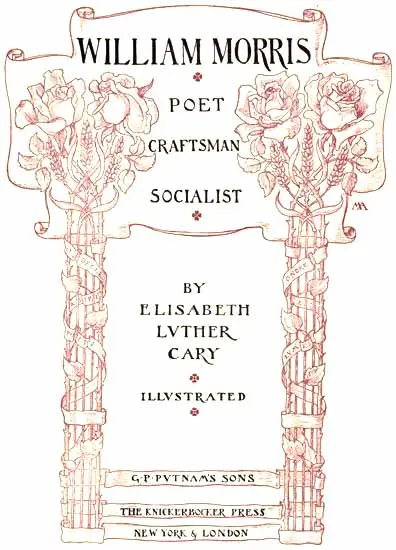
"William Morris: Poet, Craftsman, Socialist" by Elisabeth Luther Cary is a biographical account written in the early 20th century. This work explores the life and contributions of William Morris, a significant figure in the arts, literature, and socialism of the 19th century. The book likely focuses on Morris's artistic vision, creative endeavors, and his commitment to social reform, woven together with glimpses of his personal experiences and relationships. The opening of the book sets the stage by emphasizing Morris's holistic approach to life, where his artistic and social pursuits were deeply interconnected. It outlines his early life, starting with his childhood in Essex, England, highlighting how the beauty of the landscape and the rich history of the region influenced his lifelong fascination with the Middle Ages and the desire to improve the world around him. Morris's struggles with formal education and his passionate interests emerge early, demonstrating how his artistic inclinations shaped his identity and paved the way for a career dedicated to craftsmanship, poetry, and socialist ideals. This initial portrayal reveals a man driven by dreams and an idealistic vision of a better society, inviting readers to explore further into his remarkable life.
Introduction adapted from the source catalogue; source summaries may be automatically generated.
Free to read · English · 79,457 words · No account needed
MAKE TIME FOR A GOOD BOOK
On by default. Untick to stop anonymous reading totals. Each page counts after 10 seconds in view. How this works.
Anonymous counting is on unless you have switched it off.
And again: "A true architectural work," he says, "is a building duly provided with all the necessary furniture, decorated with all due ornament, according to the use, quality, and dignity of the building, from mere mouldings or abstract lines to the great epical works of sculpture and painting, which except as decorations of the nobler form of such buildings cannot be produced at all. So looked upon, a work of architecture is a harmonious, co-operative work of art, inclusive of all the serious arts--those which are not engaged in the production of mere toys or ephemeral prettinesses."
Morris communicated his momentous decision to his family as soon as it was made, and they received it with amazement and distress. While their origin was not especially aristocratic, their tastes ran toward the symbols of aristocracy. When Morris was nine years old, his father obtained a grant of arms from the Heralds' College, and the son had no small liking for the bearings assigned--bearings which included a horse's head erased argent between three horseshoes. The horse's head he introduced on the tiles and glass of the house he built for himself in later years, and he was in the habit of making a yearly pilgrimage to the famous White Horse of the Berkshire Downs, connecting it in some obscure way with his ancestry. In England, during the fifties, nothing was less calculated to appeal to an aristocratic tendency than any form of art considered as a profession. In The Newcomes Mr. Honeyman remarks with bland dignity to his aspiring young relative; "My dear Clive, there are degrees in society which we must respect. You surely cannot think of being a professional artist." In much this spirit, apparently, Mrs. Morris received her son's announcement, conveyed in a long and affectionate letter stating in detail the motives that had led him to his resolution. After defending his chosen profession at some length, calling it with characteristic avoidance of pompous phraseology, "a useful trade," he dwells upon the moderation of his hopes and expectations. He does not hope "to be great at all in anything," but thinks he may look forward to reasonable happiness in his work. It will be grievous to his pride and self-will, he says, to have to do just as he is told for three long years, but "good for it, too," and he looks forward with little delight to the drudgery of learning a new trade, but is pretty confident of success, and is happy in being able to pay "the premium and all that" without laying any fresh burden of expense upon his mother. Finally he proposes taking as his master George Edmund Street, who was living in Oxford as architect of the diocese, and whose enthusiasm for the thirteenth century could hardly have failed to claim the sympathy of Morris. Certainly it seemed precisely the fitting opportunity that offered. There could have been no better moment for him to follow the advice he so frequently gave to others--to turn his back upon an ugly age, choose the epoch that suited him best, and identify himself with that. Gothic to the core, he had come to Oxford, not, as Mr. Day has suggested, to catch the infection of mediaevalism abroad there, but to assimilate and thrive upon all the influences to which his independently mediaeval spirit was acutely susceptible. Scott, Pugin, Shaw, Viollet-le-Duc, had broken the way through popular prejudice, and Street was engaged at the time Morris went to him in the work of restoring ancient churches and designing Gothic buildings. "Restoration" had not then so evil a sound to Morris as it later came to have. Some thirty years after, he was to say: "No man or no body of men, however learned they may be in ancient art, whatever skill in design or love of beauty they may have, can persuade, or bribe, or force our workmen of to-day to do their work in the same way as the workmen of King Edward I. did theirs. Wake up Theodoric the Goth from his sleep of centuries and place him on the throne of Italy, turn our modern House of Commons into the Witenagemote (or Meeting of the Wise Men) of King Alfred the Great!--no less a feat is the restoration of an ancient building." In 1855, however, he had not fully arrived at this conviction. It was then the period of "fresh hope and partial insight" which, regarding it retrospectively, he says, "produced many interesting buildings and other works of art, and afforded a pleasant time indeed to the hopeful but very small minority engaged in it, in spite of all vexations and disappointments." There seemed no reason to suppose that, helped as he was by his predilections and by his environment, he could not become the master-builder of the house beautiful that constantly haunted his imagination.
Your reading position is saved on this browser. Take it to another device with a library code. Reading pages adapt to text, rather than matching a printed edition.
BEHIND THE BOOK
This eBook is for the use of anyone anywhere in the United States and most other parts of the world at no cost and with almost no restrictions whatsoever. You may copy it, give it away or re-use it under the terms of the Project Gutenberg License included with this eBook or online at www.gutenberg.org. If you are not located in the United States, you will have to check the laws of the country where you are located before using this eBook. Read the source licence.
The original source file, including credits and licence, is retained by this library. Request an original-format copy at no charge. Please include the book title and Project Gutenberg identifier #39725.
KEEP YOUR CURIOSITY GOING
Cécile Tormay

Moritz Busch
John L. Ransom
Frances Wright
Cécile Tormay

Mabel Potter Daggett