THE CLASSIC COLLECTION✦Artists Past and Present; Random StudiesCLASSIC FREE BOOKS
Artists Past and Present; Random Studies
Elisabeth Luther Cary
THE CLASSIC COLLECTION · 1902
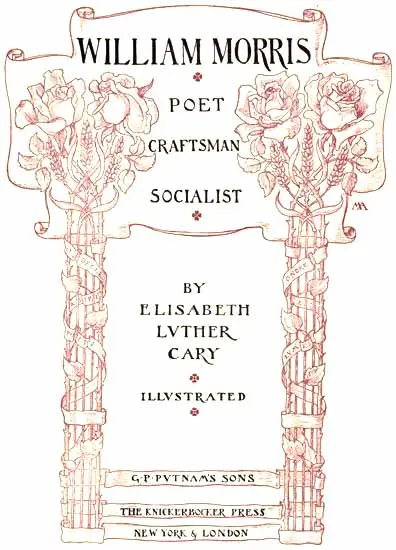
"William Morris: Poet, Craftsman, Socialist" by Elisabeth Luther Cary is a biographical account written in the early 20th century. This work explores the life and contributions of William Morris, a significant figure in the arts, literature, and socialism of the 19th century. The book likely focuses on Morris's artistic vision, creative endeavors, and his commitment to social reform, woven together with glimpses of his personal experiences and relationships. The opening of the book sets the stage by emphasizing Morris's holistic approach to life, where his artistic and social pursuits were deeply interconnected. It outlines his early life, starting with his childhood in Essex, England, highlighting how the beauty of the landscape and the rich history of the region influenced his lifelong fascination with the Middle Ages and the desire to improve the world around him. Morris's struggles with formal education and his passionate interests emerge early, demonstrating how his artistic inclinations shaped his identity and paved the way for a career dedicated to craftsmanship, poetry, and socialist ideals. This initial portrayal reveals a man driven by dreams and an idealistic vision of a better society, inviting readers to explore further into his remarkable life.
Introduction adapted from the source catalogue; source summaries may be automatically generated.
Free to read · English · 79,457 words · No account needed
MAKE TIME FOR A GOOD BOOK
On by default. Untick to stop anonymous reading totals. Each page counts after 10 seconds in view. How this works.
Anonymous counting is on unless you have switched it off.
52. Love is Enough, or the Freeing of Pharamond; A Morality. Written by William Morris. Large 4to. Troy type, with stage directions in Chaucer type. In black, red, and blue. Borders 6a and 7, and two illustrations designed by Sir Edward Burne-Jones. 300 on paper at two guineas, 8 on vellum at ten guineas. Dated December 11, 1897, issued March 24, 1898. Published at the Kelmscott Press. Bound in limp vellum.
This was the second book printed in three colours at the Kelmscott Press. As explained in the colophon, the final picture was not designed for this particular edition.
53. A Note by William Morris on his Aims in Founding the Kelmscott Press. Together with a Short Description of the Press, by S. C. COCKERELL. And an Annotated List of the Books Printed Thereat. Octavo. Golden type, with five pages in the Troy and Chaucer types. In black and red. Borders 4a and 4, and a woodcut designed by Sir E. Burne-Jones. 525 on paper at ten shillings, 12 on vellum at two guineas. Dated March 4, issued March 24, 1898. Published at the Kelmscott Press. Bound in half holland.
Various Lists, Leaflets, and Announcements Printed at the Kelmscott Press:
Eighteen lists of the books printed or in preparation at the Kelmscott Press were issued to booksellers and subscribers. The dates of these are May, July, and December, 1892; March 9, May 20, May 27, August 1, and December 1, 1893; March 31, April 21, July 2, October 1 (a leaflet), and December 1, 1894; July 1 and November 26, 1895; June 1, 1896; February 16 and July 28, 1897. The three lists for 1892, and some copies of that for March 9, 1893, were printed on Whatman paper, the last of the stock bought for the first edition of The Roots of the Mountains. Besides these, twenty-nine announcements, relating mainly to individual books, were issued; and eight leaflets, containing extracts from the lists, were printed for distribution by Messrs. Morris & Co. The following items, as having a more permanent interest than most of these announcements, merit a full description:
1. Two forms of invitation to the annual gatherings of the Hammersmith Socialist Society on January 30, 1892, and February 11, 1893. Golden type.
2. A four-page leaflet for the Ancoats Brotherhood, with the frontispiece from the Kelmscott Press edition of A Dream of John Ball on the first page. March, 189 Golden type. 2500 copies.
3. An address to Sir Lowthian Bell, Bart., from his employees, dated 30th June, 1894. Eight pages. Golden type. 250 on paper and 2 on vellum.
4. A leaflet, with fly-leaf, headed An American Memorial to Keats, together with a form of invitation to the unveiling of his bust in Hampstead Parish Church on July 16, 1894. Golden type. 750 copies.
5. A slip giving the text of a memorial tablet to Dr. Thomas Sadler, for distribution at the unveiling of it in Rosslyn Hill Chapel, Hampstead. November, 1894. Golden type. 450 copies.
Your reading position is saved on this browser. Take it to another device with a library code. Reading pages adapt to text, rather than matching a printed edition.
BEHIND THE BOOK
This eBook is for the use of anyone anywhere in the United States and most other parts of the world at no cost and with almost no restrictions whatsoever. You may copy it, give it away or re-use it under the terms of the Project Gutenberg License included with this eBook or online at www.gutenberg.org. If you are not located in the United States, you will have to check the laws of the country where you are located before using this eBook. Read the source licence.
The original source file, including credits and licence, is retained by this library. Request an original-format copy at no charge. Please include the book title and Project Gutenberg identifier #39725.
KEEP YOUR CURIOSITY GOING
Cécile Tormay

Moritz Busch
John L. Ransom
Frances Wright
Cécile Tormay

Mabel Potter Daggett