THE CLASSIC COLLECTION✦Artists Past and Present; Random StudiesCLASSIC FREE BOOKS
Artists Past and Present; Random Studies
Elisabeth Luther Cary
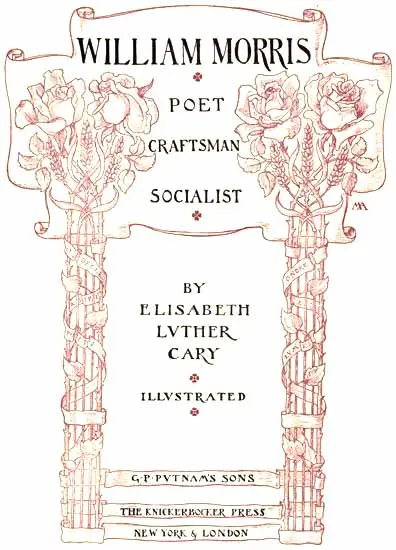
THE CLASSIC COLLECTION · 1902
"William Morris: Poet, Craftsman, Socialist" by Elisabeth Luther Cary is a biographical account written in the early 20th century. This work explores the life and contributions of William Morris, a significant figure in the arts, literature, and socialism of the 19th century. The book likely focuses on Morris's artistic vision, creative endeavors, and his commitment to social reform, woven together with glimpses of his personal experiences and relationships. The opening of the book sets the stage by emphasizing Morris's holistic approach to life, where his artistic and social pursuits were deeply interconnected. It outlines his early life, starting with his childhood in Essex, England, highlighting how the beauty of the landscape and the rich history of the region influenced his lifelong fascination with the Middle Ages and the desire to improve the world around him. Morris's struggles with formal education and his passionate interests emerge early, demonstrating how his artistic inclinations shaped his identity and paved the way for a career dedicated to craftsmanship, poetry, and socialist ideals. This initial portrayal reveals a man driven by dreams and an idealistic vision of a better society, inviting readers to explore further into his remarkable life.
Introduction adapted from the source catalogue; source summaries may be automatically generated.
Free to read · English · 79,457 words · No account needed
MAKE TIME FOR A GOOD BOOK
On by default. Untick to stop anonymous reading totals. Each page counts after 10 seconds in view. How this works.
Anonymous counting is on unless you have switched it off.
And only less delightful than these glimpses of the natural world are the recurring portraits of half-grown boys and girls, all different and all lovable. The sweetness of adolescent beauty had for Morris an irresistible appeal, and while his characters have little of the psychological charm inseparable in real life from dawning qualities and undeveloped potentialities, they are as lovely as the morning in the brightness of hair, the slimness of form, the freedom of gesture with which he endows them. The shapely brown hands and feet of Ursula, her ruddy colour, her slender sturdiness, and brave young laugh are attractions as potent as the more delicate charm of Birdalone's serious eyes and thin face, or Elfhild's flower-like head and tender playfulness; and all these heroines are alike in a fine capability for useful toil and pride in it. When the old carle says to Birdalone, "It will be no such hard life for thee, for I have still some work in me, and thou mayst do something in spite of thy slender and delicate fashion," she replies with merry laughter, "Forsooth, good sire, I might do somewhat more than something; for I am deft in all such work as here ye need; so fear not but I should earn my livelihood, and that with joy." Ursula also knows all the craft of needlework, and all the manners of the fields, and finds nothing in work to weary her; and even in the Maid of The Wood beyond the World, with her magic power to revive flowers by the touch of her fingers, is felt the preferable human power to make comfort and pleasantness by the right performance of plain tasks.
Nearly if not quite equal to Morris's expression of love for the beauty of nature and of fair humanity is his expression of the love for beautiful handicraft, to which his whole life and all his writings alike testify. Whatever is omitted from his stories of love and adventure, he never omits to familiarise his readers with the ornament lavished upon buildings and garments and countless accessories; hardly a dozen pages of any one of the romances may be turned before the description of some piece of artistic workmanship is met. Osberne's knife in The Sundering Flood is early introduced to the reader as "a goodly weapon, carven with quaintnesses about the heft, the blade inlaid with runes done in gold and the sheath of silver," and the gifts he sends to Elfhild across the flood are "an ouch or chain or arm-ring" fashioned "quaintly and finely," or "fair windowed shoon, and broidered hosen and dainty smocks, and silken kerchiefs"; much is made of his holiday raiment of scarlet and gold, of his flowered green coat, and of the fine gear of gold and green for which Elfhild changes her grey cloak. In The Story of the Glittering Plain, filled as it is with the sterner spirit of the sagas, there is still room for much detail concerning the carven panelling of the shut-bed, in which was pictured "fair groves and gardens, with flowery grass and fruited trees all about," and "fair women abiding therein, and lovely young men and warriors, and strange beasts and many marvels, and the ending of wrath and beginning of pleasure, and the crowning of love," and for the account of the painted book, "covered outside with gold and gems" and painted within with woods and castles, "and burning mountains, and the wall of the world, and kings upon their thrones, and fair women and warriors, all most lovely to behold." As for the fair Birdalone, her pleasure in fine stuffs and rich embroideries is unsurpassed in the annals of womankind. The wood-wife with canny knowledge of her tastes brings her the fairy web, declaring that if she dare wear it she shall presently be clad as goodly as she can wish. Birdalone can be trusted to don any attire that meets her fancy (and to doff it as willingly, for she has a startling habit not uncommon with Morris's heroines of stripping off her garments to let the winds of heaven play upon her unimpeded). The wood-wife places the raiment she has brought on Birdalone's outstretched arms, "and it was as if the sunbeam had thrust through the close leafage of the oak, and made its shadow nought a space about Birdalone, so gleamed and glowed in shifty brightness the broidery of the gown; and Birdalone let it fall to earth, and passed over her hands and arms the fine smock sewed in yellow and white silk, so that the web thereof seemed of mingled cream and curd; and she looked on the shoon that lay beside the gown, that were done so nicely and finely that the work was as the feather-robe of a beauteous bird, whereof one scarce can say whether it be bright or grey, thousand-hued or all simple of colour. Birdalone quivered for joy of all the fair things, and crowed in her speech as she knelt before Habundia to thank her." Thus Morris carried into his "pleasure-work of books" the "bread-and-butter work" of which he was hardly less fond.
Your reading position is saved on this browser. Take it to another device with a library code. Reading pages adapt to text, rather than matching a printed edition.
BEHIND THE BOOK
This eBook is for the use of anyone anywhere in the United States and most other parts of the world at no cost and with almost no restrictions whatsoever. You may copy it, give it away or re-use it under the terms of the Project Gutenberg License included with this eBook or online at www.gutenberg.org. If you are not located in the United States, you will have to check the laws of the country where you are located before using this eBook. Read the source licence.
The original source file, including credits and licence, is retained by this library. Request an original-format copy at no charge. Please include the book title and Project Gutenberg identifier #39725.
KEEP YOUR CURIOSITY GOING
Cécile Tormay

Moritz Busch
John L. Ransom
Frances Wright
Cécile Tormay

Mabel Potter Daggett