THE CLASSIC COLLECTION✦Artists Past and Present; Random StudiesCLASSIC FREE BOOKS
Artists Past and Present; Random Studies
Elisabeth Luther Cary
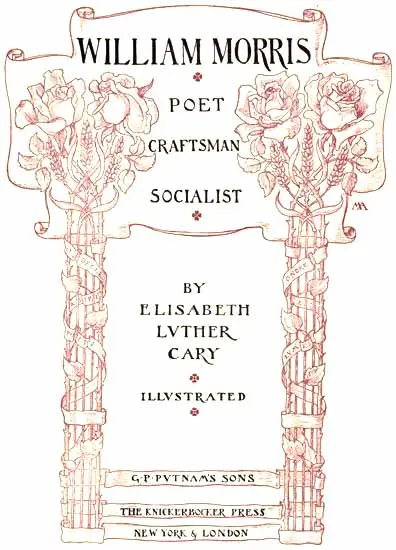
THE CLASSIC COLLECTION · 1902
"William Morris: Poet, Craftsman, Socialist" by Elisabeth Luther Cary is a biographical account written in the early 20th century. This work explores the life and contributions of William Morris, a significant figure in the arts, literature, and socialism of the 19th century. The book likely focuses on Morris's artistic vision, creative endeavors, and his commitment to social reform, woven together with glimpses of his personal experiences and relationships. The opening of the book sets the stage by emphasizing Morris's holistic approach to life, where his artistic and social pursuits were deeply interconnected. It outlines his early life, starting with his childhood in Essex, England, highlighting how the beauty of the landscape and the rich history of the region influenced his lifelong fascination with the Middle Ages and the desire to improve the world around him. Morris's struggles with formal education and his passionate interests emerge early, demonstrating how his artistic inclinations shaped his identity and paved the way for a career dedicated to craftsmanship, poetry, and socialist ideals. This initial portrayal reveals a man driven by dreams and an idealistic vision of a better society, inviting readers to explore further into his remarkable life.
Introduction adapted from the source catalogue; source summaries may be automatically generated.
Free to read · English · 79,457 words · No account needed
MAKE TIME FOR A GOOD BOOK
On by default. Untick to stop anonymous reading totals. Each page counts after 10 seconds in view. How this works.
Anonymous counting is on unless you have switched it off.
The Roots of the Mountains was written rapidly and issued with unrelaxed attention to typographical problems. Its title-page was made even more satisfactory than that of its predecessor, and the device of introducing a little poem to fill up the ugly white space in the centre was again employed. The lines in this case have nothing to do with the contents of the book, though forced into a relation with the author's purpose of providing "rest" for the reader. They were, in fact, founded upon an incident of a railway trip when the train passed through meadows in which hay-making was going on. Mr. Emery Walker was with Morris, and as they saw the hay-cocks defrauded by the summer breeze he exclaimed, "A subject for your title-page!" "Aye," said Morris, and jotted it down in his manuscript book.
The Roots of the Mountains was a favourite with Morris, and he planned for it an edition on Whatman paper and bound in two patterns of Morris and Company's chintz. Some of the paper ordered for this edition was left over, and eventually was used by Morris for the first little post-quarto catalogues and prospectuses printed at Hammersmith. Thus the book formed a material link between the Chiswick Press and the Kelmscott Press.
Before the establishment of the latter, however, Morris gave one more book to Socialism. His News from Nowhere was the last of his works to appear in The Commonweal and was almost immediately reprinted from its pages by an American publisher. It is an account of the civilised world as it might be made, according to Morris's belief, by the application of his principles of Socialism to life in general and in particular. In 1889 he had reviewed for The Commonweal Mr. Bellamy's Looking Backward, with how much approbation may readily be imagined. As an expression of the temperament of its author he considered it interesting, but as a reconstructive theory unsafe and misleading. "I believe," he said, "that the ideal of the future does not point to the lessening of man's energy by the reduction of labour to a minimum, but rather to the reduction of pain in labour to a minimum so small that it will cease to be pain; a gain to humanity which can only be dreamed of till men are more completely equal than Mr. Bellamy's Utopia would allow them to be, but which will most assuredly come about when men are really equal in condition; although it is probable that much of our so-called 'refinement,' our luxury,--in short, our civilisation,--will have to be sacrificed to it." Early in 1890 appeared the first instalment of News from Nowhere, in which Morris set himself the task of correcting the impression produced by Mr. Bellamy's views of the future by substituting his own picture of a reconstructed society, from which all the machinery that in Looking Backward was brought to so high a degree of efficiency is banished, and the natural energies of man are employed to his complete satisfaction. Homer's Odyssey, which Morris at this time was translating by way of refreshment and amusement, may well have served as a partial inspiration for the brilliant, delicate descriptions of handicrafts practised by the art-loving people of Nowhere. We read in both of lovely embroideries; of fine woven stuffs, soft and pliant in texture, and deeply dyed in rich forgotten colours of antiquity; of the quaint elaboration and charm of metals wrought into intricate designs; of all beautiful ornament to be gained from the zeal of skilled and sensitive fingers. The image is before us in News from Nowhere of a life as busy and as bright as that of the ancient Greeks, whose cunning hands could do everything save divide use from beauty. As a natural consequence of happy labour, the inhabitants of Nowhere have also the superb health and personal beauty of the Greeks. Their women of forty and fifty have smooth skins and fresh colour, bright eyes and a free walk. Their men have no knowledge of wrinkles and grey hairs. Everywhere is the freshness and sparkle of the morning. The pleasant homes nestle in peaceful security among the lavish fruits of the earth. The water of the Thames flows clean and clear between its banks; the fragrance of flowers pervades the pages and suggests a perpetual summer; athletic sports are mingled with athletic occupations. There is little studying. History is sad and often shameful--why then study it? Knowledge of geography is not important; it comes to those who care to travel. Languages one naturally picks up from intercourse with the people of other countries. Political economy? When one practises good fellowship what need of theories? Mathematics? They would wrinkle the brow; moreover, one learns all that is necessary of them by building houses and bridges and putting things together in the right way. It is not surprising that in this buoyant life filled with active interests, the religion of which is good-will and mutual helpfulness, the thought of death is not a welcome one. A dweller in Nowhere admits that in the autumn he almost believes in death; but no one entertains such a belief longer than he must. Thus we get in this fair idyll the purely visible side of the society depicted. The depths of the human heart and of the human soul are left unsounded. To have what they desire, what is claimed by their hands, by their eyes, by their senses, is the aim of the people. Renunciation, like mathematics, would wrinkle the brow. Arbitrary restraint is not to be considered. Nothing is binding, neither marriage vow nor labour contract, or, to speak more precisely, neither marriage vow nor contract for labour exists. The people live, as we are told, as some of the so-called savages in the South Seas really do live,--in a state of interdependence so perfect that if an individual lays down an obligation the community takes it up. For the fading of life, for the death that may not delay till autumn to thrust itself upon the attention, for the development of spiritual strength to meet an enemy against whom art and beauty will not avail, for the battle with those temptations of the flesh that are not averted by health and comeliness, no provision is made. The author's philosophy is that work, under pleasant conditions will do away with all the evils of both soul and body.
Your reading position is saved on this browser. Take it to another device with a library code. Reading pages adapt to text, rather than matching a printed edition.
BEHIND THE BOOK
This eBook is for the use of anyone anywhere in the United States and most other parts of the world at no cost and with almost no restrictions whatsoever. You may copy it, give it away or re-use it under the terms of the Project Gutenberg License included with this eBook or online at www.gutenberg.org. If you are not located in the United States, you will have to check the laws of the country where you are located before using this eBook. Read the source licence.
The original source file, including credits and licence, is retained by this library. Request an original-format copy at no charge. Please include the book title and Project Gutenberg identifier #39725.
KEEP YOUR CURIOSITY GOING
Cécile Tormay

Moritz Busch
John L. Ransom
Frances Wright
Cécile Tormay

Mabel Potter Daggett