THE CLASSIC COLLECTION✦Artists Past and Present; Random StudiesCLASSIC FREE BOOKS
Artists Past and Present; Random Studies
Elisabeth Luther Cary
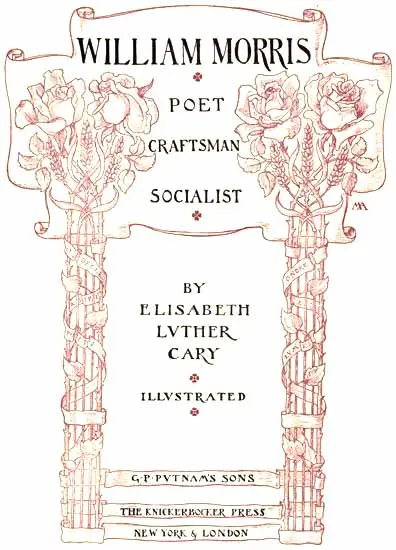
THE CLASSIC COLLECTION · 1902
"William Morris: Poet, Craftsman, Socialist" by Elisabeth Luther Cary is a biographical account written in the early 20th century. This work explores the life and contributions of William Morris, a significant figure in the arts, literature, and socialism of the 19th century. The book likely focuses on Morris's artistic vision, creative endeavors, and his commitment to social reform, woven together with glimpses of his personal experiences and relationships. The opening of the book sets the stage by emphasizing Morris's holistic approach to life, where his artistic and social pursuits were deeply interconnected. It outlines his early life, starting with his childhood in Essex, England, highlighting how the beauty of the landscape and the rich history of the region influenced his lifelong fascination with the Middle Ages and the desire to improve the world around him. Morris's struggles with formal education and his passionate interests emerge early, demonstrating how his artistic inclinations shaped his identity and paved the way for a career dedicated to craftsmanship, poetry, and socialist ideals. This initial portrayal reveals a man driven by dreams and an idealistic vision of a better society, inviting readers to explore further into his remarkable life.
Introduction adapted from the source catalogue; source summaries may be automatically generated.
Free to read · English · 79,457 words · No account needed
MAKE TIME FOR A GOOD BOOK
On by default. Untick to stop anonymous reading totals. Each page counts after 10 seconds in view. How this works.
Anonymous counting is on unless you have switched it off.
In the course of the poem the Pilgrims are called to Paris by the voice of the Revolution, and there the wife is killed. Interwoven with the main incidents is the domestic tragedy most familiar to fiction, the alienation of the wife's affections by one of the husband's friends. Morris in his treatment of this situation shows a peculiarly fine and tender quality, sufficiently rare in life itself and seldom to be found in pictures of life. He preserves the dignity of his unhappy characters by a delicate sincerity in their attitude toward one another and by an immeasurable gentleness and self-forgetfulness on the part of the one most wronged. A similar situation in News from Nowhere is made trivial and consequently revolting by the impression it gives that it was created to illustrate a theory. In no place does The Pilgrims of Hope give such an impression. It is a drawing from life, clumsy and summary enough in outline, yet firm and expressive of the thing seen, and with power to convey a genuine emotion.
The Pilgrims of Hope appeared serially in The Commonweal during 1885-1886. It was soon followed by a romance called The Dream of John Ball. This subject with its mediaeval setting suited Morris well, and was treated by him in his ripest and strongest vein. Although the story opens in a lightly facetious manner, never a particularly happy one with him, its tone as it proceeds is that of subdued and stately pathos. The writer dreams himself in a village of Kent, where men are hanging upon the words of that poor tutor of Oxford, the "Mad Priest," preaching the equality of gentle and villein on the text
When Adam dalf, and Eve span
Who was thanne a gentilman?
Apparently the dream is the result of a mournfully retrospective mood. The dreamer hears the plain and stirring speech of John Ball, listens to his eager appeal to the men of Kent that they help their brethren of Essex cast off the yoke placed upon them by bailiff and lord, and to his prophecies that in the days to come, when they are free from masters, "man shall help man, and the saints in heaven shall be glad, because men no more fear each other ... and fellowship shall be established in heaven and on the earth." But knowledge of the later time penetrates the dream, and the dreamer ponders "how men fight and lose the battle, and the thing that they fought for comes about in spite of their defeat, and when it comes it turns out not to be what they meant, and other men have to fight for what they meant under another name." At this time Morris was realising in some bitterness of heart that the thing for which he had fought was turning out to be not what he had meant, and the talk between John Ball and the dreamer concerning the future, of which the latter can reveal the secret, is eloquent of sober and noble resignation. The reformer of the earlier age receives with serenity the assurance that his sacrifice will count only as failure in the eyes of the coming generations, since with it goes the further assurance that men will continue to seek a remedy for their wrongs. But we read in the conception the author's foreboding that his own efforts toward the reconstitution of society are also doomed. The dreamer meditates, with an insight born of personal experience and disappointment, upon the darkness of our vision and the difficulty of directing our steps toward our actual goal. Morris obviously traced in John Ball's action a parallel to his own. What happened to the one was what might happen to the other. The hope that inspired the one was the same as inspired the other. The mistakes of the one were akin to the mistakes of the other. Thus, this prose romance, of all that Morris wrote, is warmest and most personal. The historical setting is an aid, not an obstacle, to the imagination. The pathos of the real life touched upon, the knowledge that the hopeful spirit of the preacher was once alive in the land, and that the response of the men of Kent was given in truth and with the might of angry, living hearts, lends a certain solidity and vitality to the figures and inspires Morris to a sturdier treatment of his material than legends could force from him. Had some of the marvellous activity that later went toward the making of purely imaginary situations and characters been spent upon realising for us the individual lives of more of the mediaeval workers and thinkers, so vivid to Morris and so dim to most of us, the result might not have been history, but it would have been literature of a rare and felicitous type.
Your reading position is saved on this browser. Take it to another device with a library code. Reading pages adapt to text, rather than matching a printed edition.
BEHIND THE BOOK
This eBook is for the use of anyone anywhere in the United States and most other parts of the world at no cost and with almost no restrictions whatsoever. You may copy it, give it away or re-use it under the terms of the Project Gutenberg License included with this eBook or online at www.gutenberg.org. If you are not located in the United States, you will have to check the laws of the country where you are located before using this eBook. Read the source licence.
The original source file, including credits and licence, is retained by this library. Request an original-format copy at no charge. Please include the book title and Project Gutenberg identifier #39725.
KEEP YOUR CURIOSITY GOING
Cécile Tormay

Moritz Busch
John L. Ransom
Frances Wright
Cécile Tormay

Mabel Potter Daggett