THE CLASSIC COLLECTION✦My diaries, being a personal narrative of events 1888-1914, Part 2 (1900-1914)CLASSIC FREE BOOKS
My diaries, being a personal narrative of events 1888-1914, Part 2 (1900-1914)
Wilfrid Scawen Blunt
THE CLASSIC COLLECTION · 1791
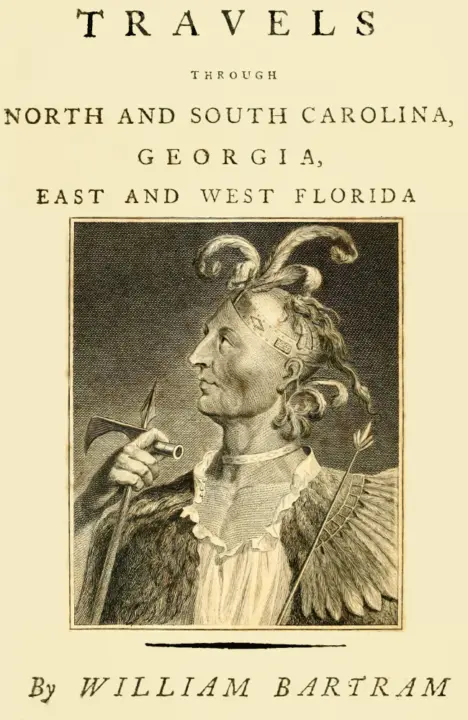
"Travels Through North and South Carolina, Georgia, East and West Florida, the Cherokee Country..." by William Bartram is a naturalist's account published in 1791. The work chronicles Bartram's four-year journey through the American South between 1773 and 1777, documenting encounters with Creek, Seminole, Cherokee, and Choctaw peoples, discoveries of plant species, and observations of unexplored territories. His sympathetic portrayal of Native Americans challenged prevailing assumptions, while his vivid descriptions influenced Romantic poets including Coleridge and Wordsworth. The book stands as both scientific documentation and literary achievement.
Introduction adapted from the source catalogue; source summaries may be automatically generated.
Free to read · English · 153,055 words · No account needed
MAKE TIME FOR A GOOD BOOK
On by default. Untick to stop anonymous reading totals. Each page counts after 10 seconds in view. How this works.
Anonymous counting is on unless you have switched it off.
Keeping along the west or Indian shore, I saw basking on the sedgy banks, numbers of alligators[16], some of them of an enormous size.
The high forests on this coast, now wore a grand and sublime appearance; the earth rising gradually from the river westward, by easy swelling ridges, behind one another, lifting the distant groves up into the skies. The trees are of the lofty kind, as the grand Laurel Magnolia, Palm elata, Liquidambar styraciflua, Fagus sylvatica, Querci, Juglans hiccory, Fraxinus, and others.
On my doubling a long point of land, the river appeared surprisingly widened, forming a large bay, of an oval form, and several miles in extent. On the west side it was bordered round with low marshes, and invested with a swamp of Cypress, the trees so lofty, as to preclude the sight of the high-land forests, beyond them; and these trees, having flat tops, and all of equal height, seemed to be a green plain, lifted up and supported upon columns in the air, round the west side of the bay.
The Cupressus disticha stands in the first order of North American trees. Its majestic stature is surprising; and on approaching it, we are struck with a kind of awe, at beholding the stateliness of the trunk, lifting its cumbrous top towards the skies, and casting a wide shade upon the ground, as a dark intervening cloud, which, for a time, excludes the rays of the sun. The delicacy of its colour, and texture of its leaves, exceed every thing in vegetation. It generally grows in the water, or in low flat lands, near the banks of great rivers and lakes, that are covered, great part of the year, with two or three feet depth of water; and that part of the trunk which is subject to be under water, and four or five feet higher up, is greatly enlarged by prodigious buttresses, or pilasters, which, in full grown trees, project out on every side, to such a distance, that several men might easily hide themselves in the hollows between. Each pilaster terminates under ground, in a very large, strong, serpentine root, which strikes off, and branches every way, just under the surface of the earth: and from these roots grow woody cones, called cypress knees, four, five, and six feet high, and from six to eighteen inches and two feet in diameter at their bases. The large ones are hollow, and serve very well for beehives; a small space of the tree itself is hollow, nearly as high as the buttresses already mentioned. From this place the tree, as it were, takes another beginning, forming a grand straight column eighty or ninety feet high, when it divides every way around into an extensive flat horizontal top, like an umbrella, where eagles have their secure nests, and cranes and storks their temporary resting-places; and what adds to the magnificence of their appearance is the streamers of long moss that hang from the lofty limbs and float in the winds. This is their majestic appearance when standing alone, in large rice plantations, or thinly planted on the banks of great rivers.
Your reading position is saved on this browser. Take it to another device with a library code. Reading pages adapt to text, rather than matching a printed edition.
BEHIND THE BOOK
This eBook is for the use of anyone anywhere in the United States and most other parts of the world at no cost and with almost no restrictions whatsoever. You may copy it, give it away or re-use it under the terms of the Project Gutenberg License included with this eBook or online at www.gutenberg.org. If you are not located in the United States, you will have to check the laws of the country where you are located before using this eBook. Read the source licence.
The original source file, including credits and licence, is retained by this library. Request an original-format copy at no charge. Please include the book title and Project Gutenberg identifier #63678.
KEEP YOUR CURIOSITY GOING
Wilfrid Scawen Blunt
Wilfrid Scawen Blunt

E. W. (Edgar Watson) Howe
Cécile Tormay

Moritz Busch
John L. Ransom