THE CLASSIC COLLECTION✦My diaries, being a personal narrative of events 1888-1914, Part 2 (1900-1914)CLASSIC FREE BOOKS
My diaries, being a personal narrative of events 1888-1914, Part 2 (1900-1914)
Wilfrid Scawen Blunt
THE CLASSIC COLLECTION · 1791
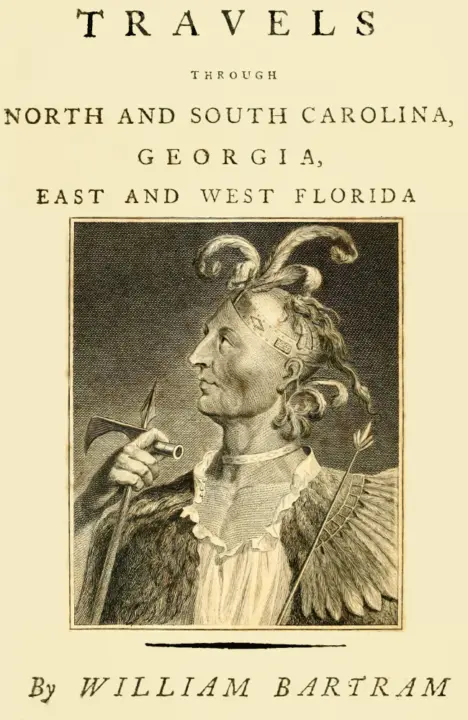
"Travels Through North and South Carolina, Georgia, East and West Florida, the Cherokee Country..." by William Bartram is a naturalist's account published in 1791. The work chronicles Bartram's four-year journey through the American South between 1773 and 1777, documenting encounters with Creek, Seminole, Cherokee, and Choctaw peoples, discoveries of plant species, and observations of unexplored territories. His sympathetic portrayal of Native Americans challenged prevailing assumptions, while his vivid descriptions influenced Romantic poets including Coleridge and Wordsworth. The book stands as both scientific documentation and literary achievement.
Introduction adapted from the source catalogue; source summaries may be automatically generated.
Free to read · English · 153,055 words · No account needed
MAKE TIME FOR A GOOD BOOK
On by default. Untick to stop anonymous reading totals. Each page counts after 10 seconds in view. How this works.
Anonymous counting is on unless you have switched it off.
The gold-fish is about the size of the anchovy, nearly four inches long, of a neat slender form; the head is covered with a salade of an ultramarine blue, the back of a reddish brown, the sides and belly of a flame, or of the colour of a fine red lead; a narrow dusky line runs along each side, from the gills to the tail; the eyes are large, with the iris like burnished gold. This branch of Broad River is about twelve yards wide, and has two, three, and four feet depth of water, and winds through a fertile vale, almost overshadowed on one side by a ridge of high hills, well timbered with Oak, Hiccory, Liriodendron, Magnolia acuminata, Pavia sylvatica, and on their rocky summits, Fagus castanea, Rhododendron ferrugineum, Kalmia latifolia, Cornus Florida, &c.
One of our Indian young men, this evening, caught a very large salmon trout, weighing about fifteen pounds, which he presented to the colonel, who ordered it to be served up for supper. The Indian struck this fish, with a reed harpoon, pointed very sharp, barbed, and hardened by the fire. The fish lay close under the steep bank, which the Indian discovered and struck with his reed; instantly the fish darted off with it, whilst the Indian pursued, without extracting the harpoon, and with repeated thrusts drowned it, and then dragged it to shore.
After leaving Broad River, the land rises very sensibly, and the country being mountainous, our progress became daily more difficult and slow; yet the varied scenes of pyramidal hills, high forests, rich vales, serpentine rivers, and cataracts, fully compensated for our difficulties and delays. I observed the great Aconitum napellus, Delphinium perigrinum, the carminative Angelica lucida,[13] and cerulean Malva.
We at length happily accomplished our line, arriving at the little river, where our hunters bringing in plenty of venison and turkeys, we had a plentiful feast at supper. Next morning we marked the corner tree, at the confluence of Little River and the Savanna; and, soon after, the Indians amicably took leave of us, returning home to their towns.
The rocks and fossils, which constitute the hills of this middle region, are of various species, as, Quartsum, Ferrum, Cos, Silex, Glarea, Arena, Ochra, Stalactites, Saxum, Mica, &c. I saw no signs of Marble, Plaster, or Lime-stone; yet there is, near Augusta, in the forests, great piles of a porous friable white rock, in large and nearly horizontal masses, which seems to be an heterogeneous concrete, consisting of pulverized sea-shells, with a small proportion of sand; it is soft, and easily wrought into any form, yet of sufficient consistence for constructing any building.
Your reading position is saved on this browser. Take it to another device with a library code. Reading pages adapt to text, rather than matching a printed edition.
BEHIND THE BOOK
This eBook is for the use of anyone anywhere in the United States and most other parts of the world at no cost and with almost no restrictions whatsoever. You may copy it, give it away or re-use it under the terms of the Project Gutenberg License included with this eBook or online at www.gutenberg.org. If you are not located in the United States, you will have to check the laws of the country where you are located before using this eBook. Read the source licence.
The original source file, including credits and licence, is retained by this library. Request an original-format copy at no charge. Please include the book title and Project Gutenberg identifier #63678.
KEEP YOUR CURIOSITY GOING
Wilfrid Scawen Blunt
Wilfrid Scawen Blunt

E. W. (Edgar Watson) Howe
Cécile Tormay

Moritz Busch
John L. Ransom