THE CLASSIC COLLECTION✦My diaries, being a personal narrative of events 1888-1914, Part 2 (1900-1914)CLASSIC FREE BOOKS
My diaries, being a personal narrative of events 1888-1914, Part 2 (1900-1914)
Wilfrid Scawen Blunt
THE CLASSIC COLLECTION · 1791
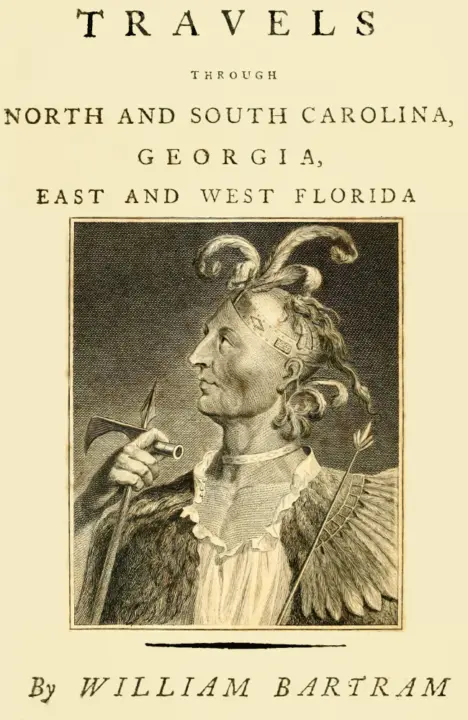
"Travels Through North and South Carolina, Georgia, East and West Florida, the Cherokee Country..." by William Bartram is a naturalist's account published in 1791. The work chronicles Bartram's four-year journey through the American South between 1773 and 1777, documenting encounters with Creek, Seminole, Cherokee, and Choctaw peoples, discoveries of plant species, and observations of unexplored territories. His sympathetic portrayal of Native Americans challenged prevailing assumptions, while his vivid descriptions influenced Romantic poets including Coleridge and Wordsworth. The book stands as both scientific documentation and literary achievement.
Introduction adapted from the source catalogue; source summaries may be automatically generated.
Free to read · English · 153,055 words · No account needed
MAKE TIME FOR A GOOD BOOK
On by default. Untick to stop anonymous reading totals. Each page counts after 10 seconds in view. How this works.
Anonymous counting is on unless you have switched it off.
The sight of this delightful and productive island, placed in front of the rising city of Sunbury, quickly induced me to explore it; which I apprehended, from former visits to this coast, would exhibit a comprehensive epitome of the history of all the sea-coast islands of Carolina and Georgia, as likewise in general of the coast of the main. And though I considered this excursion along the coast of Georgia and northern border of Florida, a deviation from the high road of my intended travels, yet I performed it in order to employ to the most advantage the time on my hands, before the treaty of Augusta came on, where I was to attend, about May or June, by desire of the Superintendant, J. Stewart, esq. who, when I was in Charleston, proposed, in order to facilitate my travels in the Indian territories, that, if I would be present at the Congress, he would introduce my business to the chiefs of the Cherokees, Creeks, and other nations, and recommend me to their friendship and protection; which promise he fully performed, and it proved of great service to me.
Obedient to the admonitions of my attendant spirit, curiosity, as well as to gratify the expectations of my worthy patron, I again sat off on my southern excursion, and left Sunbury, in company with several of its polite inhabitants, who were going to Medway meeting, a very large and well-constructed place of worship, in St. John’s parish, where I associated with them in religious exercise, and heard a very excellent sermon, delivered by their pious and truly venerable pastor, the Rev.—— Osgood. This respectable congregation is independent, and consist chiefly of families, and proselytes to a flock, which this pious man led about forty years ago, from South Carolina, and settled in this fruitful district. It is about nine miles from Sunbury to Medway meeting-house, which stands on the high road, opposite the Sunbury road. As soon as the congregation broke up, I re-assumed my travels, proceeding down the high road, towards Fort Barrington, on the Alatamaha, passing through a level country, well watered by large streams, branches of Medway and Newport rivers, coursing from extensive swamps and marshes, their sources: these swamps are daily clearing and improving into large fruitful rice plantations, aggrandizing the well inhabited and rich district of St. John’s parish. The road is straight, spacious, and kept in excellent repair by the industrious inhabitants; and is generally bordered on each side with a light grove, consisting of the following trees and shrubs: Myrica Cerifera, Calycanthus, Halesia tetraptera, Itea stewartia, Andromeda nitida, Cyrella racemiflora, entwined with bands and garlands of Bignonia sempervirens, B. crucigera, Lonicera sempervirens and Glycene frutescens; these were overshadowed by tall and spreading trees, as the Magnolia grandiflora, Liquid ambar, Liriodendron, Catalpa, Quercus sempervirens, Quercus dentata, Q. Phillos; and on the verges of the canals, where the road was causwayed, stood the Cupressus disticha, Gordonia Lacianthus, and Magnolia glauca, all planted by nature, and left standing, by the virtuous inhabitants, to shade the road and perfume the sultry air. The extensive plantations of rice and corn, now in early verdure, decorated here and there with groves of floriferous and fragrant trees and shrubs, under the cover and protection of pyramidal laurels and plumed palms, which now and then break through upon the sight from both sides of the way as we pass along; the eye at intervals stealing a view at the humble, but elegant and neat habitation, of the happy proprietor, amidst arbours and groves, all day, and moon-light nights, filled with the melody of the cheerful mockbird, warbling nonpareil, and plaintive turtle-dove, altogether present a view of magnificence and joy, inexpressibly charming and animating.
Your reading position is saved on this browser. Take it to another device with a library code. Reading pages adapt to text, rather than matching a printed edition.
BEHIND THE BOOK
This eBook is for the use of anyone anywhere in the United States and most other parts of the world at no cost and with almost no restrictions whatsoever. You may copy it, give it away or re-use it under the terms of the Project Gutenberg License included with this eBook or online at www.gutenberg.org. If you are not located in the United States, you will have to check the laws of the country where you are located before using this eBook. Read the source licence.
The original source file, including credits and licence, is retained by this library. Request an original-format copy at no charge. Please include the book title and Project Gutenberg identifier #63678.
KEEP YOUR CURIOSITY GOING
Wilfrid Scawen Blunt
Wilfrid Scawen Blunt

E. W. (Edgar Watson) Howe
Cécile Tormay

Moritz Busch
John L. Ransom