THE CLASSIC COLLECTION✦My diaries, being a personal narrative of events 1888-1914, Part 2 (1900-1914)CLASSIC FREE BOOKS
My diaries, being a personal narrative of events 1888-1914, Part 2 (1900-1914)
Wilfrid Scawen Blunt
THE CLASSIC COLLECTION · 1791
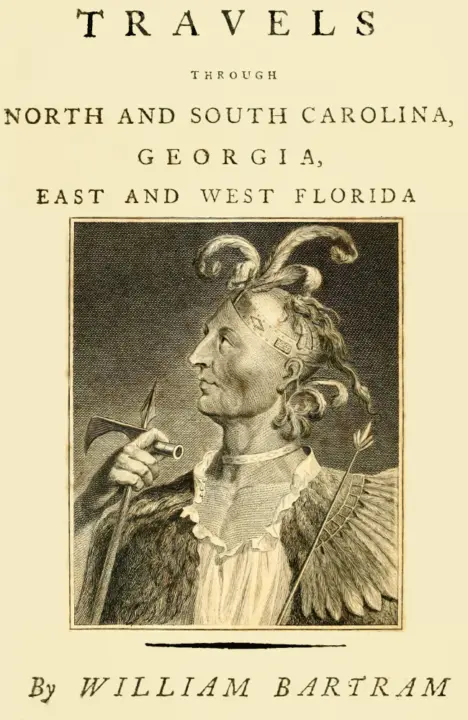
"Travels Through North and South Carolina, Georgia, East and West Florida, the Cherokee Country..." by William Bartram is a naturalist's account published in 1791. The work chronicles Bartram's four-year journey through the American South between 1773 and 1777, documenting encounters with Creek, Seminole, Cherokee, and Choctaw peoples, discoveries of plant species, and observations of unexplored territories. His sympathetic portrayal of Native Americans challenged prevailing assumptions, while his vivid descriptions influenced Romantic poets including Coleridge and Wordsworth. The book stands as both scientific documentation and literary achievement.
Introduction adapted from the source catalogue; source summaries may be automatically generated.
Free to read · English · 153,055 words · No account needed
MAKE TIME FOR A GOOD BOOK
On by default. Untick to stop anonymous reading totals. Each page counts after 10 seconds in view. How this works.
Anonymous counting is on unless you have switched it off.
As their vigils and manner of conducting their vespers and mystical fire in this rotunda, are extremely singular, and altogether different from the customs and usages of any other people, I shall proceed to describe them. In the first place, the governor or officer who has the management of this business, with his servants attending, orders the black drink to be brewed, which is a decoction or infusion of the leaves and tender shoots of the Cassine: this is done under an open shed or pavilion, at twenty or thirty yards distance, directly opposite the door of the council-house. Next he orders bundles of dry canes to be brought in: these are previously split and broken in pieces to about the length of two feet, and then placed obliquely crossways upon one another on the floor, forming a spiral circle round about the great centre pillar, rising to a foot or eighteen inches in height from the ground; and this circle spreading as it proceeds round and round, often repeated from right to left, every revolution increases its diameter, and at length extends to the distance of ten or twelve feet from the centre, more or less, according to the length of time the assembly or meeting is to continue. By the time these preparations are accomplished, it is night, and the assembly have taken their seats in order. The exterior extremity or outer end of the spiral circle takes fire and immediately rises into a bright flame (but how this is effected I did not plainly apprehend; I saw no person set fire to it; there might have been fire left on the earth, however I neither saw nor smelt fire or smoke until the blaze instantly ascended upwards), which gradually and slowly creeps round the centre pillar, with the course of the sun, feeding on the dry canes, and affords a cheerful, gentle and sufficient light until the circle is consumed, when the council breaks up. Soon after this illumination takes place, the aged chiefs and warriors being seated on their cabins or sophas, on the side of the house opposite the door, in three classes or ranks, rising a little, one above or behind the other; and the white people and red people of confederate towns in the like order on the left hand; a transverse range of pillars, supporting a thin clay wall about breast high, separates them: the king’s cabin or seat is in front; the next to the back of it the head warrior’s; and the third or last accommodates the young warriors, &c. The great war chief’s seat or place is on the same cabin with, and immediately to the left hand of the king, and next to the white people, and to the right hand of the mico or king the most venerable head men and warriors are seated. The assembly being now seated in order, and the house illuminated, two middle-aged men, who perform the office of slaves or servants, pro tempore, come in together at the door, each having very large conch shells full of black drink, advancing with slow, uniform and steady steps, their eyes or countenances lifted up, singing very low but sweetly, they come within six on eight paces of the king’s and white people’s cabins, when they stop together, and each rests his shell on a tripos or little table, but presently takes it up again, and, bowing very low, advances obsequiously, crossing or intersecting each other about midway: he who rested his shell before the white people now stands before the king, and the other who stopped before the king stands before the white people; when each presents his shell, one to the king and the other to the chief of the white people, and as soon as he raises it to his mouth, the slave utters or sings two notes, each of which continues as long as he has breath, and as long as these notes continue, so long must the person drink, or at least keep the shell to his mouth. These two long notes are very solemn, and at once strike the imagination with a religious awe or homage to the Supreme, sounding somewhat like a-hoo—ojah and a-lu—yah. After this manner the whole assembly are treated, as long as the drink and light continue to hold out, and as soon as the drinking begins, tobacco and pipes are brought. The skin of a wild cat or young tyger stuffed with tobacco is brought, and laid at the king’s feet, with the great or royal pipe beautifully adorned; the skin is usually of the animals of the king’s family or tribe, as the wild cat, otter, bear, rattle-snake, &c. A skin of tobacco is likewise brought and cast at the feet of the white chief of the town, and from him it passes from one to another to fill their pipes from, though each person has besides his own peculiar skin of tobacco. The king or chief smokes first in the great pipe a few whiffs, blowing it off ceremoniously, first towards the sun, or as it is generally supposed to the Great Spirit, for it is puffed upwards, next towards the four cardinal points, then towards the white people in the house; then the great pipe is taken from the hand of the mico by a slave, and presented to the chief white man, and then to the great war chief, whence it circulates through the rank of head men and warriors, then returns to the king. After this each one fills his pipe from his own or his neighbour’s skin.
Your reading position is saved on this browser. Take it to another device with a library code. Reading pages adapt to text, rather than matching a printed edition.
BEHIND THE BOOK
This eBook is for the use of anyone anywhere in the United States and most other parts of the world at no cost and with almost no restrictions whatsoever. You may copy it, give it away or re-use it under the terms of the Project Gutenberg License included with this eBook or online at www.gutenberg.org. If you are not located in the United States, you will have to check the laws of the country where you are located before using this eBook. Read the source licence.
The original source file, including credits and licence, is retained by this library. Request an original-format copy at no charge. Please include the book title and Project Gutenberg identifier #63678.
KEEP YOUR CURIOSITY GOING
Wilfrid Scawen Blunt
Wilfrid Scawen Blunt

E. W. (Edgar Watson) Howe
Cécile Tormay

Moritz Busch
John L. Ransom