THE CLASSIC COLLECTION✦My diaries, being a personal narrative of events 1888-1914, Part 2 (1900-1914)CLASSIC FREE BOOKS
My diaries, being a personal narrative of events 1888-1914, Part 2 (1900-1914)
Wilfrid Scawen Blunt
THE CLASSIC COLLECTION · 1791
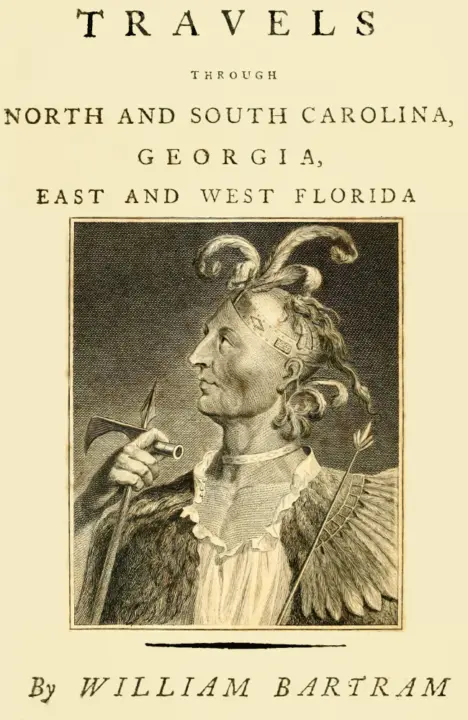
"Travels Through North and South Carolina, Georgia, East and West Florida, the Cherokee Country..." by William Bartram is a naturalist's account published in 1791. The work chronicles Bartram's four-year journey through the American South between 1773 and 1777, documenting encounters with Creek, Seminole, Cherokee, and Choctaw peoples, discoveries of plant species, and observations of unexplored territories. His sympathetic portrayal of Native Americans challenged prevailing assumptions, while his vivid descriptions influenced Romantic poets including Coleridge and Wordsworth. The book stands as both scientific documentation and literary achievement.
Introduction adapted from the source catalogue; source summaries may be automatically generated.
Free to read · English · 153,055 words · No account needed
MAKE TIME FOR A GOOD BOOK
On by default. Untick to stop anonymous reading totals. Each page counts after 10 seconds in view. How this works.
Anonymous counting is on unless you have switched it off.
About the middle of the afternoon, we were joyfully surprised at the distant prospect of the trading company coming up, and we soon met, saluting each other several times with a general Indian whoop, or shout of friendship; then each company came to camp within a few paces of each other; and before night I struck up a bargain with them for a handsome strong young horse, which cost me about ten pounds sterling. I was now constrained to leave my old slave behind, to feed in rich cane pastures, where he was to remain and recruit until the return of his new master from Mobile; from whom I extorted a promise to use him gently, and if possible, not to make a pack-horse of him.
Next morning we decamped, proceeding again on my travels, now alert and cheerful. Crossed a brisk rivulet ripling over a gravelly bed, and winding through aromatic groves of the Illicium Floridanum, then gently descended to the high forests, leaving Deadman’s creek, for at this creek a white man was found dead, supposed to have been murdered, from which circumstance it has its name.
A few days before we arrived at the Nation we met a company of emigrants from Georgia; a man, his wife, a young woman, several young children and three stout young men, with about a dozen horses loaded with their property. They informed us their design was to settle on the Alabama, a few miles above the confluence of the Tombigbe.
Being now near the Nation, the chief trader with another of our company sat off ahead for his town, to give notice to the Nation, as he said, of his approach with the merchandize, each of them taking the best horse they could pick out of the gang, leaving the goods to the conduct and care of the young Mustee and myself. Early in the evening we came to the banks of a large deep creek, a considerable branch of the Alabama: the waters ran furiously, being overcharged with the floods of rain which had fallen the day before. We discovered immediately that there was no possibility of crossing it by fording; its depth and rapidity would have swept our horses, loads and all, instantly from our sight: my companion, after consideration, said we must make a raft to ferry over our goods, which we immediately set about, after unloading our horses and turning them out to range. I undertook to collect dry canes, and my companion, dry timber or logs and vines to bind them together: having gathered the necessary materials, and laid them in order on the brink of the river, ready to work upon, we betook ourselves to repose, and early next morning sat about building our raft. This was a novel scene to me, and I could not, until finished and put to practice, well comprehend how it could possibly answer the effect desired. In the first place we laid, parallel to each other, dry, sound trunks of trees, about nine feet in length, and eight or nine inches diameter, which binding fast together with grape vines and withs, until we had formed this first floor, about twelve or fourteen feet in length, we then bound the dry canes in bundles, each near as thick as a man’s body, with which we formed the upper stratum, laying them close by the side of each other and binding them fast; after this manner our raft was constructed. Then having two strong grape vines, each long enough to cross the river, we fastened one to each end of the raft, which now being completed, and loading on as much as it would safely carry, the Indian took the end of one of the vines in his mouth, plunged into the river and swam over with it, and the vine fixed to the other end was committed to my charge, to steady the raft and haul it back again after being unloaded. As soon as he had safe landed and hauled taught his vine, I pushed off the raft, which he drew over as quick as possible, I steadying it with my vine: in this manner, though with inexpressible danger of losing our effects, we ferried all safe over. The last load, with other articles, contained my property, with all my clothes, which I stripped off, except my breeches, for they contained matters of more value and consequence than all the rest of my property put together; besides I did not choose to expose myself entirely naked to the alligators and serpents in crossing the flood. Now seeing all the goods safe over, and the horses at a landing place on the banks of the river about fifty yards above, I drove them all in together, when, seeing them safe landed, I plunged in after them, and being a tollerable swimmer, soon reached the opposite shore. But my difficulties at this place were not yet at an end, for our horses all landed just below the mouth of a considerable branch of this river, of fifteen or twenty feet width, and its perpendicular banks almost as many feet in height above its swift waters, over which we were obliged to carry every article of our effects, and this by no other bridge than a sapling felled across it, which is called a raccoon bridge, and over this my Indian friend would trip as quick and light as that quadruped, with one hundred weight of leather on his back, when I was scarcely able to shuffle myself along over it astride. At last having re-packed and sat off again, without any material occurrence intervening, in the evening we arrived at the banks of the great Tallapoose river, and came to camp under shelter of some Indian cabins, in expansive fields, close to the river bank, opposite the town of Savannuca. Late in the evening a young white man, in great haste and seeming confusion, joined our camp, who immediately related, that being on his journey from Pensacola, it happened that the very night after we had passed the company of emigrants, he met them and joined their camp in the evening, when, just at dark, the Chactaws surrounded them, plundered their camp and carried all the people off captive, except himself, he having the good fortune to escape with his horse, though closely pursued.
Your reading position is saved on this browser. Take it to another device with a library code. Reading pages adapt to text, rather than matching a printed edition.
BEHIND THE BOOK
This eBook is for the use of anyone anywhere in the United States and most other parts of the world at no cost and with almost no restrictions whatsoever. You may copy it, give it away or re-use it under the terms of the Project Gutenberg License included with this eBook or online at www.gutenberg.org. If you are not located in the United States, you will have to check the laws of the country where you are located before using this eBook. Read the source licence.
The original source file, including credits and licence, is retained by this library. Request an original-format copy at no charge. Please include the book title and Project Gutenberg identifier #63678.
KEEP YOUR CURIOSITY GOING
Wilfrid Scawen Blunt
Wilfrid Scawen Blunt

E. W. (Edgar Watson) Howe
Cécile Tormay

Moritz Busch
John L. Ransom