THE CLASSIC COLLECTION✦My diaries, being a personal narrative of events 1888-1914, Part 2 (1900-1914)CLASSIC FREE BOOKS
My diaries, being a personal narrative of events 1888-1914, Part 2 (1900-1914)
Wilfrid Scawen Blunt
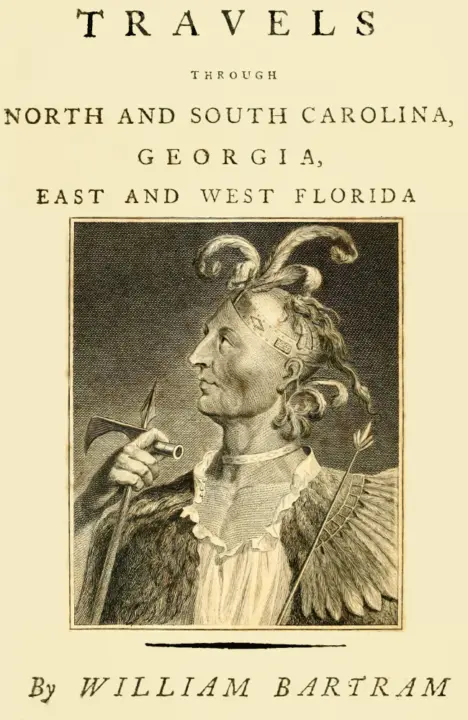
THE CLASSIC COLLECTION · 1791
"Travels Through North and South Carolina, Georgia, East and West Florida, the Cherokee Country..." by William Bartram is a naturalist's account published in 1791. The work chronicles Bartram's four-year journey through the American South between 1773 and 1777, documenting encounters with Creek, Seminole, Cherokee, and Choctaw peoples, discoveries of plant species, and observations of unexplored territories. His sympathetic portrayal of Native Americans challenged prevailing assumptions, while his vivid descriptions influenced Romantic poets including Coleridge and Wordsworth. The book stands as both scientific documentation and literary achievement.
Introduction adapted from the source catalogue; source summaries may be automatically generated.
Free to read · English · 153,055 words · No account needed
MAKE TIME FOR A GOOD BOOK
On by default. Untick to stop anonymous reading totals. Each page counts after 10 seconds in view. How this works.
Anonymous counting is on unless you have switched it off.
For instance, Triticum Cereale, which affords us bread, and is termed, by way of eminence, the staff of life, the most pleasant and nourishing food to all terrestrial animals. Vitis vinifera, whose exhilarating juice is said to cheer the hearts of gods and men. Oryza, Zea, Pyrus, Pyrus malus, Prunus, Pr. cerasus, Ficus, Nectarin, Apricot, Cydonia. Next follow the illustrious families of forest-trees, as the Magnolia grandiflora and Quercus sempervirens, which form the venerated groves and solemn shades, on the Mississipi, Alatamaha and Florida; the magnificent Cupressus disticha of Carolina and Florida; the beautiful Water Oak[1], whose vast hemispheric head presents the likeness of a distant grove in the fields and savannas of Carolina; the gigantic Black Oak[2], Platanus occidentalis, Liquidambar styraciflua, Liriodendron tulipera, Fagus castanea, Fagus sylvatica, Juglans nigra, Juglans cinerea, Jug. pecan, Ulmus, Acer saccharinum, of Virginia and Pennsylvania; Pinus phœnix, Pinus tœda, Magnolia acuminata, Nyssa aquatica, Populus heterophylla and the floriferous Gordonia lasianthus, of Carolina and Florida; the exalted Pinus strobus, Pin. balsamica, Pin. abies, Pin. Canadensis, Pin. larix, Fraxinus excelsior, Robinia pseudacacia, Guilandina dioica, Æsculus Virginica, Magnolia acuminata, of Virginia, Maryland, Pennsylvania, New Jersey, New York, New England, Ohio and the regions of Erie and the Illinois; and the aromatic and floriferous shrubs, as Azalea coccinia, Azalea rosea, Rosa, Rhododendron, Kalmia, Syringa, Gardenia, Calycanthus, Daphne, Franklinia, Styrax and others equally celebrated.
In every order of nature, we perceive a variety of qualities distributed amongst individuals, designed for different purposes and uses; yet it appears evident, that the great Author has impartially distributed his favours to his creatures, so that the attributes of each one seem to be of sufficient importance to manifest the divine and inimitable workmanship. The pompous Palms of Florida, and glorious Magnolia, strikes us with the sense of dignity and magnificence; the expansive umbrageous Live-Oak[3] with awful veneration, the Carica papaya, supercilious with all the harmony of beauty and gracefulness; the Lillium superbum represents pride and vanity; Kalmia latifolia and Azalea coccinea, exhibit a perfect show of mirth and gaiety; the Illicium Floridanum, Crinum Floridanum, Convallaria majalis of the Cherokees, and Calycanthus floridus, charm with their beauty and fragrance. Yet they are not to be compared for usefulness with the nutritious Triticum, Zea, Oryza, Solanum tuberosum, Musa, Convolvulus, Batata, Rapa, Orchis, Vitis vinifera, Pyrus, Olea; for clothing with Linum Cannabis, Gossypium, Morus; for medical virtues, Hyssopus, Thymus, Anthemis nobilis, Papaver somniferum, Quinquina, Rheum rhabarbarum, Pisum, &c. Though none of these most useful tribes are conspicuous for stateliness, figure or splendour, yet their valuable qualities and virtues, excite love, gratitude and adoration to the great Creator, who was such to endow them with such eminent qualities, and reveal them to us for our sustenance, amusement, and delight.
Your reading position is saved on this browser. Take it to another device with a library code. Reading pages adapt to text, rather than matching a printed edition.
BEHIND THE BOOK
This eBook is for the use of anyone anywhere in the United States and most other parts of the world at no cost and with almost no restrictions whatsoever. You may copy it, give it away or re-use it under the terms of the Project Gutenberg License included with this eBook or online at www.gutenberg.org. If you are not located in the United States, you will have to check the laws of the country where you are located before using this eBook. Read the source licence.
The original source file, including credits and licence, is retained by this library. Request an original-format copy at no charge. Please include the book title and Project Gutenberg identifier #63678.
KEEP YOUR CURIOSITY GOING
Wilfrid Scawen Blunt
Wilfrid Scawen Blunt

E. W. (Edgar Watson) Howe
Cécile Tormay

Moritz Busch
John L. Ransom