THE CLASSIC COLLECTION✦My diaries, being a personal narrative of events 1888-1914, Part 2 (1900-1914)CLASSIC FREE BOOKS
My diaries, being a personal narrative of events 1888-1914, Part 2 (1900-1914)
Wilfrid Scawen Blunt
THE CLASSIC COLLECTION · 1791
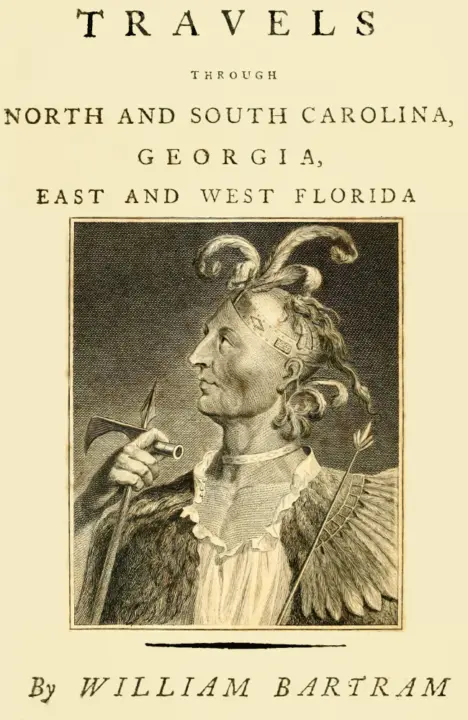
"Travels Through North and South Carolina, Georgia, East and West Florida, the Cherokee Country..." by William Bartram is a naturalist's account published in 1791. The work chronicles Bartram's four-year journey through the American South between 1773 and 1777, documenting encounters with Creek, Seminole, Cherokee, and Choctaw peoples, discoveries of plant species, and observations of unexplored territories. His sympathetic portrayal of Native Americans challenged prevailing assumptions, while his vivid descriptions influenced Romantic poets including Coleridge and Wordsworth. The book stands as both scientific documentation and literary achievement.
Introduction adapted from the source catalogue; source summaries may be automatically generated.
Free to read · English · 153,055 words · No account needed
MAKE TIME FOR A GOOD BOOK
On by default. Untick to stop anonymous reading totals. Each page counts after 10 seconds in view. How this works.
Anonymous counting is on unless you have switched it off.
Next morning I arose early, continuing my voyage; passing by, on each hand, high forests and rich swamps, and frequently ruins of ancient French plantations; the Canes, and Cypress trees of an astonishing magnitude, as were the trees of other tribes, indicating an excellent soil. Came to at noon, and advancing forward from the river, and penetrating the awful shades, passed between the stately columns of the Magnolia grandiflora, and came to the ascents supporting the high forests and expansive plains above—What a sylvan scene is here! the pompous Magnolia, reigns sovereign of the forests; how sweet the aromatic Illicium groves! how gaily flutter the radiated wings of the Magnolia auriculata, each branch supporting an expanded umbrella, superbly crested with a silver plume, fragrant blossom, or crimson studded strobile and fruits! I recline on the verdant bank, and view the beauties of the groves. Æsculus pavia, Prunus nemoralis, floribus racemosis, foliis sempervirentibus, nitidis, Æsculus alba, Hydrangia quercifolia, Cassine, Magnolia pyramidata, foliis ovatis, oblongis, acuminatis, basi auriculatis, strobilo oblongo ovato, Myrica, Rhamnus frangula, Halesea, Bignonia, Azalea, Lonicera, Sideroxylon, with many more.
Returned to the river, re-embarked, and at evening came to, in sight of the confluence or junction of the two large arms of the great Mobile river i. e. the Tombigbe or Chicasaw with the Alabama or Coosau. About one hundred and fifty miles above this conflux at Ft. Thoulouse, the Alabama receives into it from the East the great Talapoose river, when the former takes the name of Coosau, which it bears to its source, which is in the So. West promontories of the Cherokee or Apalachian Mountains in the Chickasaw territories.
Observed very large alligators, basking on the shores, as well as swimming in the river and lagoons.
Next morning entered the Tombigbe, and ascended that fine river. Just within its capes, on the left hand is a large lagoon, or capacious bay of still water, containing many acres in surface, which at a distant view presents a very singular and diverting scene; a delusive green wavy plain of the Nymphæa nelumbo: the surface of the water is overspread with its round floating leaves, whilst these are shadowed by a forest of umbrageous leaves with gay flowers, waving to and fro on flexible stems, three or four feet high: these fine flowers are double as a rose, and when expanded are seven or eight inches in diameter, of a lively lemon yellow colour. The seed vessel when ripe, is a large truncated, dry porous capsule, its plane or disk regularly perforated, each cell containing an oval osseous gland or nut, of the size of a filbert; when these are fully grown, before they become quite hard, they are sweet and pleasant eating, and taste like chesnuts: I fed freely on them without any injury, but found them laxative. I have observed this aquatic plant, in my travels along the Eastern shores of this continent, in the large rivers and lakes, from New-Jersey to this place, particularly in a large pond or lake near Cape Fear river in North Carolina, which is about two miles over and twelve feet water, notwithstanding which its surface is almost covered with the leaves of this plant; it also abounds in Wakamaw lake near the same river, and in Savanna river at Augusta, and all over East Florida.
Your reading position is saved on this browser. Take it to another device with a library code. Reading pages adapt to text, rather than matching a printed edition.
BEHIND THE BOOK
This eBook is for the use of anyone anywhere in the United States and most other parts of the world at no cost and with almost no restrictions whatsoever. You may copy it, give it away or re-use it under the terms of the Project Gutenberg License included with this eBook or online at www.gutenberg.org. If you are not located in the United States, you will have to check the laws of the country where you are located before using this eBook. Read the source licence.
The original source file, including credits and licence, is retained by this library. Request an original-format copy at no charge. Please include the book title and Project Gutenberg identifier #63678.
KEEP YOUR CURIOSITY GOING
Wilfrid Scawen Blunt
Wilfrid Scawen Blunt

E. W. (Edgar Watson) Howe
Cécile Tormay

Moritz Busch
John L. Ransom