THE CLASSIC COLLECTION✦My diaries, being a personal narrative of events 1888-1914, Part 2 (1900-1914)CLASSIC FREE BOOKS
My diaries, being a personal narrative of events 1888-1914, Part 2 (1900-1914)
Wilfrid Scawen Blunt
THE CLASSIC COLLECTION · 1791
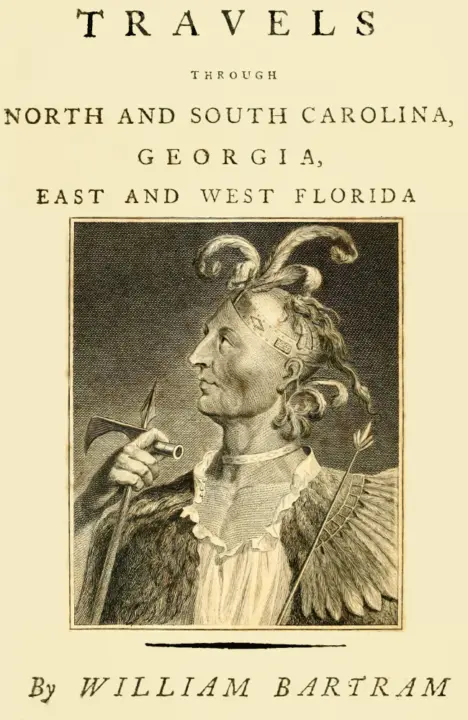
"Travels Through North and South Carolina, Georgia, East and West Florida, the Cherokee Country..." by William Bartram is a naturalist's account published in 1791. The work chronicles Bartram's four-year journey through the American South between 1773 and 1777, documenting encounters with Creek, Seminole, Cherokee, and Choctaw peoples, discoveries of plant species, and observations of unexplored territories. His sympathetic portrayal of Native Americans challenged prevailing assumptions, while his vivid descriptions influenced Romantic poets including Coleridge and Wordsworth. The book stands as both scientific documentation and literary achievement.
Introduction adapted from the source catalogue; source summaries may be automatically generated.
Free to read · English · 153,055 words · No account needed
MAKE TIME FOR A GOOD BOOK
On by default. Untick to stop anonymous reading totals. Each page counts after 10 seconds in view. How this works.
Anonymous counting is on unless you have switched it off.
We now enter a very remarkable grove of Dog wood trees (Cornus Florida), which continued nine or ten miles unalterable, except here and there a towering Magnolia grandiflora; the land on which they stand is an exact level; the surface a shallow, loose, black mould, on a stratum of stiff, yellowish clay. These trees were about twelve feet high, spreading horizontally; their limbs meeting and interlocking with each other, formed one vast, shady, cool grove, so dense and humid as to exclude the sun-beams and prevent the intrusion of almost every other vegetable, affording us a most desirable shelter from the fervid sun-beams at noon-day. This admirable grove by way of eminence has acquired the name of the Dog woods.
During a progress of near seventy miles, through this high forest, there constantly presented to view on one hand or the other, spacious groves of this fine flowering tree, which must, in the spring season, when covered with blosoms present a most pleasing scene; when at the same time a variety of other sweet shrubs display their beauty, adorned in their gay apparel, as the Halesia, Stewartia, Æsculus pavia, Æsc. alba, Æsc. Florid. ramis divaricatis, thyrsis grandis, flosculis expansis incarnatis, Azalea, &c. entangled with garlands of Bignonia crucigera, Big. radicans, Big. sempervirens, Glycine frutescens, Lonicera sempervirens, &c. and at the same time the superb Magnolia grandiflora, standing in front of the dark groves, towering far above the common level.
The evening cool, we encamped on the banks of a glittering rivulet amidst a spicy grove of the Illicium Floridanum.
Early next morning we arose, hunted up our horses and proceeded on, continuing about twenty miles, over a district which presented to view another landscape; expansive plains of Cane meadows, and detached groves, contrasted by swelling ridges, and vales supporting grand forests of the trees already noted, embellished with delightful creeks and brooks, their low grounds producing very tall canes, and their higher banks groves of the Illicium, Callicanthus, Stewartia, Halesia, Styrax and others, particulary Magnolia auriculata. In the evening we forded the river Schambe about fifty yards over, the stream active but shallow, which carries its waters into the bay of Pensacola. Came to camp on the banks of a beautiful creek, by a charming grove of the Illicium Floridanum; from this we travelled over a level country above fifty miles, very gently but perceptibly descending south-eastward before us; this district exhibited a landscape very different from what had presented to view since we left the nation, and not much unlike the low countries of Carolina; it is in fact one vast flat grassy savanna and Cane meadows, intersected or variously scrolled over with narrow forests and groves, on the banks of creeks and rivulets, or hommocks and swamps at their sources; with long leaved Pines, scatteringly planted, amongst the grass, and on the high sandy knolls and swelling ridges, Quercus nigra, Quercus flammula, Quercus incana, with various other trees and shrubs as already noted, inhabiting such situations. The rivulets however exhibited a different appearance, they are shallower, course more swift over gravelly beds, and their banks adorned with Illicium groves, Magnolias, Azaleas, Halesia, Andromedas, &c. The highest hills near large creeks afford high forests with abundance of Chesnut trees.
Your reading position is saved on this browser. Take it to another device with a library code. Reading pages adapt to text, rather than matching a printed edition.
BEHIND THE BOOK
This eBook is for the use of anyone anywhere in the United States and most other parts of the world at no cost and with almost no restrictions whatsoever. You may copy it, give it away or re-use it under the terms of the Project Gutenberg License included with this eBook or online at www.gutenberg.org. If you are not located in the United States, you will have to check the laws of the country where you are located before using this eBook. Read the source licence.
The original source file, including credits and licence, is retained by this library. Request an original-format copy at no charge. Please include the book title and Project Gutenberg identifier #63678.
KEEP YOUR CURIOSITY GOING
Wilfrid Scawen Blunt
Wilfrid Scawen Blunt

E. W. (Edgar Watson) Howe
Cécile Tormay

Moritz Busch
John L. Ransom