THE CLASSIC COLLECTION✦My diaries, being a personal narrative of events 1888-1914, Part 2 (1900-1914)CLASSIC FREE BOOKS
My diaries, being a personal narrative of events 1888-1914, Part 2 (1900-1914)
Wilfrid Scawen Blunt
THE CLASSIC COLLECTION · 1791
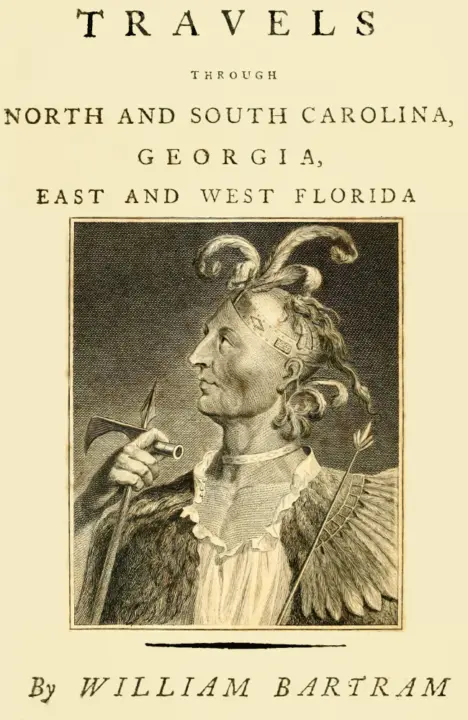
"Travels Through North and South Carolina, Georgia, East and West Florida, the Cherokee Country..." by William Bartram is a naturalist's account published in 1791. The work chronicles Bartram's four-year journey through the American South between 1773 and 1777, documenting encounters with Creek, Seminole, Cherokee, and Choctaw peoples, discoveries of plant species, and observations of unexplored territories. His sympathetic portrayal of Native Americans challenged prevailing assumptions, while his vivid descriptions influenced Romantic poets including Coleridge and Wordsworth. The book stands as both scientific documentation and literary achievement.
Introduction adapted from the source catalogue; source summaries may be automatically generated.
Free to read · English · 153,055 words · No account needed
MAKE TIME FOR A GOOD BOOK
On by default. Untick to stop anonymous reading totals. Each page counts after 10 seconds in view. How this works.
Anonymous counting is on unless you have switched it off.
Thus we see that war or the exercise of arms originates from the same motives, and operates in the spirits of the wild red men of America, as it formerly did with the renowned Greeks and Romans or modern civilized nations, and not from a ferocious, capricious desire of sheding human blood as carnivorous savages: neither does the eager avarice of plunder stimulate them to acts of madness and cruelty, that being a trifling object in their estimation, a duffield blanket, a polished rifle gun, or embroidered mantle; no, their martial prowess and objects of desire and ambition proceed from greater principles and more magnanimous intentions, even that of reuniting all nations and languages under one universal confederacy or commonwealth.
The vegetable productions in the rich low ground, near the banks of this great river, of trees and shrubs, are as follow; Platanus occidentalis, Liriodendron tulipifera, Populus heterophylla, Laurus sassafras, Laurus Borbonia, Laurus benzoin, Betula lenta, Salix fluvialis, Magnolia grandiflora, Annona glabra, Ulmus campestris, Ulmus suberifera, Carpinus, Quercus, various species, Juglans, various species, Æsculus pavia, Æsculus sylvatica, s. Virginiana, Morus, Hopea tinctoria, Fagus sylvatica, of surprising magnitude and comeliness, &c. The land rises from the river with sublime magnificence, gradually retreating by flights or steps one behind and above the other, in beautiful theatrical order, each step or terrace holding up a level plain; and as we travel back from the river, the steps are higher, and the corresponding levels are more and more expansive: the ascents produce grand high forests, and the plains present to view a delightful varied landscape, consisting of extensive grassy fields, detached groves of high forest trees, and clumps of lower trees, evergreen shrubs and herbage; green knolls, with serpentine, wavy, glittering brooks coursing through the green plains, and dark promontories, or obtuse projections of the side-long acclivities, alternately advancing or receding on the verge of the illumined native fields, to the utmost extent of sight. The summits of the acclivities afford, besides the forest trees already recited, Halesia, Ptelea, Circis, Cornus Florida and Amorpha. The upper mound or terrace holds up a dilated level plain of excellent land, for the distance of five or six miles in width, which is a high forest of the majestic trees already mentioned, as Quercus tinctoria, Juglans nigra, Morus, Ulmus, Telea, Gleditsia, Juglans hickory, &c. The land after this distance, though almost flat and level, becomes leaner; the vegetative mould or surface is shallower, on a stratum of tenacious humid clay, for the distance of fifteen or twenty miles, more or less, according to the distance of the next great river; presenting to our view a fine expanse of level grassy plains, detached forests and groves of Quercus alba, Q. lobata, Q. phillos, Q. hemispherica, Q. aquatica, with entire groves of the splendid Nyssa sylvatica and perfumed Liquidambar styraciflua, vast Cane meadows, and lastly a chain of grassy savannas. Immediately from this we began to ascend gradually the most elevated, gravelly and stony ridge, consisting of parallel chains of broken swelling hills, the very highest chain frequently presenting to view cliffs of the ferruginous rocks and red clay already noticed. This last mentioned high ridge divides the waters of the great rivers from each other, whence arise the sources of their numerous lateral branches, gradually increasing as they wind about the hills, fertilizing the vales and level plains, by their inundations, as they pour forth from the vast humid forests and shaded prolific hills and lastly, flow down, with an easy meandering, steady course, into the rivers to which they are tributary.
Your reading position is saved on this browser. Take it to another device with a library code. Reading pages adapt to text, rather than matching a printed edition.
BEHIND THE BOOK
This eBook is for the use of anyone anywhere in the United States and most other parts of the world at no cost and with almost no restrictions whatsoever. You may copy it, give it away or re-use it under the terms of the Project Gutenberg License included with this eBook or online at www.gutenberg.org. If you are not located in the United States, you will have to check the laws of the country where you are located before using this eBook. Read the source licence.
The original source file, including credits and licence, is retained by this library. Request an original-format copy at no charge. Please include the book title and Project Gutenberg identifier #63678.
KEEP YOUR CURIOSITY GOING
Wilfrid Scawen Blunt
Wilfrid Scawen Blunt

E. W. (Edgar Watson) Howe
Cécile Tormay

Moritz Busch
John L. Ransom