THE CLASSIC COLLECTION✦My diaries, being a personal narrative of events 1888-1914, Part 2 (1900-1914)CLASSIC FREE BOOKS
My diaries, being a personal narrative of events 1888-1914, Part 2 (1900-1914)
Wilfrid Scawen Blunt
THE CLASSIC COLLECTION · 1791
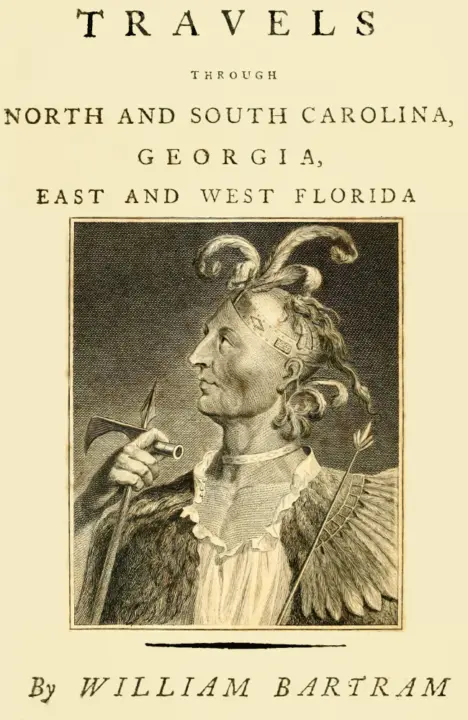
"Travels Through North and South Carolina, Georgia, East and West Florida, the Cherokee Country..." by William Bartram is a naturalist's account published in 1791. The work chronicles Bartram's four-year journey through the American South between 1773 and 1777, documenting encounters with Creek, Seminole, Cherokee, and Choctaw peoples, discoveries of plant species, and observations of unexplored territories. His sympathetic portrayal of Native Americans challenged prevailing assumptions, while his vivid descriptions influenced Romantic poets including Coleridge and Wordsworth. The book stands as both scientific documentation and literary achievement.
Introduction adapted from the source catalogue; source summaries may be automatically generated.
Free to read · English · 153,055 words · No account needed
MAKE TIME FOR A GOOD BOOK
On by default. Untick to stop anonymous reading totals. Each page counts after 10 seconds in view. How this works.
Anonymous counting is on unless you have switched it off.
After I left the graves, the ample vale soon offered on my right hand, through the tall forest trees, charming views, which exhibited a pleasing contrast, immediately out of the gloomy shades and scenes of death, into expansive, lucid, green, flowery fields, expanding between retiring hills and turfy eminences, the rapid Tanase gliding through, as a vast serpent rushing after his prey.
My winding path now leads me again over the green fields into the meadows, sometimes visiting the decorated banks of the river, as it meanders through the meadows, or boldy sweeps along the bases of the mountains, its surface receiving the images reflected from the flowery banks above.
Thus was my agreeable progress for about fifteen miles, since I came upon the sources of the Tanase, at the head of this charming vale: in the evening espying a human habitation at the foot of the sloping green hills, beneath lofty forests of the mountains on the left hand, and at the same time observing a man crossing the river from the opposite shore in a canoe and coming towards me, I waited his approach, who hailing me, I answered I was for Cowe; he entreated me very civilly to call at his house, adding, that he would presently come to me.
I was received and entertained here until next day with the most perfect civility. After I had dined, towards evening, a company of Indian girls, inhabitants of a village in the hills at a small distance, called, having baskets of strawberries; and this man, who kept here a trading-house, being married to a Cherokee woman of family, was indulged to keep a stock of cattle, and his helpmate being an excellent house-wife and a very agreeable good woman, treated us with cream and strawberries.
Next morning, after breakfasting on excellent coffee, relished with bucanned venison, hot corn cakes, excellent butter and cheese, sat forwards again for Cowe, which was about fifteen miles distance, keeping the trading path which coursed through the low lands between the hills and the river, now spacious and well beaten by travellers, but somewhat intricate to a stranger, from the frequent collateral roads falling into it from villages or towns over the hills. After riding about four miles mostly through fields and plantations, the soil incredibly fertile, arrived at the town of Echoe, consisting of many good houses, well inhabited. I passed through, and continued three miles farther to Nucasse, and three miles more brought me to Whatoga. Riding through this large town, the road carried me winding about through their little plantations of Corn, Beans, &c. up to the council-house, which was a very large dome or rotunda, situated on the top of an ancient artificial mount, and here my road terminated. All before me and on every side appeared little plantations of young Corn, Beans, &c. divided from each other by narrow strips or borders of grass, which marked the bounds of each one’s property, their habitation standing in the midst. Finding no common high road to lead me through the town, I was now at a stand how to proceed farther, when observing an Indian man at the door of his habitation, three or four hundred yards distance from me, beckoning to come to him, I ventured to ride through their lots, being careful to do no injury to the young plants, the rising hopes of their labour and industry; crossed a little grassy vale watered by a silver stream, which gently undulated through, then ascended a green hill to the house, where I was cheerfully welcomed at the door, and led in by the chief, giving the care of my horse to two handsome youths, his sons. During my continuance here, about half an hour, I experienced the most perfect and agreeable hospitality conferred on me by these happy people; I mean happy in their dispositions, in their apprehensions of rectitude with regard to our social or moral conduct. O divine simplicity and truth, friendship without fallacy or guile, hospitality disinterested, native, undefiled, unmodifyed by artificial refinements!
Your reading position is saved on this browser. Take it to another device with a library code. Reading pages adapt to text, rather than matching a printed edition.
BEHIND THE BOOK
This eBook is for the use of anyone anywhere in the United States and most other parts of the world at no cost and with almost no restrictions whatsoever. You may copy it, give it away or re-use it under the terms of the Project Gutenberg License included with this eBook or online at www.gutenberg.org. If you are not located in the United States, you will have to check the laws of the country where you are located before using this eBook. Read the source licence.
The original source file, including credits and licence, is retained by this library. Request an original-format copy at no charge. Please include the book title and Project Gutenberg identifier #63678.
KEEP YOUR CURIOSITY GOING
Wilfrid Scawen Blunt
Wilfrid Scawen Blunt

E. W. (Edgar Watson) Howe
Cécile Tormay

Moritz Busch
John L. Ransom