THE CLASSIC COLLECTION✦My diaries, being a personal narrative of events 1888-1914, Part 2 (1900-1914)CLASSIC FREE BOOKS
My diaries, being a personal narrative of events 1888-1914, Part 2 (1900-1914)
Wilfrid Scawen Blunt
THE CLASSIC COLLECTION · 1791
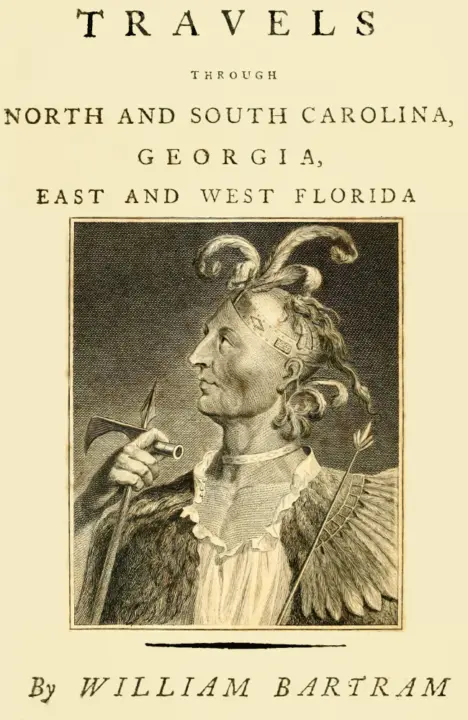
"Travels Through North and South Carolina, Georgia, East and West Florida, the Cherokee Country..." by William Bartram is a naturalist's account published in 1791. The work chronicles Bartram's four-year journey through the American South between 1773 and 1777, documenting encounters with Creek, Seminole, Cherokee, and Choctaw peoples, discoveries of plant species, and observations of unexplored territories. His sympathetic portrayal of Native Americans challenged prevailing assumptions, while his vivid descriptions influenced Romantic poets including Coleridge and Wordsworth. The book stands as both scientific documentation and literary achievement.
Introduction adapted from the source catalogue; source summaries may be automatically generated.
Free to read · English · 153,055 words · No account needed
MAKE TIME FOR A GOOD BOOK
On by default. Untick to stop anonymous reading totals. Each page counts after 10 seconds in view. How this works.
Anonymous counting is on unless you have switched it off.
After some silence the prince became more calm and easy; and returned for answer, that recollecting the former friendship and good understanding which had ever subsisted betwixt the white people and red people of the Siminole bands, and in particular, the many acts of friendship and kindness received from Mr. M’Latche, he would overlook this affront; he acknowledged his reasoning and expostulations to be just and manly, that he should suppress his resentment, and withhold his power and vengeance at present. Mr. M’Latche concluded by saying, that he was not in the least intimidated by his threats of destroying him with thunder and lightning, neither was he disposed in any manner to displease the Siminoles, and should certainly comply with his requisitions, as far as he could proceed without the advice and directions of the company; and finally agreed to supply him and his followers with such things as they stood most in need of, such as shirts, blankets and some paints, one half to be paid for directly, and the remainder to stand on credit until their return from the expedition. This determination entirely satisfied the Indians. We broke up the conference in perfect amity and good humour, and they returned to their camp and in the evening, ratified it with feasting and dancing, which continued all next day with tolerable decorum. An occurrence happened this day, by which I had an opportunity of observing their extraordinary veneration or dread of the rattle snake. I was in the forenoon busy in my apartment in the council-house, drawing some curious flowers; when, on a sudden, my attention was taken off by a tumult without, at the Indian camp. I stepped to the door opening to the piazza, where I met my friend the old interpreter, who informed me that there was a very large rattle snake in the Indian camp, which had taken possession of it, having driven the men, women and children out, and he heard them saying that they would send for Puc-Puggy (for that was the name which they had given me, signifying the Flower Hunter) to kill him or take him out of their camp. I answered that I desired to have nothing to do with him, apprehending some disagreeable consequences; and desired that the Indians might be acquainted that I was engaged in business that required application and quiet, and was determined to avoid it if possible. My old friend turned about to carry my answer to the Indians. I presently heard them approaching and calling for Puc-Puggy. Starting up to escape from their sight by a back door, a party consisting of three young fellows, richly dressed and ornamented, stepped in, and with a countenance and action of noble simplicity, amity and complaisance, requested me to accompany them to their encampment. I desired them to excuse me at this time; they plead and entreated me to go with them, in order to free them from a great rattle snake which had entered their camp; that none of them had freedom or courage to expel him; and understanding that it was my pleasure to collect all their animals and other natural productions of their land, desired that I would come with them and take him away, that I was welcome to him. I at length consented and attended on them to their encampment, where I beheld the Indians greatly disturbed indeed; the men with sticks and tomahawks, and the women and children collected together at a distance in affright and trepidation, whilst the dreaded and revered serpent leisurely traversed their camp, visiting the fire-places from one to another, picking up fragments of their provisions, and licking their platters. The men gathered around me, exciting me to remove him: being armed with a lightwood knot, I approached the reptile, who instantly collected himself in a vast coil (their attitude of defence) I cast my missile weapon at him, which luckily taking his head, dispatched him instantly, and laid him trembling at my feet. I took out my knife, severed his head from his body, then turning about, the Indians complimented me with every demonstration of satisfaction and approbation for my heroism, and friendship for them. I carried off the head of the serpent bleeding in my hand as a trophy of victory; and taking out the mortal fangs, deposited them carefully amongst my collections. I had not been long retired to my apartment, before I was again roused from it by a tumult in the yard; and hearing Puc-Puggy called on, I started up, when instantly the old interpreter met me again, and told me the Indians were approaching in order to scratch me. I asked him for what? he answered for killing the rattle snake within their camp. Before I could make any reply or effect my escape, three young fellows singing, arm in arm, came up to me. I observed one of the three was a young prince who had, on my first interview with him, declared himself my friend and protector, when he told me that if ever occasion should offer in his presence, he would risk his life to defend mine or my property. This young champion stood by his two associates, one on each side of him: the two affecting a countenance and air of displeasure and importance, instantly presenting their scratching instruments, and flourishing them, spoke boldly, and said that I was too heroic and violent, that it would be good for me to lose some of my blood to make me more mild and tame, and for that purpose they were come to scratch me. They gave me no time to expostulate or reply, but attempted to lay hold on me, which I resisted; and my friend, the young prince, interposed and pushed them off, saying that I was a brave warrior and his friend; that they should not insult me; when instantly they altered their countenance and behaviour: they all whooped in chorus, took me friendly by the hand, clapped me on the shoulder, and laid their hands on their breasts in token of sincere friendship, and laughing aloud, said I was a sincere friend to the Siminoles, a worthy and brave warrior, and that no one should hereafter attempt to injure me. They then all three joined arm in arm again and went off, shouting and proclaiming Puc-Puggy was their friend, &c. Thus it seemed that the whole was a ludicrous farce to satisfy their people, and appease the manes[41] of the dead rattle snake.
Your reading position is saved on this browser. Take it to another device with a library code. Reading pages adapt to text, rather than matching a printed edition.
BEHIND THE BOOK
This eBook is for the use of anyone anywhere in the United States and most other parts of the world at no cost and with almost no restrictions whatsoever. You may copy it, give it away or re-use it under the terms of the Project Gutenberg License included with this eBook or online at www.gutenberg.org. If you are not located in the United States, you will have to check the laws of the country where you are located before using this eBook. Read the source licence.
The original source file, including credits and licence, is retained by this library. Request an original-format copy at no charge. Please include the book title and Project Gutenberg identifier #63678.
KEEP YOUR CURIOSITY GOING
Wilfrid Scawen Blunt
Wilfrid Scawen Blunt

E. W. (Edgar Watson) Howe
Cécile Tormay

Moritz Busch
John L. Ransom