THE CLASSIC COLLECTION✦My diaries, being a personal narrative of events 1888-1914, Part 2 (1900-1914)CLASSIC FREE BOOKS
My diaries, being a personal narrative of events 1888-1914, Part 2 (1900-1914)
Wilfrid Scawen Blunt
THE CLASSIC COLLECTION · 1791
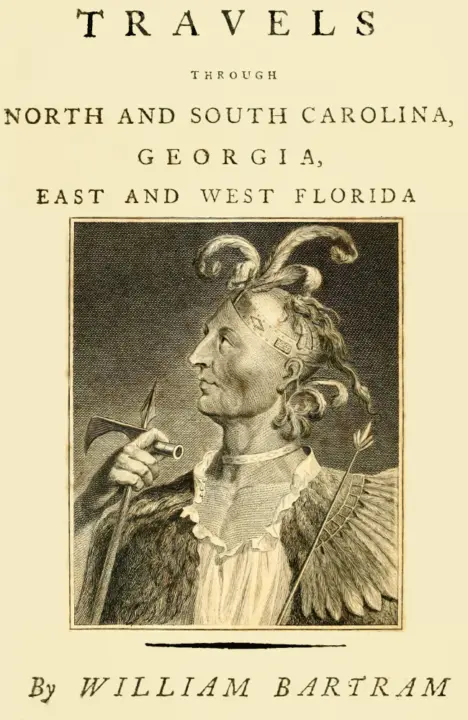
"Travels Through North and South Carolina, Georgia, East and West Florida, the Cherokee Country..." by William Bartram is a naturalist's account published in 1791. The work chronicles Bartram's four-year journey through the American South between 1773 and 1777, documenting encounters with Creek, Seminole, Cherokee, and Choctaw peoples, discoveries of plant species, and observations of unexplored territories. His sympathetic portrayal of Native Americans challenged prevailing assumptions, while his vivid descriptions influenced Romantic poets including Coleridge and Wordsworth. The book stands as both scientific documentation and literary achievement.
Introduction adapted from the source catalogue; source summaries may be automatically generated.
Free to read · English · 153,055 words · No account needed
MAKE TIME FOR A GOOD BOOK
On by default. Untick to stop anonymous reading totals. Each page counts after 10 seconds in view. How this works.
Anonymous counting is on unless you have switched it off.
On our taking leave of the king and head men, they entreated our chief to represent to the white people, their unfeigned desire to bury in oblivion the late breach of amity and intermission of commerce, which they trusted would never be reflected on the people of Talahasochte; and, lastly, that we would speedily return with merchandize as heretofore; all which was cheerfully consented to, assuring them their wishes and sentiments fully coincided with ours.
The chief trader, intending to show me some remarkable barren plains, on our return to our encampment, about noon we sat off: when we came within sight of them, I was struck with astonishment at their dreary appearance; the view Southerly seemed endless wastes, presenting rocky, gravelly and sandy barren plains, producing scarcely any vegetable substances, except a few shrubby, crooked Pine trees, growing out of heaps of white rocks, which represented ruins of villages, planted over the plains; with clumps of mean shrubs, which served only to perpetuate the persecuting power and rage of fire, and to testify the aridity of the soil. The shrubs I observed were chiefly the following, Myrica cerifera, two or three varieties, one of which is very dwarfish, the leaves small, yet toothed or sinuated, of a yellowish green colour, owing to a farinaceous pubesence or vesicula which covers their surfaces; Prinos, varieties, Andromeda ferruginea, Andr. nitida, varieties, Rhamnus frangula, Sideroxylon fericium, Ilex aquifolium, Ilex myrtifolium, Empetrum, Kalmia ciliata, Cassine, and a great variety of shrub Oaks, evergreen and deciduous, some of them singularly beautiful; Corypha repens, with a great variety of herbage, particularly Cacalia, Prenanthus, Chrysocoma, Helianthus, Silphium, Lobelia, Globularia, Helenium, Polygala, varieties, Clinopodium, Cactus, various species, Euphorbia, various species, Asclepias carnosa, very beautiful and singular, Sophora, Dianthus, Cisus, Sisymbrium, Pedicularis, Gerardia, Lechea, Gnaphalium, Smilax sarsaparilla, Smilax pumila, Solidago, Aster, Lupinus filifolius, Galega, Hedysarum, &c. with various species of grasses. But there appeared vast spaces of gravel and plains of flat rocks, just even with the surface of the earth, which seemed entirely destitute of any vegetation, unless we may except some different kinds of mosses of the crustaceous sorts, as lichen, alga, &c. and coralloides. After passing several miles on the borders of these deserts, frequently alighting on them for observation and making collections, they at length gradually united or joined with infinite savannas and ponds stretching beyond the sight Southerly, parallel with the rocky barrens, being separated only by a narrow, low, rocky ridge of open groves, consisting of low, spreading Live Oaks, Zanthoxylon, Ilex, Sideroxylon, &c.; and here and there, standing either in groups or alone, the pompous Palm tree, gloriously erect or gracefully bowing towards the earth; exhibiting a most pleasing contrast and wild Indian scene of primitive unmodified nature, ample and magnificent. We at length came abreast of the expansive, glittering lake, which divided the ample meadows, one end of which stretching towards a verdant eminence, formed a little bay, which was partly encircled by groups of white chalky rocks, shaded with Live Oaks, Bays, Zanthoxylon and Palm trees. We turned our horses to graze in the green lawns, whilst we traversed the groves and meadows. Here the palmated Convolvulus trailed over the rocks, with the Hedera carnosa (fol. quinatis inciso-serratis, perennentibus), and the fantastic Clitoria, decorating the shrubs with garlands (Clit. caule volubili fol. ternatis pennetisque, flor. majore cæruleo, vexillo rotundiore, siliquis longissimis compressis.)
Your reading position is saved on this browser. Take it to another device with a library code. Reading pages adapt to text, rather than matching a printed edition.
BEHIND THE BOOK
This eBook is for the use of anyone anywhere in the United States and most other parts of the world at no cost and with almost no restrictions whatsoever. You may copy it, give it away or re-use it under the terms of the Project Gutenberg License included with this eBook or online at www.gutenberg.org. If you are not located in the United States, you will have to check the laws of the country where you are located before using this eBook. Read the source licence.
The original source file, including credits and licence, is retained by this library. Request an original-format copy at no charge. Please include the book title and Project Gutenberg identifier #63678.
KEEP YOUR CURIOSITY GOING
Wilfrid Scawen Blunt
Wilfrid Scawen Blunt

E. W. (Edgar Watson) Howe
Cécile Tormay

Moritz Busch
John L. Ransom