THE CLASSIC COLLECTION✦My diaries, being a personal narrative of events 1888-1914, Part 2 (1900-1914)CLASSIC FREE BOOKS
My diaries, being a personal narrative of events 1888-1914, Part 2 (1900-1914)
Wilfrid Scawen Blunt
THE CLASSIC COLLECTION · 1791
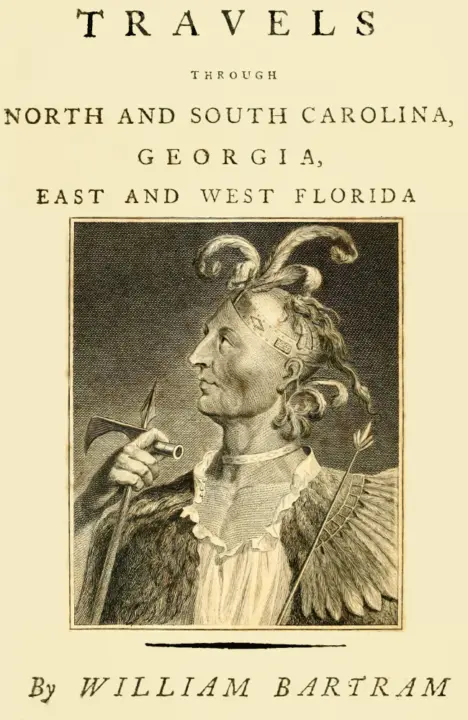
"Travels Through North and South Carolina, Georgia, East and West Florida, the Cherokee Country..." by William Bartram is a naturalist's account published in 1791. The work chronicles Bartram's four-year journey through the American South between 1773 and 1777, documenting encounters with Creek, Seminole, Cherokee, and Choctaw peoples, discoveries of plant species, and observations of unexplored territories. His sympathetic portrayal of Native Americans challenged prevailing assumptions, while his vivid descriptions influenced Romantic poets including Coleridge and Wordsworth. The book stands as both scientific documentation and literary achievement.
Introduction adapted from the source catalogue; source summaries may be automatically generated.
Free to read · English · 153,055 words · No account needed
MAKE TIME FOR A GOOD BOOK
On by default. Untick to stop anonymous reading totals. Each page counts after 10 seconds in view. How this works.
Anonymous counting is on unless you have switched it off.
Our companions soon arrived, we set forward again, enjoying the like scenes we had already past; observed parties of Siminole horses coursing over the plains, and frequently saw deer, turkeys, and wolves, but they knew their safety here, keeping far enough out of our reach. The wary, sharp-sighted crane, circumspectly observed our progress. We saw a female of them sitting on her nest, and the male, her mate, watchfully traversing backwards and forwards, at a small distance; they suffered us to approach near them before they arose, when they spread their wings, running and tipping the ground with their feet some time, and then mounted aloft, soaring round and round over the nest. They sit upon only two eggs at a time, which are very large, long and pointed at one end, of a pale ash colour, powdered or speckled with brown. The manner of forming their nests and sitting is very singular: choosing a tussock and there forming a rude heap of dry grass, or such like materials, near as high as their body is from the ground, when standing upon their feet, on the summit of this they form the nest of fine soft dry grass. When they cover their eggs to hatch them, they stand over them, bearing their bodies and wings over the eggs.
We again came up to a long projecting point of the high forests, beyond which opened to view an extensive grassy cove of the savanna, several miles in circuit. We crossed straight over from this promontory to the opposite coast, and on the way were constrained to wade a mile or more through the water, though at a little distance from us it appeared as a delightful meadow, the grass growing through the water, the middle of which, however, when we came up, proved to be a large space of clear water, almost deep enough to swim our horses; it being a large branch of the main creek which drains the savanna. After getting through this morass, we arrived on a delightful, level, green meadow, as usual, which continued about a mile, when we reached the firm land; and then gradually ascending, we alighted on a hard sandy beach, which exhibited evident signs of being washed by the waves of the savanna, when in the winter season it is all under water, and then presents the appearance of a large lake. The coast here is much lower than the opposite side, which we had left behind us, and rises from the meadows with a gradual sloping ascent, covered scatteringly with low spreading Live Oaks, short Palms, Zanthoxylon, Laurus Borbonia, Cassine, Sideroxylon, Quercus nigra, Q. sinuata and others; all leaning from the bleak winds that oppress them. About one hundred yards back from this beach, the sand hills gradually rise, and the open pine forests appear. We coasted a mile or two along the beach, then doubled a promontory of high forests, and soon after came to a swift running brook of clear water, rolling over gravel and white sand, which being brought along with it, in its descent down the steeper sandy beach, formed an easy swelling bank or bar. The waters spread greatly at this place, exhibiting a shallow glittering sheet of clear water, but just sufficient continually to cover the clear gravelly bed, and seemed to be sunk a little below the common surface of the beach. This stream, however, is soon separated into a number of rivulets, by small sandy and gravelly ridges, and the waters are finally stolen away from the sight, by a charming green meadow, but again secretly uniting under the tall grass, form a little creek, meandering through the turfy plain, marking its course by reeds and rushes, which spring up from its banks, joining the main creek that runs through the savanna, and at length delivers the water into the Great Sink. Proceeding about a mile farther, we came up to and crossed another brook, larger than the former, which exhibited the like delightful appearance. We next passed over a level green lawn, a cove of the savanna, and arrived at a hilly grove. We alighted in a pleasant vista, turning our horses to graze while we amused ourselves with exploring the borders of the Great Sink. In this place a group of rocky hills almost surrounds a large bason, which is the general receptacle of the water, draining from every part of the vast savanna by lateral conduits, winding about, and one after another joining the main creek or general conductor, which at length delivers them into this sink; where they descend by slow degrees, through rocky caverns, into the bowels of the earth, whence they are carried by secret subterraneous channels into other receptacles and basons.
Your reading position is saved on this browser. Take it to another device with a library code. Reading pages adapt to text, rather than matching a printed edition.
BEHIND THE BOOK
This eBook is for the use of anyone anywhere in the United States and most other parts of the world at no cost and with almost no restrictions whatsoever. You may copy it, give it away or re-use it under the terms of the Project Gutenberg License included with this eBook or online at www.gutenberg.org. If you are not located in the United States, you will have to check the laws of the country where you are located before using this eBook. Read the source licence.
The original source file, including credits and licence, is retained by this library. Request an original-format copy at no charge. Please include the book title and Project Gutenberg identifier #63678.
KEEP YOUR CURIOSITY GOING
Wilfrid Scawen Blunt
Wilfrid Scawen Blunt

E. W. (Edgar Watson) Howe
Cécile Tormay

Moritz Busch
John L. Ransom