THE CLASSIC COLLECTION✦My diaries, being a personal narrative of events 1888-1914, Part 2 (1900-1914)CLASSIC FREE BOOKS
My diaries, being a personal narrative of events 1888-1914, Part 2 (1900-1914)
Wilfrid Scawen Blunt
THE CLASSIC COLLECTION · 1791
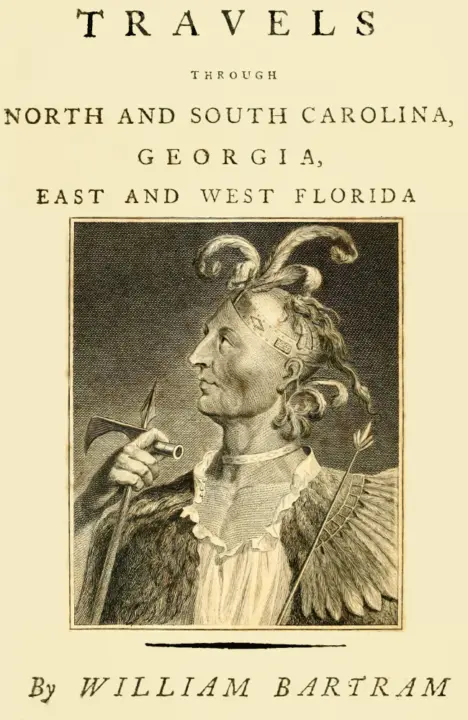
"Travels Through North and South Carolina, Georgia, East and West Florida, the Cherokee Country..." by William Bartram is a naturalist's account published in 1791. The work chronicles Bartram's four-year journey through the American South between 1773 and 1777, documenting encounters with Creek, Seminole, Cherokee, and Choctaw peoples, discoveries of plant species, and observations of unexplored territories. His sympathetic portrayal of Native Americans challenged prevailing assumptions, while his vivid descriptions influenced Romantic poets including Coleridge and Wordsworth. The book stands as both scientific documentation and literary achievement.
Introduction adapted from the source catalogue; source summaries may be automatically generated.
Free to read · English · 153,055 words · No account needed
MAKE TIME FOR A GOOD BOOK
On by default. Untick to stop anonymous reading totals. Each page counts after 10 seconds in view. How this works.
Anonymous counting is on unless you have switched it off.
The morning being clear, I sat sail with a favourable breeze, coasting along the shores; when on a sudden the waters became transparent, and discovered the sandy bottom, and the several nations of fish, passing and repassing each other. Following this course I was led to the cape of the little river, descending from Six Mile Springs, and meanders six miles from its source through green meadows. I entered this pellucid stream, sailing over the heads of innumerable squadrons of fish, which, although many feet deep in the water, were distinctly to be seen. I passed by charming islets of flourishing trees, as Palm, Red Bay, Ash, Maple, Nyssa, and others. As I approached the distant high forest on the main, the river widened, floating fields of the green Pistia surrounded me, the rapid stream winding through them. What an alluring scene was now before me! A vast bason or little lake of crystal waters, half encircled by swelling hills, clad with Orange and odoriferous Illicium groves. The towering Magnolia, itself a grove, and the exalted Palm, as if conscious of their transcendent glories, tossed about their lofty heads, painting, with mutable shades, the green floating fields beneath. The social pratling coot enrobed in blue, and the squeeling water-hen, with wings half expanded, tripped after each other, over the watery mirror.
I put in at an ancient landing place, which is a sloping ascent to a level grassy plain, an old Indian field. As I intended to make my most considerable collections at this place, I proceeded immediately to fix my encampment but a few yards from my safe harbour, where I securely fastened my boat to a Live Oak, which overshadowed my port.
After collecting a good quantity of fire-wood, as it was about the middle of the afternoon, I resolved to reconnoitre the ground about my encampment. Having penetrated the groves next to me, I came to the open forests, consisting of exceedingly tall straight Pines (Pinus Palustris) that stood at a considerable distance from each other, through which appeared at N. W. an almost unlimited plain of grassy savannas, embellished with a chain of shallow ponds, as far as the sight could reach. Here is a species of Magnolia that associates with the Gordonia lasianthus; it is a tall tree, sixty or eighty feet in heighth; the trunk straight; its head terminating in the form of a sharp cone; the leaves are oblong, lanceolate, of a fine deep green, and glaucous beneath; the flowers are large, perfectly white and extremely fragrant: with respect to its flowers and leaves, it differs very little from the Magnolia glauca. The silvery whiteness of the leaves of this tree, had a striking and pleasing effect on the sight, as it stood amidst the dark green of the Quercus dentata, Nyssa sylvatica, Nys. aquatica, Gordonia lasianthus, and many others of the same hue. The tall aspiring Gordonia lasianthus, which now stood in my view in all its splendour, is every way deserving of our admiration. Its thick foliage, of a dark green colour, is flowered over with large milk-white fragrant blossoms, on long slender elastic peduncles, at the extremities of its numerous branches, from the bosom of the leaves, and renewed every morning; and that in such incredible profusion, that the tree appears silvered over with them, and the ground beneath covered with the fallen flowers. It at the same time continually pushes forth new twigs, with young buds on them, and in the winter and spring the third year’s leaves, now partly concealed by the new and perfect ones, are gradually changing colour, from green to golden yellow, from that to a scarlet, from scarlet to crimson; and lastly to a brownish purple, and then fall to the ground. So that the Gordonia lasianthus may be said to change and renew its garments every morning throughout the year; and every day appears with unfading lustre. And moreover, after the general flowering is past, there is a thin succession of scattering blossoms to be seen, on some parts of the tree, almost every day throughout the remaining months, until the floral season returns again. Its natural situation, when growing, is on the edges of shallow ponds, or low wet grounds on rivers, in a sandy soil, the nearest to the water of any other tree, so that in droughty seasons its long serpentine roots which run near or upon the surface of the earth, may reach into the water. When the tree has arrived to the period of perfect magnitude, it is sixty, eighty, or an hundred feet high, forming a pyramidal head. The wood of old trees when sawn into plank is deservedly admired in cabinet-work or furniture; it has a cinnamon coloured ground, marbled and veined with many colours: the inner bark is used for dying a reddish or sorrel colour; it imparts this colour to wool, cotton, linnen, and dressed deer-skins, and is highly esteemed by tanners.
Your reading position is saved on this browser. Take it to another device with a library code. Reading pages adapt to text, rather than matching a printed edition.
BEHIND THE BOOK
This eBook is for the use of anyone anywhere in the United States and most other parts of the world at no cost and with almost no restrictions whatsoever. You may copy it, give it away or re-use it under the terms of the Project Gutenberg License included with this eBook or online at www.gutenberg.org. If you are not located in the United States, you will have to check the laws of the country where you are located before using this eBook. Read the source licence.
The original source file, including credits and licence, is retained by this library. Request an original-format copy at no charge. Please include the book title and Project Gutenberg identifier #63678.
KEEP YOUR CURIOSITY GOING
Wilfrid Scawen Blunt
Wilfrid Scawen Blunt

E. W. (Edgar Watson) Howe
Cécile Tormay

Moritz Busch
John L. Ransom