
Life of Edwin Forrest, the American Tragedian. Volume 2 (of 2)
William Rounseville Alger & Horatio, Jr. Alger
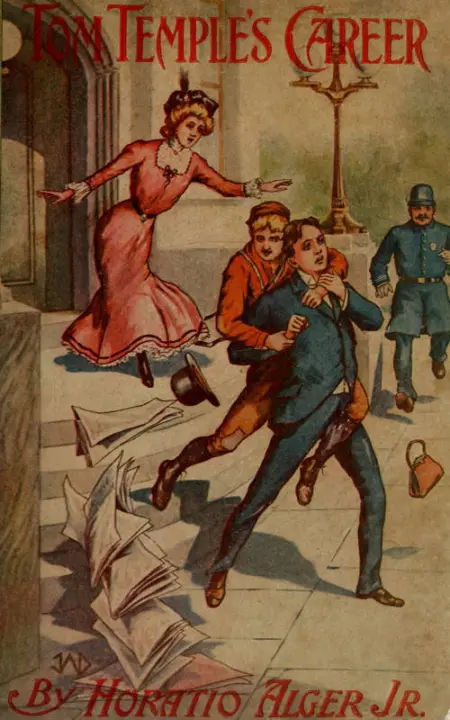
THE CLASSIC COLLECTION · 1888
"Tom Temple's Career" by Horatio Alger, Jr. is a novel written in the late 19th century. This story revolves around Tom Temple, a sixteen-year-old boy who finds himself suddenly adopted by Nathan Middleton, an insurance agent, after the death of his father. The narrative explores themes of wealth, social class, and personal development as Tom navigates his new life with his eccentric guardians in a small town. The opening of the novel introduces Nathan Middleton, a miserly and calculating man, who learns he must take Tom Temple, the son of a deceased childhood friend, into his home. Initially resistant, Nathan's perspective shifts upon learning that he will receive an annual allowance for caring for Tom. As Tom arrives, he immediately challenges the Middletons' frugal lifestyle, revealing his bold personality and appetite for both food and life. The story establishes the dynamics between Tom, his new guardians, and the children of the local elite, hinting at future conflicts and adventures that will arise from his assertive character and changing fortunes.
Introduction adapted from the source catalogue; source summaries may be automatically generated.
Free to read · English · 59,555 words · No account needed
MAKE TIME FOR A GOOD BOOK
On by default. Untick to stop anonymous reading totals. Each page counts after 10 seconds in view. How this works.
Anonymous counting is on unless you have switched it off.
He took out a hundred dollars in gold and handed it to Tom.
“Here, Tom,” said he. “I give you a hundred dollars. It will show you that I am not ungrateful.”
“A hundred dollars!” said Tom, in astonishment. “You give it to me?”
“Yes, I don’t know but I ought to give you more.”
“No, no,” said Tom hastily. “You are very generous. But I don’t think I ought to take it.”
“Then be guided by me and accept it. I give it to you freely. Without you I should have lost eight times the amount. You not only have done your duty faithfully, but you risked your life in doing it.”
“I suppose I did,” said Tom, “but I didn’t think of that at the time.”
“Take the money, then, and I hope it may be of service to you.”
“Thank you, sir. The money will be of service to me, and since you insist upon it, I will accept it.”
“Understand, Tom, that in giving you this money I don’t feel that I have cancelled the obligation. Should another opportunity occur, I shall do what I can to promote your interests.”
“Thank you, sir,” said Tom.
The consciousness of having done one’s duty faithfully, and having that service appreciated, is certainly pleasant, and Tom went about his duties from this time with even greater alacrity than before, feeling that he had made a friend of his employer.
It was certainly a great change from the character which he had previously sustained as a bully, and an arrogant, imperious boy. The truth was that he had been injured by his prosperity.
When, through circumstances over which he had no control, he had lost his fortune, and been reduced to comparative poverty, he found himself for the first time filling a useful place in the world.
His new position required courtesy and a disposition to oblige, and he was wise enough to see it. So he had improved in a marked manner under the discipline of adversity, and no longer deserved the appellation once given him of “Bully of the Village.”
So far as his situation went, Tom had nothing to complain of. Rather he had reason to congratulate himself on his success. Coming to California, wholly without friends or acquaintances, and with very slender means, he had certainly been fortunate, and had deserved his good fortune. But he did not forget that he came to San Francisco with a special mission, and he had not as yet taken a single step toward fulfilling this mission.
Your reading position is saved on this browser. Take it to another device with a library code. Reading pages adapt to text, rather than matching a printed edition.
William Rounseville Alger & Horatio, Jr. Alger

William Rounseville Alger & Horatio, Jr. Alger

Horatio, Jr. Alger

Horatio, Jr. Alger
BEHIND THE BOOK
This eBook is for the use of anyone anywhere in the United States and most other parts of the world at no cost and with almost no restrictions whatsoever. You may copy it, give it away or re-use it under the terms of the Project Gutenberg License included with this eBook or online at www.gutenberg.org. If you are not located in the United States, you will have to check the laws of the country where you are located before using this eBook. Read the source licence.
The original source file, including credits and licence, is retained by this library. Request an original-format copy at no charge. Please include the book title and Project Gutenberg identifier #56686.
KEEP YOUR CURIOSITY GOING
Coulson Kernahan

Maurice Baring
Frances Wright
Cécile Tormay

Frederic Jesup Stimson

W. H. P. (William Henry Pope) Jarvis