
Life of Edwin Forrest, the American Tragedian. Volume 2 (of 2)
William Rounseville Alger & Horatio, Jr. Alger
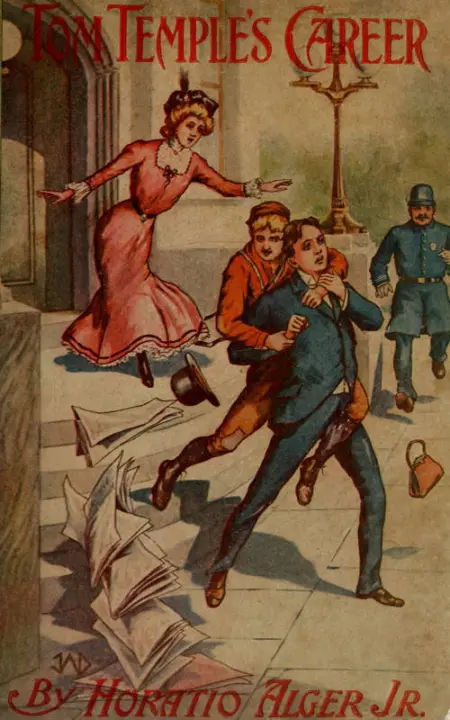
THE CLASSIC COLLECTION · 1888
"Tom Temple's Career" by Horatio Alger, Jr. is a novel written in the late 19th century. This story revolves around Tom Temple, a sixteen-year-old boy who finds himself suddenly adopted by Nathan Middleton, an insurance agent, after the death of his father. The narrative explores themes of wealth, social class, and personal development as Tom navigates his new life with his eccentric guardians in a small town. The opening of the novel introduces Nathan Middleton, a miserly and calculating man, who learns he must take Tom Temple, the son of a deceased childhood friend, into his home. Initially resistant, Nathan's perspective shifts upon learning that he will receive an annual allowance for caring for Tom. As Tom arrives, he immediately challenges the Middletons' frugal lifestyle, revealing his bold personality and appetite for both food and life. The story establishes the dynamics between Tom, his new guardians, and the children of the local elite, hinting at future conflicts and adventures that will arise from his assertive character and changing fortunes.
Introduction adapted from the source catalogue; source summaries may be automatically generated.
Free to read · English · 59,555 words · No account needed
MAKE TIME FOR A GOOD BOOK
On by default. Untick to stop anonymous reading totals. Each page counts after 10 seconds in view. How this works.
Anonymous counting is on unless you have switched it off.
THE FIDDLER struck up a lively polka. The members of the band, two by two, begun to dance. Gates, entering into the spirit of the joke, impressed Tom as a not unwilling partner, and Morton was seized by one of his captors and compelled to join in. But Herr Schmidt looked on stupidly, and stood motionless.
Alonzo gave a signal for the music to cease.
“Why don’t you dance?” he demanded sternly of the German.
“Ich kann nicht. I have never learn,” said Johann, in a tone of apology.
“Then I will teach you,” and the lieutenant seized the unwilling Teuton, and forced him to jump and caper as well as his great bulk would permit.
Gradually the rest stopped, and fixed their eyes upon the Dutchman’s unwilling gambols. The lieutenant had threatened him with instant death if he did not do his best, and the distressed Teuton, fearing to be shot, exerted himself to please his captor.
If the reader will imagine a frisky elephant, he can form some idea of mynheer’s wonderful feats, as in panic-stricken resignation he hopped and jumped at the will of the lieutenant. But he was short of breath and yielded at last to fatigue, sinking in a heap upon the earth.
“I can no more,” he said, panting heavily. “I am ausgespielt!”
“He looks played out,” said the lieutenant. “Dick, bring him a drop of
brandy.”
“Have you any lager,” asked Herr Schmidt eagerly.
“No; don’t deal in that article. Brandy is better.”
“Nothing so good as lager,” murmured Johann, closing his eyes and
panting.
Nevertheless he took the brandy, and was mischievously plied with more till, sad as I am to record it, the worthy Johann got decidedly fuddled, and losing sight of his unfortunate position, volunteered a German song, which convulsed his audience with mirth.
“You’re a jolly old boy,” said the lieutenant, slapping him on the shoulder. “Won’t you stay with us and take up our trade?”
“What’s der wages?” asked Johann gravely.
“Fifty dollars a month and found.”
“You give me fifty dollars a month, and then you find me,” repeated the
Dutchman soberly.
Probably this was not meant as a joke, but it was so understood, and Herr Schmidt was amazed at the universal merriment which followed. But he bethought himself of a condition.
“I must have my Katrine and my Kinder here, too.”
“What’s Kinder?” asked Jack.
“Children. I know enough German for that,” said Tom.
“I don’t know about that,” said the lieutenant gravely. “Is Katrine
beautiful?”
“She was once,” said Johann. “She is now one fine woman.”
Your reading position is saved on this browser. Take it to another device with a library code. Reading pages adapt to text, rather than matching a printed edition.
William Rounseville Alger & Horatio, Jr. Alger

William Rounseville Alger & Horatio, Jr. Alger

Horatio, Jr. Alger

Horatio, Jr. Alger
BEHIND THE BOOK
This eBook is for the use of anyone anywhere in the United States and most other parts of the world at no cost and with almost no restrictions whatsoever. You may copy it, give it away or re-use it under the terms of the Project Gutenberg License included with this eBook or online at www.gutenberg.org. If you are not located in the United States, you will have to check the laws of the country where you are located before using this eBook. Read the source licence.
The original source file, including credits and licence, is retained by this library. Request an original-format copy at no charge. Please include the book title and Project Gutenberg identifier #56686.
KEEP YOUR CURIOSITY GOING
Coulson Kernahan

Maurice Baring
Frances Wright
Cécile Tormay

Frederic Jesup Stimson

W. H. P. (William Henry Pope) Jarvis