
Life of Edwin Forrest, the American Tragedian. Volume 2 (of 2)
William Rounseville Alger & Horatio, Jr. Alger
THE CLASSIC COLLECTION · 1888
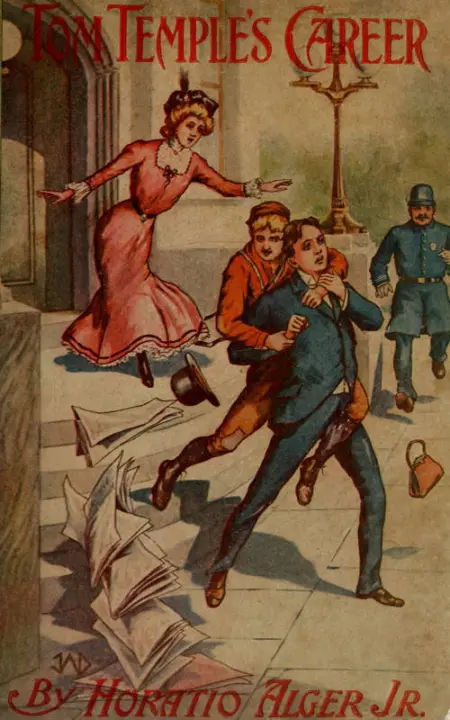
"Tom Temple's Career" by Horatio Alger, Jr. is a novel written in the late 19th century. This story revolves around Tom Temple, a sixteen-year-old boy who finds himself suddenly adopted by Nathan Middleton, an insurance agent, after the death of his father. The narrative explores themes of wealth, social class, and personal development as Tom navigates his new life with his eccentric guardians in a small town. The opening of the novel introduces Nathan Middleton, a miserly and calculating man, who learns he must take Tom Temple, the son of a deceased childhood friend, into his home. Initially resistant, Nathan's perspective shifts upon learning that he will receive an annual allowance for caring for Tom. As Tom arrives, he immediately challenges the Middletons' frugal lifestyle, revealing his bold personality and appetite for both food and life. The story establishes the dynamics between Tom, his new guardians, and the children of the local elite, hinting at future conflicts and adventures that will arise from his assertive character and changing fortunes.
Introduction adapted from the source catalogue; source summaries may be automatically generated.
Free to read · English · 59,555 words · No account needed
MAKE TIME FOR A GOOD BOOK
On by default. Untick to stop anonymous reading totals. Each page counts after 10 seconds in view. How this works.
Anonymous counting is on unless you have switched it off.
THERE was another tea-table in Plympton where Tom’s affairs were discussed the same afternoon. As the reader will conjecture, I refer to that of Lawyer Davenport.
“Was Thomas Temple here this afternoon?” he asked when they were all
seated.
“Yes,” said Imogene promptly.
“Imogene is setting her cap for him,” said James.
“You should not tease your sister, James,” said his mother. “It is perfectly natural that Tom should be polite to your sister. He is in her own social rank, and will possess a fine fortune. What do you say, Mr. Davenport?”
“That the intimacy had better cease,” said the lawyer.
“Really, I can’t understand your reasons,” said Mrs. Davenport.
“What is the matter with Tom?” demanded Imogene.
“I have heard some news about him this afternoon,” said the lawyer, “which influences me in what I have said.”
“We shouldn’t be too hard upon his boyish scrapes,” said Mrs. Davenport charitably. “Boys will be boys.”
“It isn’t any boyish scrape.”
“What is it, then?”
“Much worse than that. He has lost his entire fortune!”
“You don’t mean it!” ejaculated his wife.
“It can’t be true, papa,” said Imogene.
“It is perfectly true. I had it from Mr. Middleton, and he received the information this very day from Mr. Sharp, the boy’s guardian.”
“But how could he lose it?” asked James.
“By bad investments and the failure of large creditors.”
“Has he lost everything?”
“All but a few hundred dollars.”
“Of course, that alters the case very much,” said Mrs. Davenport. “He is a poor boy now.”
“To be sure. He will have to work for a living. Probably he will become
a common mechanic.”
“Horrible!” exclaimed Imogene, with a shudder.
“Of course, he is no fit companion for our children now.”
“Certainly not,” said Mrs. Davenport decidedly.
“I am not sorry,” said James. “I never liked him. I always thought him
low.”
“I hope, Imogene,” said her mother, “you won’t think of encouraging his visits now,” said her mother. “He is far below you in the social scale.”
“I understand that well enough, mother. I should not be willing to associate with a working boy.”
“Right, my love! I see that you cherish sentiments worthy of my
daughter. There is nothing like having a proper sense of your own
dignity.”
“You won’t have to complain of me,” said Imogene, tossing her head.
“Nor of me,” said James. “I’ll keep him at a distance, never fear.”
“If he persists in coming here, you must tell him decidedly that he is not wanted,” said Mrs. Davenport.
Your reading position is saved on this browser. Take it to another device with a library code. Reading pages adapt to text, rather than matching a printed edition.
William Rounseville Alger & Horatio, Jr. Alger

William Rounseville Alger & Horatio, Jr. Alger

Horatio, Jr. Alger

Horatio, Jr. Alger
BEHIND THE BOOK
This eBook is for the use of anyone anywhere in the United States and most other parts of the world at no cost and with almost no restrictions whatsoever. You may copy it, give it away or re-use it under the terms of the Project Gutenberg License included with this eBook or online at www.gutenberg.org. If you are not located in the United States, you will have to check the laws of the country where you are located before using this eBook. Read the source licence.
The original source file, including credits and licence, is retained by this library. Request an original-format copy at no charge. Please include the book title and Project Gutenberg identifier #56686.
KEEP YOUR CURIOSITY GOING
Coulson Kernahan

Maurice Baring
Frances Wright
Cécile Tormay

Frederic Jesup Stimson

W. H. P. (William Henry Pope) Jarvis