
Life of Edwin Forrest, the American Tragedian. Volume 2 (of 2)
William Rounseville Alger & Horatio, Jr. Alger
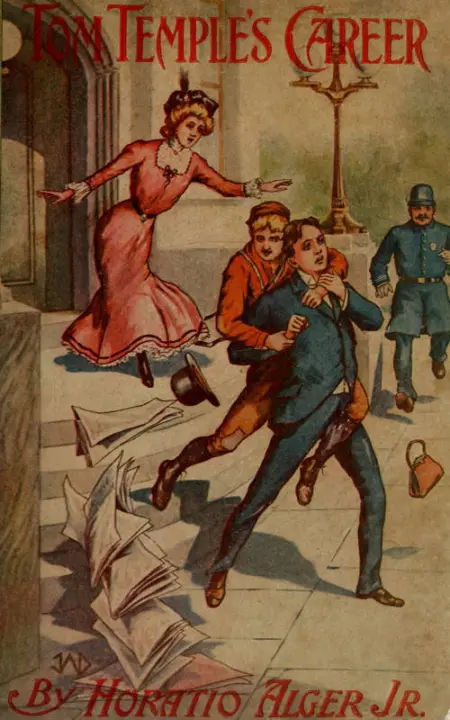
THE CLASSIC COLLECTION · 1888
"Tom Temple's Career" by Horatio Alger, Jr. is a novel written in the late 19th century. This story revolves around Tom Temple, a sixteen-year-old boy who finds himself suddenly adopted by Nathan Middleton, an insurance agent, after the death of his father. The narrative explores themes of wealth, social class, and personal development as Tom navigates his new life with his eccentric guardians in a small town. The opening of the novel introduces Nathan Middleton, a miserly and calculating man, who learns he must take Tom Temple, the son of a deceased childhood friend, into his home. Initially resistant, Nathan's perspective shifts upon learning that he will receive an annual allowance for caring for Tom. As Tom arrives, he immediately challenges the Middletons' frugal lifestyle, revealing his bold personality and appetite for both food and life. The story establishes the dynamics between Tom, his new guardians, and the children of the local elite, hinting at future conflicts and adventures that will arise from his assertive character and changing fortunes.
Introduction adapted from the source catalogue; source summaries may be automatically generated.
Free to read · English · 59,555 words · No account needed
MAKE TIME FOR A GOOD BOOK
On by default. Untick to stop anonymous reading totals. Each page counts after 10 seconds in view. How this works.
Anonymous counting is on unless you have switched it off.
THE SUPPER was as excellent as the dinner, and Tom, made hungry by his exertions upon the river, enjoyed it.
By accident he found himself seated next to Mary Somers, the poor cousin. The two conversed quite socially, rather to the disgust of Imogene, who, hearing that Tom was rich, wished to monopolize him herself. She was vexed to find that he was considerably more attentive to her penniless cousin than he had been to herself.
If Mary had been homely, and she herself handsome, she could have been quite friendly, but Mary’s fresh color and bright eyes showed to such advantage compared with her own sallow complexion and dull eyes that she envied and hated her.
“Did you have a pleasant afternoon, Mr. Temple?” asked Mary.
“Very pleasant,” said Tom. “We had an adventure, too.”
“What was it?”
“We saved a little Irish boy from drowning.”
“That is new business for Cousin James,” said Mary, smiling.
“You needn’t lay it to me,” said James. “I didn’t have anything to do with the little brat.”
“You speak as if it were discreditable,” said Tom. “I’ll stand the
blame.”
“I didn’t want him to drown,” said James, “but I am not partial to
ragged boys.”
“It is always well to be humane,” said Lawyer Davenport. “I am glad that my boy was instrumental in preserving the life of a fellow-being.”
Mary and Tom continued their conversation, while Imogene grew more and more vexed with her cousin, till she had the ill-breeding to say, in an ill-natured tone:
“Really, Mary, you talk so much that nobody else gets a chance.”
“I am sorry,” said Mary blushing.
“I am just as much to blame,” said Tom good-naturedly. “I’ve been asking your cousin questions.”
“I hate to see girls so forward,” said Imogene spitefully.
Mary looked pained, and there was some spirit in her answer.
“I didn’t think it would be polite to refuse answering Mr. Temple,” she
said.
“Imogene is right,” said Mrs. Davenport, who thoroughly sympathized with her daughter. “You are too forward.”
Mary’s mouth quivered with mortification, but she said nothing. Neither did Tom. He was indignant at the petty malice of Imogene, and determined, if he could not speak to Mary, he would not speak at all. He only answered the questions of the rest in monosyllables during the remainder of the meal.
When supper was over, Mrs. Davenport said:
“We will go into the parlor. Imogene, can’t you play for Mr. Temple?”
“Do you like music, Mr. Temple?” asked Imogene.
“Pretty well,” said Tom, “but I am not much of a judge of it.”
Your reading position is saved on this browser. Take it to another device with a library code. Reading pages adapt to text, rather than matching a printed edition.
William Rounseville Alger & Horatio, Jr. Alger

William Rounseville Alger & Horatio, Jr. Alger

Horatio, Jr. Alger

Horatio, Jr. Alger
BEHIND THE BOOK
This eBook is for the use of anyone anywhere in the United States and most other parts of the world at no cost and with almost no restrictions whatsoever. You may copy it, give it away or re-use it under the terms of the Project Gutenberg License included with this eBook or online at www.gutenberg.org. If you are not located in the United States, you will have to check the laws of the country where you are located before using this eBook. Read the source licence.
The original source file, including credits and licence, is retained by this library. Request an original-format copy at no charge. Please include the book title and Project Gutenberg identifier #56686.
KEEP YOUR CURIOSITY GOING
Coulson Kernahan

Maurice Baring
Frances Wright
Cécile Tormay

Frederic Jesup Stimson

W. H. P. (William Henry Pope) Jarvis