
Life of Edwin Forrest, the American Tragedian. Volume 2 (of 2)
William Rounseville Alger & Horatio, Jr. Alger
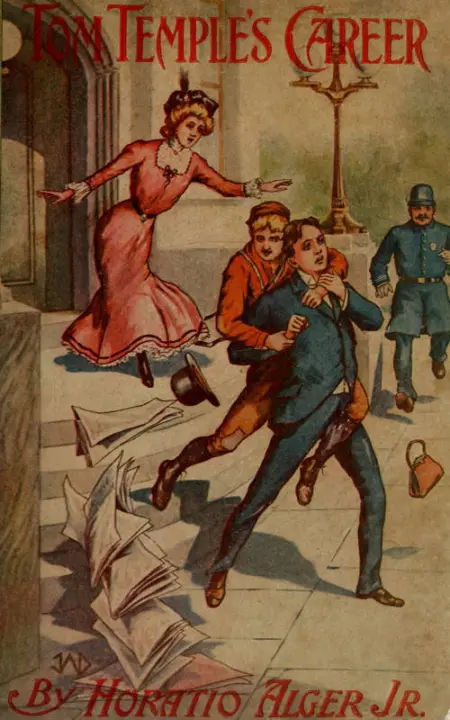
THE CLASSIC COLLECTION · 1888
"Tom Temple's Career" by Horatio Alger, Jr. is a novel written in the late 19th century. This story revolves around Tom Temple, a sixteen-year-old boy who finds himself suddenly adopted by Nathan Middleton, an insurance agent, after the death of his father. The narrative explores themes of wealth, social class, and personal development as Tom navigates his new life with his eccentric guardians in a small town. The opening of the novel introduces Nathan Middleton, a miserly and calculating man, who learns he must take Tom Temple, the son of a deceased childhood friend, into his home. Initially resistant, Nathan's perspective shifts upon learning that he will receive an annual allowance for caring for Tom. As Tom arrives, he immediately challenges the Middletons' frugal lifestyle, revealing his bold personality and appetite for both food and life. The story establishes the dynamics between Tom, his new guardians, and the children of the local elite, hinting at future conflicts and adventures that will arise from his assertive character and changing fortunes.
Introduction adapted from the source catalogue; source summaries may be automatically generated.
Free to read · English · 59,555 words · No account needed
MAKE TIME FOR A GOOD BOOK
On by default. Untick to stop anonymous reading totals. Each page counts after 10 seconds in view. How this works.
Anonymous counting is on unless you have switched it off.
MR. ARMSTRONG sat in his counting-room deep in thought. An arrangement had been made with his creditors by which he was allowed to go on. It was his ambition to repay them their confidence by paying all claims upon him dollar for dollar. But he found it up-hill work. His resources were contracted, and success was, to say the least, problematical. This was the reason of his present abstraction. He was anxiously considering what measures to adopt in order to facilitate the attainment of the end he had in view.
“If I only had the eighty thousand dollars’ worth of securities that scoundrelly clerk robbed me of,” he said to himself, “all would be well. I could clear off all liabilities to-day, and start afresh with the most encouraging chances of success. But I suppose there isn’t one chance in a hundred of my ever recovering a cent from that source.”
Just then an intimate friend, Hugh Osborn, entered.
“You seem in a brown study, Armstrong,” he said.
“Yes; I was thinking about my affairs.”
“Your creditors have allowed you to go on?”
“Yes, and I want to justify their confidence.”
“Oh, you’ll do that.”
“I hope so, but business is dull, and it’s hard work getting back to my old position. If I only had the money Lincoln abstracted, all would be well.”
“What efforts have you made to recover it?”
“I have informed the police, but thus far I have heard nothing.”
“Have you done nothing further?”
“Yes,” said Mr. Armstrong, hesitating. “I have sent a special messenger to California to hunt up the defaulter.”
“Come, that’s enterprising. Who is your special messenger?”
“You will laugh at me if I tell you.”
“Why should I?”
“Because my messenger is a boy of sixteen.”
“You are not in earnest, surely?”
“Yes, I am.”
“What could induce you to employ a mere boy?”
“He is one of my creditors—Tom Temple. He volunteered to go, and asked for no allowance for expenses.”
“Very kind, no doubt, but you might as well have sent nobody.”
“You may be right. Still Tom is a bright, smart lad.”
“I hope you don’t base any very extravagant hopes on this mission.”
“I never have been very sanguine, Hugh, for the mission presents difficulties even to man. Still I would rather trust Tom than some men.”
“My old friend, you are foolish to expect anything from a boy of sixteen. Such boys are confident, no doubt; it is a characteristic of that age, but what could one do against a crafty rogue?”
Your reading position is saved on this browser. Take it to another device with a library code. Reading pages adapt to text, rather than matching a printed edition.
William Rounseville Alger & Horatio, Jr. Alger
William Rounseville Alger & Horatio, Jr. Alger
Horatio, Jr. Alger
Horatio, Jr. Alger
BEHIND THE BOOK
This eBook is for the use of anyone anywhere in the United States and most other parts of the world at no cost and with almost no restrictions whatsoever. You may copy it, give it away or re-use it under the terms of the Project Gutenberg License included with this eBook or online at www.gutenberg.org. If you are not located in the United States, you will have to check the laws of the country where you are located before using this eBook. Read the source licence.
The original source file, including credits and licence, is retained by this library. Request an original-format copy at no charge. Please include the book title and Project Gutenberg identifier #56686.
KEEP YOUR CURIOSITY GOING
Coulson Kernahan

Maurice Baring
Frances Wright
Cécile Tormay

Frederic Jesup Stimson

W. H. P. (William Henry Pope) Jarvis