
Life of Edwin Forrest, the American Tragedian. Volume 2 (of 2)
William Rounseville Alger & Horatio, Jr. Alger
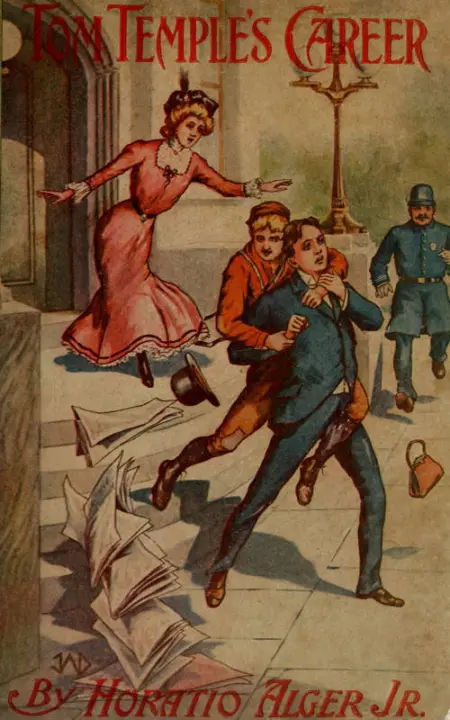
THE CLASSIC COLLECTION · 1888
"Tom Temple's Career" by Horatio Alger, Jr. is a novel written in the late 19th century. This story revolves around Tom Temple, a sixteen-year-old boy who finds himself suddenly adopted by Nathan Middleton, an insurance agent, after the death of his father. The narrative explores themes of wealth, social class, and personal development as Tom navigates his new life with his eccentric guardians in a small town. The opening of the novel introduces Nathan Middleton, a miserly and calculating man, who learns he must take Tom Temple, the son of a deceased childhood friend, into his home. Initially resistant, Nathan's perspective shifts upon learning that he will receive an annual allowance for caring for Tom. As Tom arrives, he immediately challenges the Middletons' frugal lifestyle, revealing his bold personality and appetite for both food and life. The story establishes the dynamics between Tom, his new guardians, and the children of the local elite, hinting at future conflicts and adventures that will arise from his assertive character and changing fortunes.
Introduction adapted from the source catalogue; source summaries may be automatically generated.
Free to read · English · 59,555 words · No account needed
MAKE TIME FOR A GOOD BOOK
On by default. Untick to stop anonymous reading totals. Each page counts after 10 seconds in view. How this works.
Anonymous counting is on unless you have switched it off.
“Give us a good double-room,” he said to the clerk.
“No. 157,” said the clerk, calling a servant. “Show these gentlemen up
to No. 157.”
They were shown into a room of good size, comfortably furnished. Tom, who was dusty, refreshed himself by washing his face and hands.
“Are you hungry?” asked Mr. Livingston.
“I’ve got rather a healthy appetite,” said Tom.
“After you’ve washed we’ll go down into the refectory and have some dinner. It will be more social dining together.”
“Just as you like.”
“You must be my guest at dinner.”
“Thank you,” said Tom, “but I would rather pay for my own dinner.”
“Oh, don’t be squeamish.”
“I don’t like to accept favors from a stranger.”
“Then to ease your scruples, I will take supper with you.”
Tom would prefer to have paid his own way independently of Mr. Livingston, but as the latter said, it would amount to very much the same thing, so he made no further objections.
They adjourned to the refectory, and although it was not yet one o’clock, both exhibited a hearty appetite. But prices were reasonable, and the united tickets only came to one dollar and a half.
“Give me the checks,” said Livingston to the waiter.
He opened his pocket-book and examined its contents.
“On second thought,” he said, “my young friend, I will suggest a change in our arrangements. You may pay for the dinner and I will pay for the supper.”
Tom looked surprised, and he explained:
“You see,” he continued, in an off-hand tone, “I’ve got a check here for six hundred dollars, which I am going to get cashed. Besides this, I have only a little change.”
“Will you show me the check?” asked Tom, who had become rather
suspicious.
“To be sure,” said his companion.
He exhibited a check on the Park Bank, which looked all right. It was payable to bearer, and was in the sum of six hundred dollars, as he alleged.
Tom’s suspicions were allayed. He concluded that his new friend was all right, and settled the bill.
“Where are you going this afternoon?” asked Livingston.
“I shall walk around the city a little,” said Tom.
“I’m sorry I can’t go with you. I have some goods to buy and some other business to attend to, but I’ll meet you in the reading-room at six o’clock and we’ll go down to supper.”
“Very well,” said Tom. “That will suit me well enough.”
Your reading position is saved on this browser. Take it to another device with a library code. Reading pages adapt to text, rather than matching a printed edition.
William Rounseville Alger & Horatio, Jr. Alger

William Rounseville Alger & Horatio, Jr. Alger

Horatio, Jr. Alger

Horatio, Jr. Alger
BEHIND THE BOOK
This eBook is for the use of anyone anywhere in the United States and most other parts of the world at no cost and with almost no restrictions whatsoever. You may copy it, give it away or re-use it under the terms of the Project Gutenberg License included with this eBook or online at www.gutenberg.org. If you are not located in the United States, you will have to check the laws of the country where you are located before using this eBook. Read the source licence.
The original source file, including credits and licence, is retained by this library. Request an original-format copy at no charge. Please include the book title and Project Gutenberg identifier #56686.
KEEP YOUR CURIOSITY GOING
Coulson Kernahan

Maurice Baring
Frances Wright
Cécile Tormay

Frederic Jesup Stimson

W. H. P. (William Henry Pope) Jarvis