
Life of Edwin Forrest, the American Tragedian. Volume 2 (of 2)
William Rounseville Alger & Horatio, Jr. Alger
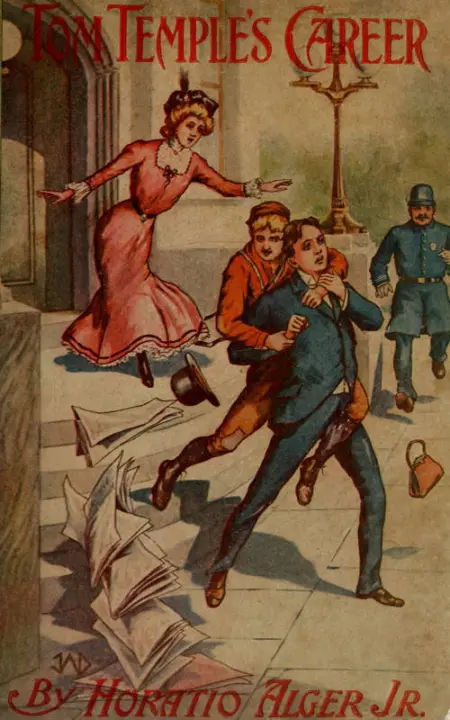
THE CLASSIC COLLECTION · 1888
"Tom Temple's Career" by Horatio Alger, Jr. is a novel written in the late 19th century. This story revolves around Tom Temple, a sixteen-year-old boy who finds himself suddenly adopted by Nathan Middleton, an insurance agent, after the death of his father. The narrative explores themes of wealth, social class, and personal development as Tom navigates his new life with his eccentric guardians in a small town. The opening of the novel introduces Nathan Middleton, a miserly and calculating man, who learns he must take Tom Temple, the son of a deceased childhood friend, into his home. Initially resistant, Nathan's perspective shifts upon learning that he will receive an annual allowance for caring for Tom. As Tom arrives, he immediately challenges the Middletons' frugal lifestyle, revealing his bold personality and appetite for both food and life. The story establishes the dynamics between Tom, his new guardians, and the children of the local elite, hinting at future conflicts and adventures that will arise from his assertive character and changing fortunes.
Introduction adapted from the source catalogue; source summaries may be automatically generated.
Free to read · English · 59,555 words · No account needed
MAKE TIME FOR A GOOD BOOK
On by default. Untick to stop anonymous reading totals. Each page counts after 10 seconds in view. How this works.
Anonymous counting is on unless you have switched it off.
“Not at all,” said Nathan modestly. “For the sake of my old friend I am glad to assume his place to his orphan boy.”
“I hope, young man,” said the lawyer, “that you are sensible of Mr. Middleton’s kindness.”
“Oh, yes,” said Tom, “I appreciate it properly.”
Our hero’s tone was rather peculiar, and Nathan Middleton felt uncomfortable, not knowing what he might be tempted to say. He was quite conscious that boarding Tom for twenty dollars a week did not involve any extraordinary kindness on his part.
“I believe, young man, you had some difficulty with my son yesterday,” said the lawyer, in a tone calculated to overawe our hero.
“I had a little difficulty with two boys,” said Tom coolly.
“My son and nephew.”
“I am very sorry that anything unpleasant should have occurred, Squire Davenport,” said Nathan nervously.
“It is for the young man to apologize, not you, Mr. Middleton,” said the
lawyer severely.
“You are quite mistaken, sir,” said Tom; “it is for your son to
apologize.”
“Young man, this assurance is most extraordinary,” gasped the lawyer, in
amazement.
“If your son had behaved like a gentleman he would have had nothing to complain of,” said Tom. “He refused to play with me, and I playfully threw his ball into a corn-field. Then, as he rushed at me, I defended myself.”
“Mr. Middleton, do you sustain this boy in his extraordinary and defiant
attitude?”
“There must have been a misunderstanding,” said Nathan eagerly. “I am anxious that Thomas should enjoy the privilege of associating with your son and nephew, and I hope when they come to know each other better they will become friends.”
“It is rather presumptuous for a charity boy to expect to associate with my family,” thought the lawyer; but he said: “If this young man will apologize for this outrage of yesterday and treat my son with proper respect, I may consent to his occasionally visiting him.”
“I am sure he will be willing,” said Mr. Middleton.
“Quite a mistake,” said Tom. “He owes me an apology for his boorish conduct. As to the ball—if it’s lost, I’ll pay for it.”
He drew out his pocket-book and displayed a roll of bills, considerably to the astonishment of the lawyer, who begun to think he had acted too hastily.
“Be kind enough to take pay for the ball out of that,” said Tom, offering a ten-dollar bill to the visitor.
Lawyer Davenport had a respect for money. Tom was no longer a charity boy, to be condescended to, but a young gentleman.
Your reading position is saved on this browser. Take it to another device with a library code. Reading pages adapt to text, rather than matching a printed edition.
William Rounseville Alger & Horatio, Jr. Alger

William Rounseville Alger & Horatio, Jr. Alger

Horatio, Jr. Alger

Horatio, Jr. Alger
BEHIND THE BOOK
This eBook is for the use of anyone anywhere in the United States and most other parts of the world at no cost and with almost no restrictions whatsoever. You may copy it, give it away or re-use it under the terms of the Project Gutenberg License included with this eBook or online at www.gutenberg.org. If you are not located in the United States, you will have to check the laws of the country where you are located before using this eBook. Read the source licence.
The original source file, including credits and licence, is retained by this library. Request an original-format copy at no charge. Please include the book title and Project Gutenberg identifier #56686.
KEEP YOUR CURIOSITY GOING
Coulson Kernahan

Maurice Baring
Frances Wright
Cécile Tormay

Frederic Jesup Stimson

W. H. P. (William Henry Pope) Jarvis