
Life of Edwin Forrest, the American Tragedian. Volume 2 (of 2)
William Rounseville Alger & Horatio, Jr. Alger
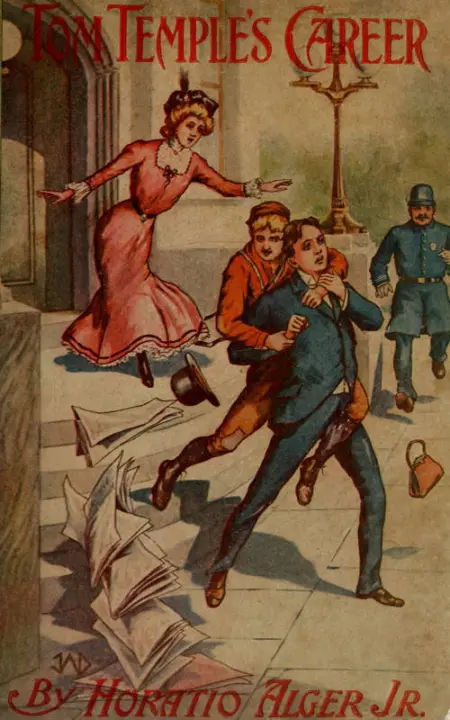
THE CLASSIC COLLECTION · 1888
"Tom Temple's Career" by Horatio Alger, Jr. is a novel written in the late 19th century. This story revolves around Tom Temple, a sixteen-year-old boy who finds himself suddenly adopted by Nathan Middleton, an insurance agent, after the death of his father. The narrative explores themes of wealth, social class, and personal development as Tom navigates his new life with his eccentric guardians in a small town. The opening of the novel introduces Nathan Middleton, a miserly and calculating man, who learns he must take Tom Temple, the son of a deceased childhood friend, into his home. Initially resistant, Nathan's perspective shifts upon learning that he will receive an annual allowance for caring for Tom. As Tom arrives, he immediately challenges the Middletons' frugal lifestyle, revealing his bold personality and appetite for both food and life. The story establishes the dynamics between Tom, his new guardians, and the children of the local elite, hinting at future conflicts and adventures that will arise from his assertive character and changing fortunes.
Introduction adapted from the source catalogue; source summaries may be automatically generated.
Free to read · English · 59,555 words · No account needed
MAKE TIME FOR A GOOD BOOK
On by default. Untick to stop anonymous reading totals. Each page counts after 10 seconds in view. How this works.
Anonymous counting is on unless you have switched it off.
Mr. Schmidt groaned piteously, and for the fiftieth time execrated his folly in selling out a lager bier saloon, in which he was making money, to start in quest of the mines. Ah, little did the plump Katrine and the children, waiting eagerly to hear of his success, dream that he was even now in the clutches of robbers.
But the longest journey has an ending, and this was not a very long
journey.
They reached a rude wooden building, backed by a precipitous elevation. There was nothing peculiar in its appearance, except that it had no windows. In fact, the main wonder was, that in this lonely place there should be any building at all.
“Halt, gentlemen,” said the captain, “it is here that we stop.”
“Is this our hotel?” asked Tom lightly.
“Yes,” said the captain, relaxing his stern features with a smile. “Shall I announce to you the rules of this house?”
“What are they?”
“Payment in advance.”
Morton’s face changed, and the Dutchman looked unhappy.
“I hope your bill won’t be unreasonable,” said Gates.
“Not at all. We shall not ask more than you have.”
“Thank you; you are very considerate.”
“We’ll begin with you, then,” said the captain, addressing Gates.
“Oh, I’m a poor devil. I haven’t much.”
“Produce what you have.”
Gates took out his purse, which proved to contain a hundred and fifty
dollars in gold.
“Is that all?”
“Every cent.”
“Search him.”
Two members of the band advanced and searched him, but nothing more was
to be found.
“You are an honest fellow. I won’t take all. Here!” and the robber returned twenty dollars of the sum taken.
“Thank you!” said Gates, with a little surprise. “Really, for a robber, you are very polite and honorable.”
“Now it’s your turn, young bantam,” was addressed to Tom.
Our hero produced all his money, as was shown by the subsequent search.
“Good!” said the captain. “Here are twenty for you. It will take you to the mines. Now, old man, it’s your turn.”
Herr Schmidt would have done well to profit by the example of his companions, and surrendered what he could not retain. But it was too much for his equanimity. He brought out twenty-five dollars, and stoutly asseverated that it was all he had. But the captain was too sharp for him. A skillful examination disclosed eleven times as much more.
“You were richer than you thought,” said the captain, in a sarcastic
tone.
“It is all I had. I am ruined!” exclaimed Johann piteously. “Good robber, give me back half.”
Your reading position is saved on this browser. Take it to another device with a library code. Reading pages adapt to text, rather than matching a printed edition.
William Rounseville Alger & Horatio, Jr. Alger

William Rounseville Alger & Horatio, Jr. Alger

Horatio, Jr. Alger

Horatio, Jr. Alger
BEHIND THE BOOK
This eBook is for the use of anyone anywhere in the United States and most other parts of the world at no cost and with almost no restrictions whatsoever. You may copy it, give it away or re-use it under the terms of the Project Gutenberg License included with this eBook or online at www.gutenberg.org. If you are not located in the United States, you will have to check the laws of the country where you are located before using this eBook. Read the source licence.
The original source file, including credits and licence, is retained by this library. Request an original-format copy at no charge. Please include the book title and Project Gutenberg identifier #56686.
KEEP YOUR CURIOSITY GOING
Coulson Kernahan

Maurice Baring
Frances Wright
Cécile Tormay

Frederic Jesup Stimson

W. H. P. (William Henry Pope) Jarvis