
Life of Edwin Forrest, the American Tragedian. Volume 2 (of 2)
William Rounseville Alger & Horatio, Jr. Alger
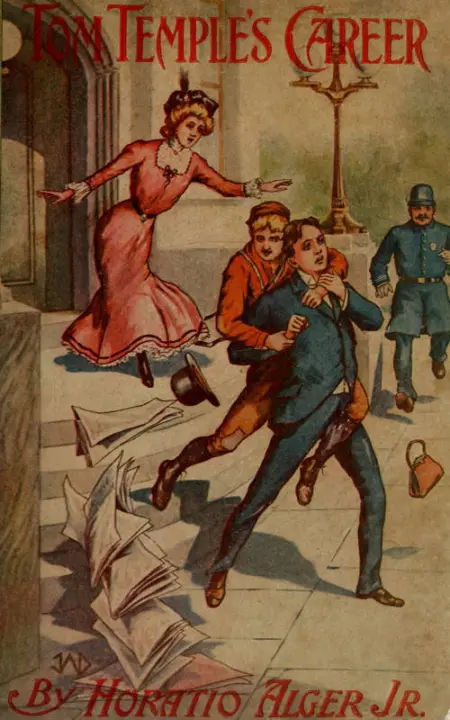
THE CLASSIC COLLECTION · 1888
"Tom Temple's Career" by Horatio Alger, Jr. is a novel written in the late 19th century. This story revolves around Tom Temple, a sixteen-year-old boy who finds himself suddenly adopted by Nathan Middleton, an insurance agent, after the death of his father. The narrative explores themes of wealth, social class, and personal development as Tom navigates his new life with his eccentric guardians in a small town. The opening of the novel introduces Nathan Middleton, a miserly and calculating man, who learns he must take Tom Temple, the son of a deceased childhood friend, into his home. Initially resistant, Nathan's perspective shifts upon learning that he will receive an annual allowance for caring for Tom. As Tom arrives, he immediately challenges the Middletons' frugal lifestyle, revealing his bold personality and appetite for both food and life. The story establishes the dynamics between Tom, his new guardians, and the children of the local elite, hinting at future conflicts and adventures that will arise from his assertive character and changing fortunes.
Introduction adapted from the source catalogue; source summaries may be automatically generated.
Free to read · English · 59,555 words · No account needed
MAKE TIME FOR A GOOD BOOK
On by default. Untick to stop anonymous reading totals. Each page counts after 10 seconds in view. How this works.
Anonymous counting is on unless you have switched it off.
“I wish I had not come out here,” he bewailed to himself. “Why could I not stay zu home in my lager bier saloon, where I was make much money. I shall not never go back once more, and what will meine Frau do?”
“Oh, don’t mind about her,” said Gates mischievously. “She’ll marry another man, and he’ll take care of the children.”
“Was!” roared the Teuton, his small eyes lighted up with anger. “Mein frau marry another man! Den I will not die at all!”
“That’s where your head’s level,” said Tom, who had picked up the phrase in San Francisco. “I wouldn’t peg out it I were you.”
“And my Katrine be another man’s frau!” continued the German, in a tone
of disgust.
“You couldn’t blame her, you know,” said Gates, in a mischievous spirit. “Of course she couldn’t manage the children alone. I’m not married, and I might be willing to take her myself, that is, if anything happened to you.”
“You marry my Katrine!” exclaimed Herr Schmidt, almost speechless with
indignation.
“I suppose you would prefer that a friend like me should marry her to a stranger, wouldn’t you, Herr Schmidt?”
“But I am not dead! I will not die!” roared Johann. “You shall not have
her!”
“Oh, of course if you are not going to die, that makes a difference. You said you were, you know.”
“I have change my mind—I will go home to mein Katrine myself. She shall have no other husband.”
“Good for you! I like your pluck,” said Gates. “Give me your hand.”
But Herr Schmidt was offended.
“I will nicht give my hand to dem man who will wish to marry meine Katrine,” he said obstinately.
“Oh, that was only to oblige you, Herr Schmidt. I thought you might like to have your wife and children taken care of.”
“I take care of them myself.”
“To be sure you will, if you don’t kick the bucket. I see you’re riled, Herr Schmidt. My advice is that you smoke a pipe. It will make you feel better.”
This suggestion appeared to strike the German favorably, for though he did not deign an articulate reply, he pulled out a pipe, which appeared to have seen much service, and was soon smoking placidly, and to judge from appearance, much more comfortable in mind.
Meanwhile the road had entered the forest and the trees cut off what scanty daylight yet remained.
“How long are these woods?” inquired Gates of the driver.
“Two miles or thereabouts, sir.”
“It is a lonely place?”
Your reading position is saved on this browser. Take it to another device with a library code. Reading pages adapt to text, rather than matching a printed edition.
William Rounseville Alger & Horatio, Jr. Alger

William Rounseville Alger & Horatio, Jr. Alger

Horatio, Jr. Alger

Horatio, Jr. Alger
BEHIND THE BOOK
This eBook is for the use of anyone anywhere in the United States and most other parts of the world at no cost and with almost no restrictions whatsoever. You may copy it, give it away or re-use it under the terms of the Project Gutenberg License included with this eBook or online at www.gutenberg.org. If you are not located in the United States, you will have to check the laws of the country where you are located before using this eBook. Read the source licence.
The original source file, including credits and licence, is retained by this library. Request an original-format copy at no charge. Please include the book title and Project Gutenberg identifier #56686.
KEEP YOUR CURIOSITY GOING
Coulson Kernahan

Maurice Baring
Frances Wright
Cécile Tormay

Frederic Jesup Stimson

W. H. P. (William Henry Pope) Jarvis