THE CLASSIC COLLECTION✦A dead man’s diaryCLASSIC FREE BOOKS
A dead man’s diary
Coulson Kernahan
THE CLASSIC COLLECTION · 1906
"The Way of the Gods" by John Luther Long is a novel written in the early 20th century. The narrative centers around the character Shijiro Arisuga, a samurai struggling with the weight of duty and honor in a rapidly changing Japan influenced by Western ideals and militarism. Long's work delves into the concepts of happiness and sorrow, portraying the complexities of existence, particularly through the lens of Japanese culture and beliefs. At the start of the story, the opening explores the philosophical underpinnings of joy and sorrow within Japanese society, illustrating that one's happiness often comes at a cost to others. Shijiro recalls five pivotal moments in his life that he deems the happiest, signaling his reflections on loyalty to the emperor and family legacy. The narrative further introduces Shijiro's interactions with various characters, including his uncles, and sets the stage for the conflicts he will face regarding his identity, societal expectations, and the looming presence of love in the form of Yoné, his childhood companion. The text reveals the struggles of a young boy caught between tradition and a desire for personal fulfillment amidst the backdrop of a historic and culturally rich setting.
Introduction adapted from the source catalogue; source summaries may be automatically generated.
Free to read · English · 38,598 words · No account needed
MAKE TIME FOR A GOOD BOOK
On by default. Untick to stop anonymous reading totals. Each page counts after 10 seconds in view. How this works.
Anonymous counting is on unless you have switched it off.
Produced by Chuck Greif and the Online Distributed Proofreading Team at http://www.pgdp.net (This book was produced from scanned images of public domain material from the Google Print project.)
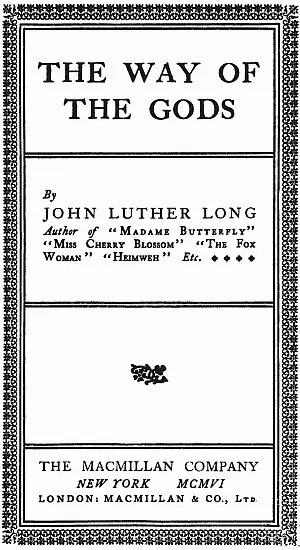
By JOHN LUTHER LONG
Author of "MADAME BUTTERFLY"
"MISS CHERRY BLOSSOM" "THE FOX WOMAN"
"HEIMWEH" Etc. * * * *
Set up and electrotyped. Published April, 1906.
Norwood Press
J. S. Cushing & Co.--Berwick & Smith Co.
Norwood, Mass.,
U.S.A.
TO HIM WHO OWNS
HIS JOY BECAUSE
HE HAS BOUGHT
IT WITH SORROW--OR
WILL * * * * * *
TADAIMA! (Wait a moment!), 3
XXXIV Afterward 311
I thought I saw the bronze god Asamra (he who may speak but once in a thousand years, and whose friendship I keep by making time stand still for him in the stopping of the clock and its turning back) shake his head in doubt as I put the manuscript into its wrappings and addressed it to the publisher.
"Well?" I inquired, testily.
"Suppose They do not like it?" sighed the god.
"Why should They not?" demanded I, loftily.
"It has, among other unusualities, (I hope you like the gentleness of the word!) those dashes which--You ought to have learned by this time that They don't like to read over dashes."
"Why not?" asked I, again. "I like them. And, they are my own!"
"Well, you know a dash necessitates lucubration. It stands for something which you trust your reader to supply. That is unfair. If you are writing a book and receiving an honorarium for it, do not expect him to do it. It is a bit like eating. One does not go to a restaurant, and pay for his food, then cook it himself."
"I have seen it done," cried I, "by particular people!"
"Ahem!" murmured the polite god: more polite on this day than I had recently observed him--which meant some sort of propaganda.
"It is not an ahem!" I went on in the unregenerate heat which the
friction of the god often engendered in me. "Have you never seen it
done?"
"I have," admitted the effigy, "seen a waiter sorely vexed to bring the
materials for a salad--"
"Aha!" cried I, triumphantly.
"Gomen nasai," begged the deity, "I had not finished. I have seen a waiter, I say, sorely vexed to bring the materials for a salad which the maker has--spoiled!"
"Then," demanded I, with icy coldness, "you think that if I permit Them to supply a few thoughts to carry Them over the dashes They will--"
"Think something you did not think; perhaps something worse," the
effigy finished, calamitously.
"Or better?" I suggested, bitterly.
Your reading position is saved on this browser. Take it to another device with a library code. Reading pages adapt to text, rather than matching a printed edition.
BEHIND THE BOOK
This eBook is for the use of anyone anywhere in the United States and most other parts of the world at no cost and with almost no restrictions whatsoever. You may copy it, give it away or re-use it under the terms of the Project Gutenberg License included with this eBook or online at www.gutenberg.org. If you are not located in the United States, you will have to check the laws of the country where you are located before using this eBook. Read the source licence.
The original source file, including credits and licence, is retained by this library. Request an original-format copy at no charge. Please include the book title and Project Gutenberg identifier #33616.
KEEP YOUR CURIOSITY GOING
Coulson Kernahan

Maurice Baring
Frances Wright
Cécile Tormay

Frederic Jesup Stimson

W. H. P. (William Henry Pope) Jarvis