THE CLASSIC COLLECTION✦A dead man’s diaryCLASSIC FREE BOOKS
A dead man’s diary
Coulson Kernahan
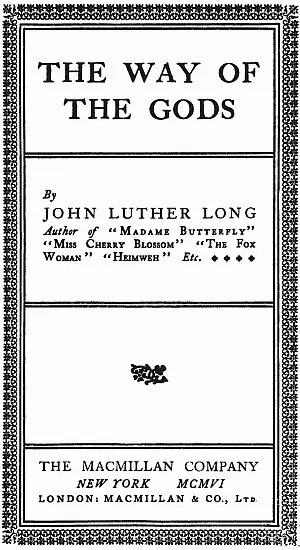
THE CLASSIC COLLECTION · 1906
"The Way of the Gods" by John Luther Long is a novel written in the early 20th century. The narrative centers around the character Shijiro Arisuga, a samurai struggling with the weight of duty and honor in a rapidly changing Japan influenced by Western ideals and militarism. Long's work delves into the concepts of happiness and sorrow, portraying the complexities of existence, particularly through the lens of Japanese culture and beliefs. At the start of the story, the opening explores the philosophical underpinnings of joy and sorrow within Japanese society, illustrating that one's happiness often comes at a cost to others. Shijiro recalls five pivotal moments in his life that he deems the happiest, signaling his reflections on loyalty to the emperor and family legacy. The narrative further introduces Shijiro's interactions with various characters, including his uncles, and sets the stage for the conflicts he will face regarding his identity, societal expectations, and the looming presence of love in the form of Yoné, his childhood companion. The text reveals the struggles of a young boy caught between tradition and a desire for personal fulfillment amidst the backdrop of a historic and culturally rich setting.
Introduction adapted from the source catalogue; source summaries may be automatically generated.
Free to read · English · 38,598 words · No account needed
MAKE TIME FOR A GOOD BOOK
On by default. Untick to stop anonymous reading totals. Each page counts after 10 seconds in view. How this works.
Anonymous counting is on unless you have switched it off.
Said Namishima, Arisuga's uncle from Kobe, to Kiomidzu, his uncle from
Osaka:--
"The flying of the august carp has been honorably auspicious and doubtless the gods now design to make him, in spirit, unlike his regretted father."
"It was the gods' punishment upon him for fighting against his
emperor--that his son should miserably be an onna-jin," whispered
Kiomidzu.
"Nevertheless the honorable picture has aided greatly in making him adore the emperor," protested Namishima.
"Yes, the money for its painting was augustly well spent," agreed Kiomidzu, wisely shaking his head.
"Some day he will know, notwithstanding, that his father was a rebel. Others know. It cannot unhappily be kept from him always."
"No."
"Perhaps then we shall be augustly dead--"
Both bowed and murmured again.
"And beyond his most excellent vengeance."
"Nevertheless," said Namishima, finally, "the august conscience within informs me that we have brought him up honorably well!"
"There is excellently no doubt of it!" agreed Kiomidzu.
They bowed to each other.
For a while there was silence and the tapping of the pipes. Then they spoke of a new and weightier matter.
Said Namishima--and here the little boy's eyes bulged:--
"If the soul of our brother continues to wander in the Meido, it will not be chargeable, now, in the heavens, to us, but to him. We have kept the lamps alight. We have taught him honor."
"We are too aged, also," agreed Kiomidzu, "to redeem him forth unto the way to the heavens by dying in his stead the great death. It is for his son!"
"In us, besides," Namishima went on, "the gods could not be augustly deceived. But the child has his name."
"Therefore, should he die the great death, the merciful gods may be deceived by the name into thinking it he who died at Jokoji. In that case he would not only be redeemed to the way to the heavens, but on this earth his name would be graciously added to honor."
So said he from Kobe. And he from Osaka:--
"For the gods are merciful!"
"So merciful, I sometimes abjectly think, that they desire to be deceived, for our peace of mind."
"Or, at least," mended Kiomidzu, to whom this was a trifle too much, "they will close their eyes while we augustly do it."
Namishima disliked a trifle the correction of his brother:--
Your reading position is saved on this browser. Take it to another device with a library code. Reading pages adapt to text, rather than matching a printed edition.
BEHIND THE BOOK
This eBook is for the use of anyone anywhere in the United States and most other parts of the world at no cost and with almost no restrictions whatsoever. You may copy it, give it away or re-use it under the terms of the Project Gutenberg License included with this eBook or online at www.gutenberg.org. If you are not located in the United States, you will have to check the laws of the country where you are located before using this eBook. Read the source licence.
The original source file, including credits and licence, is retained by this library. Request an original-format copy at no charge. Please include the book title and Project Gutenberg identifier #33616.
KEEP YOUR CURIOSITY GOING
Coulson Kernahan

Maurice Baring
Frances Wright
Cécile Tormay

Frederic Jesup Stimson

W. H. P. (William Henry Pope) Jarvis