THE CLASSIC COLLECTION✦A dead man’s diaryCLASSIC FREE BOOKS
A dead man’s diary
Coulson Kernahan
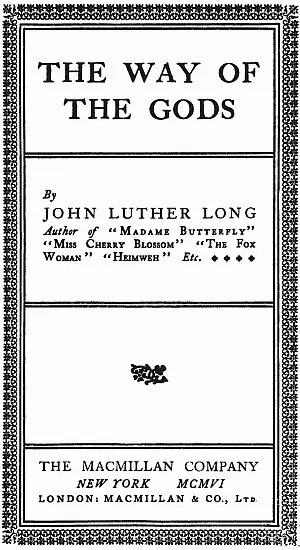
THE CLASSIC COLLECTION · 1906
"The Way of the Gods" by John Luther Long is a novel written in the early 20th century. The narrative centers around the character Shijiro Arisuga, a samurai struggling with the weight of duty and honor in a rapidly changing Japan influenced by Western ideals and militarism. Long's work delves into the concepts of happiness and sorrow, portraying the complexities of existence, particularly through the lens of Japanese culture and beliefs. At the start of the story, the opening explores the philosophical underpinnings of joy and sorrow within Japanese society, illustrating that one's happiness often comes at a cost to others. Shijiro recalls five pivotal moments in his life that he deems the happiest, signaling his reflections on loyalty to the emperor and family legacy. The narrative further introduces Shijiro's interactions with various characters, including his uncles, and sets the stage for the conflicts he will face regarding his identity, societal expectations, and the looming presence of love in the form of Yoné, his childhood companion. The text reveals the struggles of a young boy caught between tradition and a desire for personal fulfillment amidst the backdrop of a historic and culturally rich setting.
Introduction adapted from the source catalogue; source summaries may be automatically generated.
Free to read · English · 38,598 words · No account needed
MAKE TIME FOR A GOOD BOOK
On by default. Untick to stop anonymous reading totals. Each page counts after 10 seconds in view. How this works.
Anonymous counting is on unless you have switched it off.
But the next day trouble, though not exactly of the heart, did arrive. It was one of Arisuga's days of retreat from Hoshiko. He asked her why she lived there--in China--when she might live in Japan, where she belonged.
She answered him that her father had come there many years before, when
she was a child.
"I will ask him the reason if you wish."
"No, no, no!" laughed Arisuga. "What does it matter, my dear child?"
She ran away from him again. And all that day she kept repeating:--
"'My dear child'! I am as tall as he!"
And at night, again, while the maid was undressing her, it was that
still.
"Now he shall never know who--what I am. For I am beautiful. The mirror says so. As beautiful as if I were not--what I am. Look, look and tell me!"
This the maid, for the hundredth time since he had come, did.
"You are, indeed, beautiful, dear mistress, yet, nevertheless, it is your duty to tell him! Otherwise he might wish to marry you. Already he loves you."
"I will not! And if you do, I will kill you!" threatened Hoshiko. "I will have these few days of heaven. He will go and not think of me again. He will never know. He will not have been contaminated. But I will have the few days in heaven! To him I am only a child."
And she fell to the floor and sobbed for an hour, during which the maid lay like a graven image at her side. Then she sat up and asked:
"Now you don't blame me, do you?"
"No."
"Anyhow, he will go as soon as possible."
"No, he will not," said the impertinent Isonna.
"He will! You know that he will! Say that he will!"
But the maid knew better.
"That is what men always do when they find out."
"He will not," said Isonna.
"You are very impertinent!" And her mistress punished her maid's impertinence by flinging her the amber bracelet she wore.
"Now, disobedient one, you shall tell me why you think such a naughty thing. Yet you cannot know. No one can see into his large mind. He keeps it closed. He is as wise as a priest. Not even I can enter it. And you are very ignorant, Isonna."
"Nevertheless, his mind is as glass to me!" insisted the maid.
"I will tell my father and he shall punish you with whips. Now, you dear little beast, I shall force you to tell me the reason you think in your evil mind the great color-bearer to the prince of heaven stays here!"
Your reading position is saved on this browser. Take it to another device with a library code. Reading pages adapt to text, rather than matching a printed edition.
BEHIND THE BOOK
This eBook is for the use of anyone anywhere in the United States and most other parts of the world at no cost and with almost no restrictions whatsoever. You may copy it, give it away or re-use it under the terms of the Project Gutenberg License included with this eBook or online at www.gutenberg.org. If you are not located in the United States, you will have to check the laws of the country where you are located before using this eBook. Read the source licence.
The original source file, including credits and licence, is retained by this library. Request an original-format copy at no charge. Please include the book title and Project Gutenberg identifier #33616.
KEEP YOUR CURIOSITY GOING
Coulson Kernahan

Maurice Baring
Frances Wright
Cécile Tormay

Frederic Jesup Stimson

W. H. P. (William Henry Pope) Jarvis