THE CLASSIC COLLECTION✦A dead man’s diaryCLASSIC FREE BOOKS
A dead man’s diary
Coulson Kernahan
THE CLASSIC COLLECTION · 1906
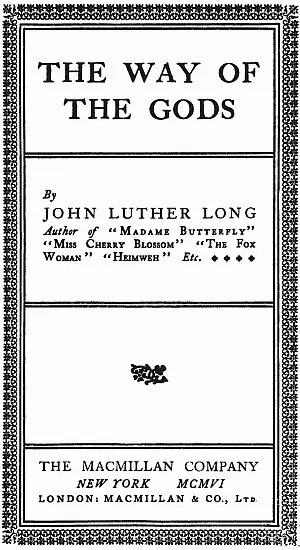
"The Way of the Gods" by John Luther Long is a novel written in the early 20th century. The narrative centers around the character Shijiro Arisuga, a samurai struggling with the weight of duty and honor in a rapidly changing Japan influenced by Western ideals and militarism. Long's work delves into the concepts of happiness and sorrow, portraying the complexities of existence, particularly through the lens of Japanese culture and beliefs. At the start of the story, the opening explores the philosophical underpinnings of joy and sorrow within Japanese society, illustrating that one's happiness often comes at a cost to others. Shijiro recalls five pivotal moments in his life that he deems the happiest, signaling his reflections on loyalty to the emperor and family legacy. The narrative further introduces Shijiro's interactions with various characters, including his uncles, and sets the stage for the conflicts he will face regarding his identity, societal expectations, and the looming presence of love in the form of Yoné, his childhood companion. The text reveals the struggles of a young boy caught between tradition and a desire for personal fulfillment amidst the backdrop of a historic and culturally rich setting.
Introduction adapted from the source catalogue; source summaries may be automatically generated.
Free to read · English · 38,598 words · No account needed
MAKE TIME FOR A GOOD BOOK
On by default. Untick to stop anonymous reading totals. Each page counts after 10 seconds in view. How this works.
Anonymous counting is on unless you have switched it off.
And, slowly, that fantasy of a great death which infects every Japanese crept into the life and thought of Shijiro Arisuga. Though it came to him, in whom it had lain latent, hardly. But, perhaps for that reason, as is the case with certain diseases, it came with greater certainty and severity than if it had been always with him.
Yet the Yamato Damashii outstripped them both: the spirit of war--the
ghost of Japan!
He still went with little Yone to Mukojima sometimes, though less frequently. And the small heart of the small girl wondered and grew hurt at this. So that she asked him one day:--
"Little lord, why is it that we so seldom come here and that you no more sing, no more carry your samisen, and are grown too suddenly for your years a man with a face as serious as the unlaughing barbarians of the West--why is it?"
They were at Shiba. And Shijiro laughed again, as he had used to laugh,
while he answered:--
"Sing no more! Listen!"
"Reign on for a thousand years of peace!
Reign on for a myriad years of ease!
Till the pebbles are boulders,
Moss grows to our shoulders,
O heaven-born lord of Nippon!"
"The Kimi Gayo!" said the little girl. "You sing the Imperial Hymn with that light in your face who never sang it before--whose face was never before so lighted? You answer my fear with fears."
"I sing a war-song, little moon-maid, because I am now a soldier," cried Arisuga, with a certain fanatical ecstasy in spite of his gayety. "I am going to die for the emperor the great death! I am going to set my father free to pursue his way to the heavens or another reincarnation! Think! The gods will love me for such a holy thing! Why do not you?"
"Oh, yes," whispered the little girl, "the gods will love you. And I. But who, then, will come with me here? And who will hold my hand?"
"My spirit, I promise you that!"
A little chill crept over the girl.
"Yes," she answered doubtfully, "if I cannot have your body."
Shijiro still laughed.
"After all, a spirit is a safer comrade than a body. The custodians cannot drive it away from the tombs. And will you wait here for my spirit, as you do for my body?"
"Yes," she whispered, in her awe, once more.
But he gayly touched her.
"I will come like that--that--that!"
"I would rather have you so," said the little girl, touching him, as flesh touches flesh, not as spirit touches flesh in the East.
Your reading position is saved on this browser. Take it to another device with a library code. Reading pages adapt to text, rather than matching a printed edition.
BEHIND THE BOOK
This eBook is for the use of anyone anywhere in the United States and most other parts of the world at no cost and with almost no restrictions whatsoever. You may copy it, give it away or re-use it under the terms of the Project Gutenberg License included with this eBook or online at www.gutenberg.org. If you are not located in the United States, you will have to check the laws of the country where you are located before using this eBook. Read the source licence.
The original source file, including credits and licence, is retained by this library. Request an original-format copy at no charge. Please include the book title and Project Gutenberg identifier #33616.
KEEP YOUR CURIOSITY GOING
Coulson Kernahan

Maurice Baring
Frances Wright
Cécile Tormay

Frederic Jesup Stimson

W. H. P. (William Henry Pope) Jarvis