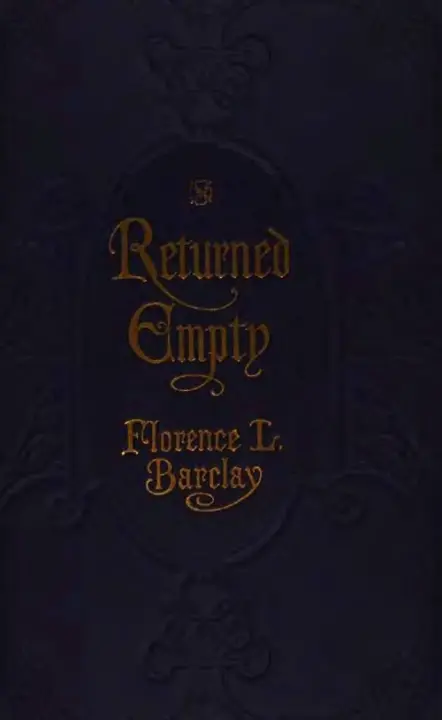
Returned Empty
Florence L. (Florence Louisa) Barclay
THE CLASSIC COLLECTION · 1912
"The Upas Tree: A Christmas Story for all the Year" by Florence L. Barclay is a fictional narrative written in the early 20th century. This work is centered around the lives of Ronald West and his wife Helen, exploring their relationship, ambitions, and the challenges they face as Ronald prepares to travel to Central Africa for his writing. The evocative title suggests themes of personal sacrifice, love, and the journey of self-discovery intertwined with Christmas sentimentality. The opening of the story sets the stage for the relationship dynamics between Ronald and Helen. It begins with Ronald contemplating how to discuss a significant matter with Helen, revealing that he wishes to travel to Africa to gather inspiration for a novel. Helen, who is depicted as supportive yet rational, expresses concerns about his decision and the potential separation it entails. As the couple navigates their feelings, the tension between personal aspirations and marital responsibilities unfolds, hinting at deeper themes of love and duty. The initial interaction establishes a strong emotional layer to their relationship, drawing readers into their world of longing, creativity, and impending separation.
Introduction adapted from the source catalogue; source summaries may be automatically generated.
Free to read · English · 43,301 words · No account needed
MAKE TIME FOR A GOOD BOOK
On by default. Untick to stop anonymous reading totals. Each page counts after 10 seconds in view. How this works.
Anonymous counting is on unless you have switched it off.
Had he thought-read from his 'cello the happenings of a century before? Had it transmitted to his over-wrought brain, the scene in which it had once played so prominent a part?
Had it, before then, in the Leipzig flat, imparted to Aubrey
Treherne--unconsciously to himself--an accurate mental picture of its
former owner?
Ronnie mused on this, and wondered. Then the desire rose strong within him to hear once more the golden voice of the Infant, even at the risk of calling up again those ghostly phantoms of a vanished past.
He drew the Florentine chair into the centre of the room.
He took his seat on the embossed leather of crimson and gold.
He glanced at his reflection. His face was whiter than it had been five weeks ago, when he returned, deep bronzed, from Africa. His hair, too, was longer than it ought to be; though not so long as the heavy black locks of the 'cellist of that past reflection.
Ronnie's rough tweed suit and shooting boots, were a curious contrast to the satin knee-breeches, silken hose, and diamond shoe-buckles he remembered in his vision; yet his manner of holding the 'cello, assumed without conscious thought, and the positions of his knees and feet, were so precisely those of that quaint old-time figure, that Ronnie never doubted that when he raised the bow and his fingers bit into the strings, the flood of harmony would be the same.
He waited for the strong tremor to seize his wrist.
It did not come.
He sounded the four open strings, slowly, one after the other.
Yes, the tones were very pure, very rich, very clear.
Then he took courage, pressed his fingers into the finger-board, and
began to play.
Alas, poor Infant of Prague!
Alas, poor born musician, who preferred doing things he had never
learned to do!
The exquisite rise and fall of harmony, came not again.
Bitterly disappointed, Ronnie waited, staring into the mirror.
But a rather weary, very lonely, and exceedingly modern young man stared
back at him.
At last he realised that he could no longer play the 'cello by inspiration. So he began very carefully feeling for the notes.
The Infant squeaked occasionally, and wailed a little; but on the whole it behaved very well; and, after half-an-hour's work, having found out the key which enabled him to use chiefly the open strings, Ronnie managed to play right through, very fairly in tune, "O come, all ye faithful, joyful and triumphant!"
This gave him extraordinary pleasure. It seemed such a certainty of possession, to be able to pick out all the notes for himself.
He longed that Helen might be there to hear.
Your reading position is saved on this browser. Take it to another device with a library code. Reading pages adapt to text, rather than matching a printed edition.
Florence L. (Florence Louisa) Barclay

Florence L. (Florence Louisa) Barclay
Florence L. (Florence Louisa) Barclay
Florence L. (Florence Louisa) Barclay
BEHIND THE BOOK
This eBook is for the use of anyone anywhere in the United States and most other parts of the world at no cost and with almost no restrictions whatsoever. You may copy it, give it away or re-use it under the terms of the Project Gutenberg License included with this eBook or online at www.gutenberg.org. If you are not located in the United States, you will have to check the laws of the country where you are located before using this eBook. Read the source licence.
The original source file, including credits and licence, is retained by this library. Request an original-format copy at no charge. Please include the book title and Project Gutenberg identifier #16454.
KEEP YOUR CURIOSITY GOING
Coulson Kernahan

Maurice Baring
Frances Wright
Cécile Tormay

Frederic Jesup Stimson

W. H. P. (William Henry Pope) Jarvis