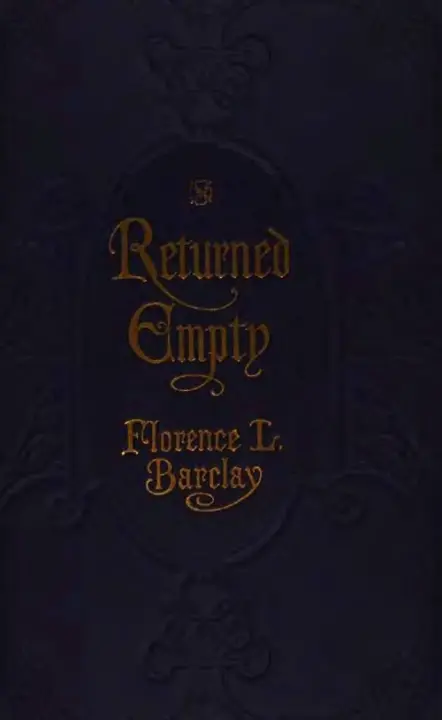
Returned Empty
Florence L. (Florence Louisa) Barclay
THE CLASSIC COLLECTION · 1912
"The Upas Tree: A Christmas Story for all the Year" by Florence L. Barclay is a fictional narrative written in the early 20th century. This work is centered around the lives of Ronald West and his wife Helen, exploring their relationship, ambitions, and the challenges they face as Ronald prepares to travel to Central Africa for his writing. The evocative title suggests themes of personal sacrifice, love, and the journey of self-discovery intertwined with Christmas sentimentality. The opening of the story sets the stage for the relationship dynamics between Ronald and Helen. It begins with Ronald contemplating how to discuss a significant matter with Helen, revealing that he wishes to travel to Africa to gather inspiration for a novel. Helen, who is depicted as supportive yet rational, expresses concerns about his decision and the potential separation it entails. As the couple navigates their feelings, the tension between personal aspirations and marital responsibilities unfolds, hinting at deeper themes of love and duty. The initial interaction establishes a strong emotional layer to their relationship, drawing readers into their world of longing, creativity, and impending separation.
Introduction adapted from the source catalogue; source summaries may be automatically generated.
Free to read · English · 43,301 words · No account needed
MAKE TIME FOR A GOOD BOOK
On by default. Untick to stop anonymous reading totals. Each page counts after 10 seconds in view. How this works.
Anonymous counting is on unless you have switched it off.
Ronnie's first sensation as he returned to consciousness, was of extreme lassitude and exhaustion.
His eyelids lifted heavily; he had some difficulty in realising where he
was.
Then he saw his 'cello, leaning against a chair; and, a moment later, Aubrey Treherne, lying back in the seat opposite, enveloped in a cloud of tobacco smoke.
"Hullo, West!" said Aubrey, kindly. "You put in your half-hour quite unexpectedly. You were trying, in a sleepy fashion, to tell me how you came to purchase this fine 'cello; but you dropped off, with the tale unfinished."
Ronnie looked in silence at his wife's cousin.
"Are you the better for your sleep?"
"I am fagged out," said Ronnie, wearily.
Aubrey went to a cupboard, poured something into a glass, and handed it
to Ronald.
"Drink this, my boy. It will soon wake you up."
Ronnie drank it. Its tint was golden, its odour, fragrant; but otherwise, for aught he knew, it might have been pure water.
He sat up and took careful note of his surroundings.
Then an idea seemed to strike him. He leaned forward and twanged the strings of his 'cello. They were not in tune.
"Will you lend me your tuning-fork?" he said to Aubrey.
But Aubrey had expected this.
"Sorry," he said. "I don't possess one, just now. I gave away mine last week. You can tune your 'cello by the organ."
"I don't know how to tune a 'cello," said Ronnie.
"Let me show you," suggested Aubrey, with the utmost friendliness.
He walked over to the organ, drew out the 'cello stop, sounded a note, then came back humming it.
Then he took up the Infant and carefully tuned the four strings, talking
easily meanwhile.
"You see? You screw up the pegs--so. The notes are A, D, G, C."
"What have you done to your lip?" said Ronald, suddenly.
"Knocked it on the stove just now, as I bent to stoke it with my fingers, for fear of waking you. It bled amazingly."
Aubrey produced a much-stained handkerchief.
"It is curious how a tiny knock will sometimes draw as much blood as a sword-thrust. There! The Infant is in perfect tune, so far as I can tell without the bow. Do you mind if I just pass the bow across the strings? After each string is perfectly tuned to a piano or organ, you must make them vibrate together in order to get the fifths perfect. A violin or a 'cello is capable of a more complete condition of intuneness--if I may coin a word--than an organ or a piano."
Your reading position is saved on this browser. Take it to another device with a library code. Reading pages adapt to text, rather than matching a printed edition.
Florence L. (Florence Louisa) Barclay

Florence L. (Florence Louisa) Barclay
Florence L. (Florence Louisa) Barclay
Florence L. (Florence Louisa) Barclay
BEHIND THE BOOK
This eBook is for the use of anyone anywhere in the United States and most other parts of the world at no cost and with almost no restrictions whatsoever. You may copy it, give it away or re-use it under the terms of the Project Gutenberg License included with this eBook or online at www.gutenberg.org. If you are not located in the United States, you will have to check the laws of the country where you are located before using this eBook. Read the source licence.
The original source file, including credits and licence, is retained by this library. Request an original-format copy at no charge. Please include the book title and Project Gutenberg identifier #16454.
KEEP YOUR CURIOSITY GOING
Coulson Kernahan

Maurice Baring
Frances Wright
Cécile Tormay

Frederic Jesup Stimson

W. H. P. (William Henry Pope) Jarvis