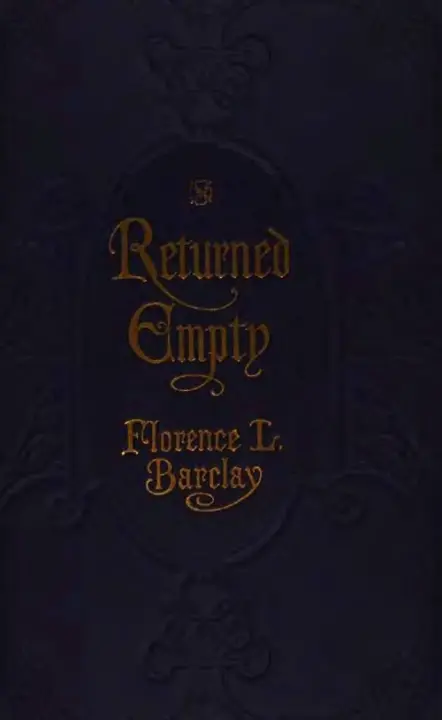
Returned Empty
Florence L. (Florence Louisa) Barclay
THE CLASSIC COLLECTION · 1912
"The Upas Tree: A Christmas Story for all the Year" by Florence L. Barclay is a fictional narrative written in the early 20th century. This work is centered around the lives of Ronald West and his wife Helen, exploring their relationship, ambitions, and the challenges they face as Ronald prepares to travel to Central Africa for his writing. The evocative title suggests themes of personal sacrifice, love, and the journey of self-discovery intertwined with Christmas sentimentality. The opening of the story sets the stage for the relationship dynamics between Ronald and Helen. It begins with Ronald contemplating how to discuss a significant matter with Helen, revealing that he wishes to travel to Africa to gather inspiration for a novel. Helen, who is depicted as supportive yet rational, expresses concerns about his decision and the potential separation it entails. As the couple navigates their feelings, the tension between personal aspirations and marital responsibilities unfolds, hinting at deeper themes of love and duty. The initial interaction establishes a strong emotional layer to their relationship, drawing readers into their world of longing, creativity, and impending separation.
Introduction adapted from the source catalogue; source summaries may be automatically generated.
Free to read · English · 43,301 words · No account needed
MAKE TIME FOR A GOOD BOOK
On by default. Untick to stop anonymous reading totals. Each page counts after 10 seconds in view. How this works.
Anonymous counting is on unless you have switched it off.
It was Ronnie's last evening in England. The parting, which had seemed so far away, must take place on the morrow. It took all Helen's bright courage to keep up Ronnie's spirits.
After dinner they sat together in a room they still called the studio, although Helen had given up her painting, soon after their marriage.
It was a large old-fashioned room, oak-panelled and spacious.
A huge mirror, in a massive gilt frame, hung upon the wall opposite door and fireplace, reaching from the ceiling to the parquet floor.
Ronald, who used the studio as a smoking-room, had introduced three or four deep wicker chairs, comfortably cushioned, and a couple of oriental tables.
The fireplace lent itself grandly in winter to great log-fires, when the crimson curtains were drawn in ample folds over the many windows, shutting out the dank bleakness of the park without, and imparting a look of cosiness to the empty room.
A dozen old family portraits--banished from more important places, because their expressions annoyed Ronnie--were crowded into whatever space was available, and glowered down, from the bad light to which they had been relegated, on the very modern young man whose uncomplimentary remarks had effected their banishment, and who sprawled luxuriously in the firelight, monarch of all he surveyed, in the domain which for centuries had been their own.
The only other thing in the room was a piano, on which Ronnie very effectively and very inaccurately strummed by ear; and on which Helen, with careful skill, played his accompaniments, when he was seized with a sudden desire to sing.
Ronald's music was always a perplexity to Helen. There was a quality about it so extraordinarily, so unusually, beautiful; combined with an entire lack of method or of training, and a quite startling ignorance of the most rudimentary rules.
On one occasion, during a sharp attack of influenza, when he had insisted upon being down and about, with a temperature of 104, he suddenly rose from the depths of a chair in which he had been lying, talking wild and feverish nonsense; stumbled over to the piano, dropped heavily upon the stool, then proceeded to play and sing, in a way, which brought tears to his wife's eyes, while her heart stood still with anxiety and wonder.
Yet, when she mentioned it a few days later, he appeared to have
forgotten all about it, turning the subject with almost petulant
abruptness.
But, on this their last evening together, the piano stood unheeded. They seemed only to want two chairs, and each other.
Your reading position is saved on this browser. Take it to another device with a library code. Reading pages adapt to text, rather than matching a printed edition.
Florence L. (Florence Louisa) Barclay

Florence L. (Florence Louisa) Barclay
Florence L. (Florence Louisa) Barclay
Florence L. (Florence Louisa) Barclay
BEHIND THE BOOK
This eBook is for the use of anyone anywhere in the United States and most other parts of the world at no cost and with almost no restrictions whatsoever. You may copy it, give it away or re-use it under the terms of the Project Gutenberg License included with this eBook or online at www.gutenberg.org. If you are not located in the United States, you will have to check the laws of the country where you are located before using this eBook. Read the source licence.
The original source file, including credits and licence, is retained by this library. Request an original-format copy at no charge. Please include the book title and Project Gutenberg identifier #16454.
KEEP YOUR CURIOSITY GOING
Coulson Kernahan

Maurice Baring
Frances Wright
Cécile Tormay

Frederic Jesup Stimson

W. H. P. (William Henry Pope) Jarvis