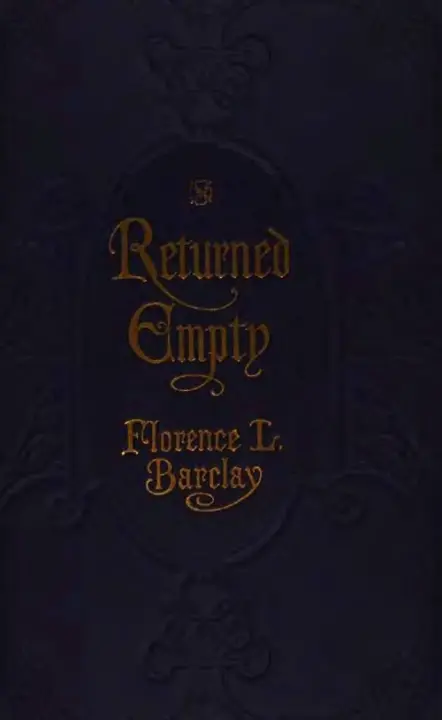
Returned Empty
Florence L. (Florence Louisa) Barclay
THE CLASSIC COLLECTION · 1912
"The Upas Tree: A Christmas Story for all the Year" by Florence L. Barclay is a fictional narrative written in the early 20th century. This work is centered around the lives of Ronald West and his wife Helen, exploring their relationship, ambitions, and the challenges they face as Ronald prepares to travel to Central Africa for his writing. The evocative title suggests themes of personal sacrifice, love, and the journey of self-discovery intertwined with Christmas sentimentality. The opening of the story sets the stage for the relationship dynamics between Ronald and Helen. It begins with Ronald contemplating how to discuss a significant matter with Helen, revealing that he wishes to travel to Africa to gather inspiration for a novel. Helen, who is depicted as supportive yet rational, expresses concerns about his decision and the potential separation it entails. As the couple navigates their feelings, the tension between personal aspirations and marital responsibilities unfolds, hinting at deeper themes of love and duty. The initial interaction establishes a strong emotional layer to their relationship, drawing readers into their world of longing, creativity, and impending separation.
Introduction adapted from the source catalogue; source summaries may be automatically generated.
Free to read · English · 43,301 words · No account needed
MAKE TIME FOR A GOOD BOOK
On by default. Untick to stop anonymous reading totals. Each page counts after 10 seconds in view. How this works.
Anonymous counting is on unless you have switched it off.
Precisely how long she remained alone in her sitting-room, Helen never knew; but it cannot have been the long hours it seemed, seeing that Simpkins did not appear to fetch the tea-tray, nor did Nurse send down any message from the nursery.
Helen had wept herself into the calm of exhaustion, and was trying to decide what her next move should be, when the hoot of a motor sounded in the park. In another moment she heard it panting at the door. Then the bell pealed.
With the unfailing instinct of her kind, to hide private grief and show a brave front to the world, Helen flew to the mirror, smoothed her tumbled hair, put away her damp handkerchief; and, standing calmly beside the mantel-piece, one foot on the fender, awaited her unexpected visitor.
She heard voices in the hall, then Simpkins opened the door and tried to make an announcement, but some unseen force from behind whirled him away, and a broad-shouldered young man in an ulster, travel-stained and dishevelled, appeared in his stead, shut the door upon Simpkins, and strode into the lamplight, his cloth cap still on the back of his head, his keen dark eyes searching Helen's face eagerly.
His cap came off before he spoke to her; but, with his thick, short-cropped hair standing on end, a bare head only added to the wildness of his appearance.
He stopped when he reached the tea-table.
"Where's Ronnie?" he said, and he spoke as if he had been running for
many miles.
"My husband is in the studio," replied Helen, with gentle dignity.
"What's he doing?"
"I believe he is playing his 'cello."
"Oh, lor! That wretched Infant! Is he all right?"
"So far as I know."
"What time did he get here?"
"At half-past four."
The dishevelled young man glanced at the clock.
"Oh, lor!" he said again. "To think I've travelled night and day and raced down from town in a motor to get here first, and he beat me by an hour and a half! However, if he's all right, no harm's done."
He dropped into Ronnie's chair, and rumpled his hair still further with
his hands.
"I must try to explain," he said.
Then he lifted a rather white, very grubby face to Helen's. His lips
twitched.
"I'm dry," he said; and dropped his face into his hands.
Helen rang the bell.
"Bring whisky and soda at once," she ordered, the instant Simpkins
appeared in the doorway.
Then she crossed over, and laid her hand lightly on her visitor's broad
shoulder.
Your reading position is saved on this browser. Take it to another device with a library code. Reading pages adapt to text, rather than matching a printed edition.
Florence L. (Florence Louisa) Barclay

Florence L. (Florence Louisa) Barclay
Florence L. (Florence Louisa) Barclay
Florence L. (Florence Louisa) Barclay
BEHIND THE BOOK
This eBook is for the use of anyone anywhere in the United States and most other parts of the world at no cost and with almost no restrictions whatsoever. You may copy it, give it away or re-use it under the terms of the Project Gutenberg License included with this eBook or online at www.gutenberg.org. If you are not located in the United States, you will have to check the laws of the country where you are located before using this eBook. Read the source licence.
The original source file, including credits and licence, is retained by this library. Request an original-format copy at no charge. Please include the book title and Project Gutenberg identifier #16454.
KEEP YOUR CURIOSITY GOING
Coulson Kernahan

Maurice Baring
Frances Wright
Cécile Tormay

Frederic Jesup Stimson

W. H. P. (William Henry Pope) Jarvis