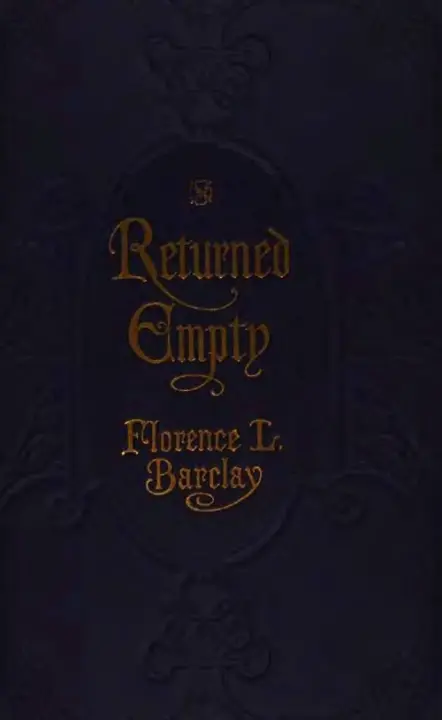
Returned Empty
Florence L. (Florence Louisa) Barclay
THE CLASSIC COLLECTION · 1912
"The Upas Tree: A Christmas Story for all the Year" by Florence L. Barclay is a fictional narrative written in the early 20th century. This work is centered around the lives of Ronald West and his wife Helen, exploring their relationship, ambitions, and the challenges they face as Ronald prepares to travel to Central Africa for his writing. The evocative title suggests themes of personal sacrifice, love, and the journey of self-discovery intertwined with Christmas sentimentality. The opening of the story sets the stage for the relationship dynamics between Ronald and Helen. It begins with Ronald contemplating how to discuss a significant matter with Helen, revealing that he wishes to travel to Africa to gather inspiration for a novel. Helen, who is depicted as supportive yet rational, expresses concerns about his decision and the potential separation it entails. As the couple navigates their feelings, the tension between personal aspirations and marital responsibilities unfolds, hinting at deeper themes of love and duty. The initial interaction establishes a strong emotional layer to their relationship, drawing readers into their world of longing, creativity, and impending separation.
Introduction adapted from the source catalogue; source summaries may be automatically generated.
Free to read · English · 43,301 words · No account needed
MAKE TIME FOR A GOOD BOOK
On by default. Untick to stop anonymous reading totals. Each page counts after 10 seconds in view. How this works.
Anonymous counting is on unless you have switched it off.
Ronnie reached Liverpool Street Station at 8 o'clock on a foggy November
morning.
After the quiet night on the steamer, the landing in darkness at Harwich, and the steady run up to town, alone in a first-class compartment, he felt momentarily confused by the noise and movement within the great city terminus.
The brilliant lights of the station, combined with the yellow fog rolling in from the various entrances; the onward rush of many feet, as hundreds of busy men and eager young women poured out of suburban trains, hurrying to the scenes which called for their energy during the whole of the coming day; the gliding in and out of trains, the passing to and fro of porters, wheeling heavy luggage; the clang of milk-cans, the hoot of taxi-cabs, and, beyond it all, the distant roar of London, awaking, and finding its way about heavily, like an angry old giant in the fog--all seemed to Ronnie to be but another of the queer nightmares which came to him now with exhausting frequency.
As a rule, he found it best to wait until they passed off. So, holding the Infant of Prague in its canvas case in one hand, and the bag containing his manuscript in the other, he stood quite still upon the platform, waiting for the roar to cease, the rush to pass by, the nightmare to be over.
Presently an Inspector who knew Ronnie walked down the platform. He paused at once, with the ready and attentive courtesy of the London railway official.
"Any luggage, Mr. West?" he asked, lifting his cap.
"No, thank you," replied Ronnie, "not to-day."
He knew he had luggage somewhere--heaps of it. But what was the good of hunting up luggage in a nightmare? Dream luggage was not worth retrieving. Besides, the more passive you are, the sooner the delusion leaves off tormenting you.
"Have you come from the Hook, sir?" inquired the inspector.
"Yes," said Ronnie. "Did you think I had come from the Eye?"
He knew it was a vile pun, but it seemed exactly the sort of thing one
says in a nightmare.
The inspector laughed, and passed on; then returned, looking rather
searchingly at Ronnie.
Ronnie thought it well to explain further. "As a matter of fact, my friend," he said, "I have come from Central Africa, where I have been sitting round camp-fires, in company with asps and cockatrices, and other interesting creatures. I am writing a book about it--the best thing I have done yet."
The inspector had read and enjoyed all Ronnie's books. He smiled uneasily. Asps and cockatrices sounded queer company.
Your reading position is saved on this browser. Take it to another device with a library code. Reading pages adapt to text, rather than matching a printed edition.
Florence L. (Florence Louisa) Barclay

Florence L. (Florence Louisa) Barclay
Florence L. (Florence Louisa) Barclay
Florence L. (Florence Louisa) Barclay
BEHIND THE BOOK
This eBook is for the use of anyone anywhere in the United States and most other parts of the world at no cost and with almost no restrictions whatsoever. You may copy it, give it away or re-use it under the terms of the Project Gutenberg License included with this eBook or online at www.gutenberg.org. If you are not located in the United States, you will have to check the laws of the country where you are located before using this eBook. Read the source licence.
The original source file, including credits and licence, is retained by this library. Request an original-format copy at no charge. Please include the book title and Project Gutenberg identifier #16454.
KEEP YOUR CURIOSITY GOING
Coulson Kernahan

Maurice Baring
Frances Wright
Cécile Tormay

Frederic Jesup Stimson

W. H. P. (William Henry Pope) Jarvis